Photo Sharing Ideas for Family Reunions: Keep Everyone Connected After the Event


Picture this: forty-three relatives in one backyard. Three generations, two golden retrievers, one uncle who insists on documenting every single dish on the buffet table. By the end of the afternoon, there are hundreds of photos scattered across two dozen phones. And then everyone drives home.
Two weeks later, Aunt Linda texts the group chat: "Can someone send me that photo of Grandma with all the grandkids?" Four people respond with slightly different versions. Nobody has the one where Grandma was actually smiling. The cousin who took it forgot to share it, and now she can't find it in her camera roll of 3,000 photos.
This is the family reunion photo problem. Not taking the photos. Everyone does that. The problem is what happens (or doesn't happen) afterward.
Why Family Reunion Photos Disappear
The numbers paint a clear picture. According to a 2023 survey by Deseret News, 80% of people have photos on their phone they haven't looked at since taking them. The average person stores roughly 2,800 photos in their camera roll. Your reunion photos don't vanish because people don't care. They vanish because they drown in everything else.
And family reunions have a unique challenge that weddings and corporate events don't: the attendees are spread across different cities, sometimes different countries. There's no office Slack channel to share them in. The WhatsApp group from 2019 is buried under 4,000 unread messages. iCloud shared albums require everyone to have an Apple device (they don't). Google Photos shared albums need Google accounts (half the family "doesn't trust Google").
So the photos sit. On phones, in pockets, in cars driving away from the reunion. Gone.
The Real Goal: A Shared Collection Everyone Can Access
Before jumping into specific ideas, it helps to name what you're actually trying to achieve. It's not just "sharing photos." It's building a shared collection that:
- Works for everyone, from the 14-year-old with the latest iPhone to the 72-year-old who just figured out text messages
- Doesn't require any specific app, account, or ecosystem
- Stays accessible weeks and months after the reunion, not just the day of
- Includes photos from everyone, not just the three family members who are good at remembering to share
That last point matters more than people realize. Family photography researcher Tatiana Belova, who has conducted over 3,000 family sessions, notes that family photographs function as "emotional anchors" that actively shape identity and strengthen intergenerational bonds. The candid shot your nephew took of Grandpa teaching his granddaughter to fish is worth more than any posed portrait. But only if anyone ever sees it.
Idea 1: Set Up a QR Code Photo Gallery
This is the approach that works best for mixed-age, mixed-device groups. You create a shared gallery before the event, generate a QR code, and print it on a few table cards or tape it to the cooler. Guests scan with their phone camera, the gallery opens in their browser, and they upload directly. No app download, no account creation.
The beauty of this for family reunions specifically: Uncle Dave, who still uses a Galaxy S10 and has never downloaded an app voluntarily, can do this. Your teenager, who rolls her eyes at anything that isn't TikTok, can do this. The barrier is genuinely low enough for a multi-generational group.
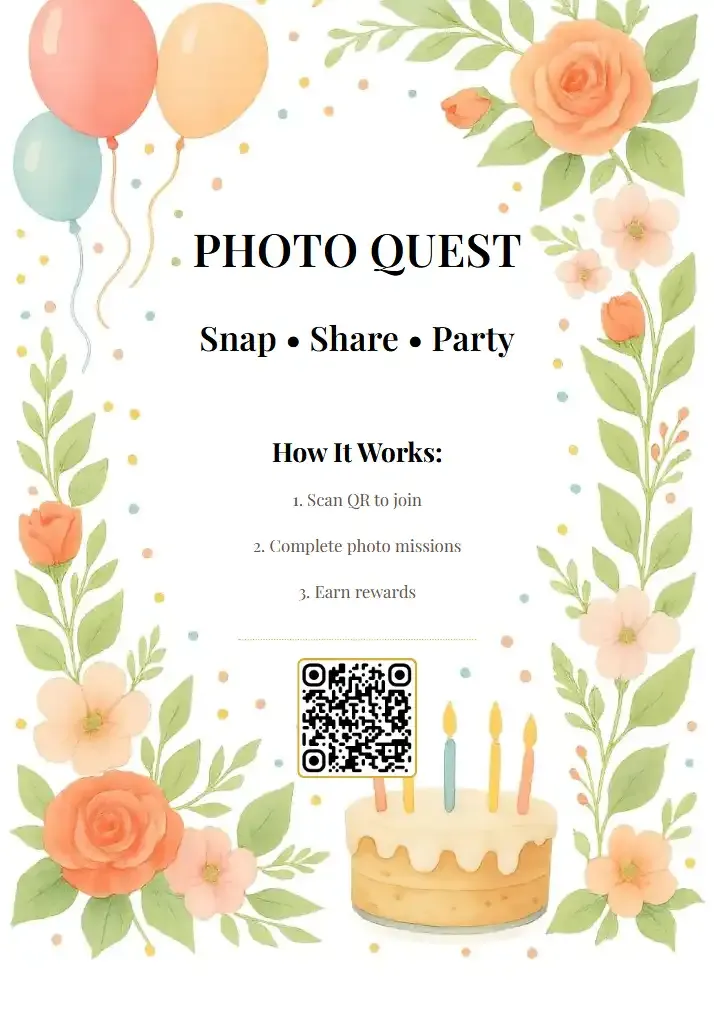
1.One scan opens the gallery. No app, no sign-up.
With Photogala, for example, you'd create the gallery in about two minutes, customize the QR code design (some families print them on magnets as keepsakes), and share the link. Photos upload in original quality, and there's no limit on how many people can view the gallery. The 75 uploader slots on the Plus plan comfortably cover most family reunions.
Print the QR code big. Not on a tiny table tent that gets buried under potato salad. Tape an 8×11 printout to the drinks table, the front door, and the bathroom mirror. The more places people see it, the more they remember to upload.
Idea 2: Run a Photo Challenge (Yes, Even for Families)
"Photo challenges" might sound like a corporate team-building exercise, but they work surprisingly well at family reunions, especially for getting people to take photos they wouldn't otherwise think of.
Imagine setting up challenges like:
- "Snap a photo with the oldest and youngest person at the reunion"
- "Capture someone doing something they're famous for in the family"
- "Find the best hiding spot in the yard and take a selfie"
- "Recreate this old family photo" (attach a reference image from 1995)
That last one is gold. Photogala's challenge feature lets you attach an example photo that guests try to recreate. Upload that grainy 1998 Christmas photo as the reference, and watch three cousins spend twenty minutes trying to recreate the exact pose. The results are always funnier than anyone expects.
Challenges also solve a subtle problem: they give people who feel awkward about taking photos a reason to do it. "I'm doing the challenge" is an easier excuse than "I want to photograph you." Research on gamification shows engagement increases by 48% in gamified environments. At a family reunion, that translates to photos from people who'd normally just eat and leave.
See it in action
Every guest photo in one album – no app.
Idea 3: Create a Living Photo Timeline
Most photo sharing stops after the event. The gallery fills up over the weekend, people browse for a day or two, and then it's forgotten. But family reunions are different from weddings or parties in one important way: there's usually a next one.
The idea: keep the gallery alive as a family archive between reunions. Add a few rules to keep it going:
- At the reunion, everyone uploads their photos to the shared gallery
- In the weeks after, family members can still add photos they forgot (this is when the best ones surface)
- Before the next reunion, share the old gallery link in the family group chat to build excitement
- At the next reunion, start a new gallery but link back to the previous one
This turns a one-time photo dump into a running family visual history. The Capture.com team notes that family memories help form identities, maintain traditions, and preserve legacies. A photo gallery that spans multiple reunions becomes exactly that kind of artifact.
Idea 4: Put Up a Photo Wall at the Venue
If you have access to a TV or projector at the reunion venue (or even a laptop with a large screen), a live photo wall changes the dynamic completely.
Imagine a screen near the food table cycling through the photos guests are uploading in real time. Someone captures the three-legged race and thirty seconds later, everyone standing around the screen is laughing at it. It creates a feedback loop: people see photos appearing on the wall, they want their photos up there too, so they upload more.
1.Photos appear on the big screen as guests upload them.
One practical note: assign someone as the gallery moderator. In Photogala, you can set up pre-approval so every photo gets reviewed before it hits the big screen. Give that job to a cousin who's always on their phone anyway. One tap to approve, one tap to reject. It takes about three seconds per photo, and it prevents Uncle Steve's out-of-focus thumb from appearing on the screen twelve times.
Idea 5: Don't Forget the Photos You Already Have
Here's something most photo sharing guides miss entirely: the best family reunion photo collection includes old photos too.
Photo preservation experts recommend digitizing old family photos, converting old films, and recording life stories of elderly relatives. A family reunion is the perfect moment for this, because the people who can identify faces in a 1970s photo are in the same room as the people with the technology to scan them.
Set up a simple scanning station: a phone with a document scanning app (Google PhotoScan is free and works well) and a small table where relatives can bring old prints. Scan them, upload them to the shared gallery alongside the new photos. Suddenly the gallery has depth. It's not just "Saturday afternoon in the backyard." It's three generations of the same family, side by side.
A limitation worth noting: Browser-based photo galleries like Photogala don't have built-in scanning features. You'd scan the old photos with a separate app, then upload the digital copies to the gallery. It's one extra step, but the result is worth it.
Making It Last: After the Reunion
The reunion ends. People pack up. Cars pull out of the driveway. This is where most photo sharing efforts die. Here's how to keep the momentum:
Send one reminder. Not five. Not a guilt-trip chain of "did anyone get a photo of..." messages. One well-timed text in the family chat, about 48 hours after the event: "The photo gallery is still open if you haven't uploaded yours yet. Here's the link." That's it. The people who are going to upload will upload. The ones who won't, won't. Nagging doesn't help.
Download the full collection. Once uploads taper off (usually within a week), download everything as a ZIP file and store it somewhere permanent. Cloud storage, an external hard drive, wherever your family keeps important files. Galleries have storage limits (Photogala's Plus plan keeps photos for 6 months), so don't rely on the gallery as your only archive.
Pick a few for printing. This sounds old-fashioned, but research from Prosper Counseling shows that physical photos displayed in homes have a measurable impact on family connectedness, self-esteem, and even children's sense of belonging. Pull five great shots from the gallery, order prints, and mail them to Grandma. It costs about eight dollars. It's worth more than that.
Quick Setup: Family Reunion Photo Gallery
Create your gallery
Set up a shared gallery with your family reunion name and date. Takes about 2 minutes.
Print and share the QR code
Print QR codes on table cards, tape them to the cooler, or add the link to the family group chat.
Add photo challenges
Set up 3-5 fun challenges to encourage everyone to participate. Attach reference photos for recreations.
Download and archive afterward
Once uploads slow down, download the full collection as a ZIP and store it somewhere permanent.
What About Privacy?
Family reunions feel private, but the photos might include children, elderly relatives, or family members who are particular about their image appearing online. A few things to consider:
- Use a gallery that requires a QR code or link to access (not publicly searchable)
- Mention the photo gallery at the beginning of the reunion so everyone knows it exists
- If someone asks for a photo to be removed, make sure the gallery host can do that quickly
- For families with young children, some parents may prefer photos of their kids stay within the family circle. A private gallery addresses this better than social media ever could
This is actually one area where a dedicated photo sharing tool beats generic options. A shared Google Photos album is technically accessible to anyone with the link and a Google account, and photos in shared albums can be saved by any member. With a QR-code-gated gallery, you control access more tightly.
The photos from your family reunion won't take themselves. But with a QR code on the picnic table, a few creative challenges, and one reminder text after the event, you'll end up with something most families never manage: a complete collection, from every angle, that everyone can actually find six months later.
And maybe next year, Uncle Dave will upload more than just buffet photos.
All of this comes with your own event.
Setting it up takes five minutes. You can build and view everything before you decide.
Starting from €39 one-timeOne-time payment — No subscription
- No App Required
- Setup in 5 Minutes
- 30-Day Money Back
“We used the software at my mum's birthday party. It went down really well 😊”
Written by

I believe event photos should be more than static galleries. They should be live, playful, and unforgettable.
Categories
Related Posts
Bridal Shower Photo Sharing: Collect Every Sweet Moment in One Gallery
Bridal shower photos end up scattered across 15 phones. Here's how to get them all into one gallery before the mimosas wear off.

Maternity Photo Sharing: How to Keep Every Announcement, Bump Shot, and Memory in One Place
Pregnancy announcements land on 4 different apps. Maternity photos get lost in group chats. Here's how to keep every photo in one shared gallery your whole family can access.

Sales Kickoff Photo Sharing: How to Turn a Mandatory Meeting Into a Team Memory
Sales kickoffs are expensive. The photos from them usually disappear into 14 different camera rolls. Here's how to fix that.