Event Photography Tips That Actually Matter (From Someone Who's Seen It Go Wrong)

Picture this: a corporate awards dinner for 120 people. The hired photographer delivers 280 beautiful, professionally lit photos two weeks later. Crisp. Polished. And somehow missing the moment the sales team spontaneously broke into a conga line at 11 PM.
That moment exists on seven different phones. None of those photos will ever leave those phones.
This is the fundamental problem with event photography that most "tips for beginners" articles ignore entirely. They'll tell you about aperture settings and shot lists (both important, and we'll cover them), but they skip the bigger question: what happens to the 90% of event photos that guests take and never share?
This guide covers both sides. The technical basics that make your photos worth keeping, and the practical systems that ensure photos from every angle, every phone, and every guest actually end up in one place.
The Settings That Actually Matter
Most event photography settings guides read like a camera manual. Here's what you actually need to know, stripped down to the decisions that make a visible difference.
Aperture priority mode is your friend. As event photographer Frederic Paulussen explains, aperture is the most critical element in event settings because it controls how much of the scene stays in focus. At a busy event, you want to isolate people from cluttered backgrounds. A wide aperture (f/2.8 to f/4) blurs the background and makes your subject pop. A narrower aperture (f/5.6 to f/8) keeps group shots sharp from front to back.
Set your camera to aperture priority (A or Av mode) and let it handle the rest. You're making the one decision that matters most, and the camera calculates shutter speed automatically.
ISO: go higher than you think. Indoor events are dark. Ballrooms, conference halls, restaurant venues: they all look brighter to your eyes than they do to a sensor. Don't be afraid of ISO 1600 or even 3200 on a modern camera. A slightly grainy photo of a genuine laugh beats a perfectly clean photo of someone blinking.
Flash: bounce it or skip it. Direct on-camera flash makes everyone look like a deer in headlights. If you have an external flash, point it at the ceiling. If you don't, turn it off and push your ISO up instead. Natural light (even dim natural light) almost always produces more flattering results than a direct flash blasting someone in the face from three feet away.
The 1/focal-length rule: Your shutter speed should be at least 1 divided by your focal length to avoid motion blur. Shooting at 50mm? Keep your shutter above 1/50s. At 100mm? Stay above 1/100s. This is the single most useful rule for sharp handheld shots in dim venues.
The Shot List Nobody Tells You to Make
Here's something that separates forgettable event coverage from genuinely useful documentation: a shot list. According to StudioBinder's event photography guide, a comprehensive shot list provides the confidence and structure to capture critical moments, especially when you're juggling a fast-paced event.
But "make a shot list" is vague advice. What actually goes on it?
UberSnap compiled 46 essential event shots, and the list is more useful as a framework than a checklist. The shots break into four categories:
- Pre-event: Empty venue setup, table arrangements, signage, name tags, welcome desk. These photos seem boring during setup but become invaluable for planning next year's event.
- Key moments: Speaker introductions, award presentations, toasts, ribbon cuttings. These are the shots your client specifically hired you for. Miss one and nothing else matters.
- Candid interactions: People laughing between sessions, hallway conversations, the CEO chatting casually with an intern. These are the photos that actually get shared on LinkedIn afterward.
- Details and atmosphere: Food spreads, branded materials, flower arrangements, lighting setups. They round out the story.
The mistake beginners make: spending all their energy on category two and ignoring categories one and four. A Scurry Street guide on event storytelling makes a strong point: your photos should tell a story, not just document highlights. That means capturing the quiet moments before guests arrive and the messy aftermath of a great party.
Meet with whoever organized the event beforehand. Ten minutes of conversation about their priorities saves hours of guessing. "What three moments absolutely cannot be missed?" is the most important question you'll ask.
The Guest Photo Problem
Here's where most event photography guides end. Camera settings, check. Shot list, check. Go shoot, good luck.
But there's a massive blind spot.
At any event with 50+ people, the guests collectively take more photos than the photographer. Not better photos, necessarily, but different ones. The candid selfies in the bathroom mirror. The group shot at the table that the photographer never visited. The blurry-but-hilarious video of someone's dance moves.
These photos matter. They're the ones people actually want to see again. And they almost never get collected.
The usual approach: someone creates a WhatsApp group or a shared Google Photos album and asks everyone to upload. A 2023 survey found that 80% of people have photos on their phone they haven't looked at since taking them. Asking those same people to manually export, download an app, or sign into an album? The dropout rate is brutal.
This is the gap that QR code photo sharing fills. Instead of asking guests to navigate tech they don't use, you give them a QR code. Scan, upload, done.
See it in action
Every guest photo in one album – no app.
Collecting Every Angle Without Chasing People
Say you're organizing a company team-building day for 60 people. You've hired a photographer for the main activities, but the real moments happen during lunch, on the bus ride, during the awkward icebreaker that somehow turned into the highlight of the day.
With a QR code gallery, you print codes on table tents, project one on the welcome slide, or stick one on the check-in desk. Guests scan with their phone camera, a browser gallery opens (no app download, no account creation), and they upload directly.
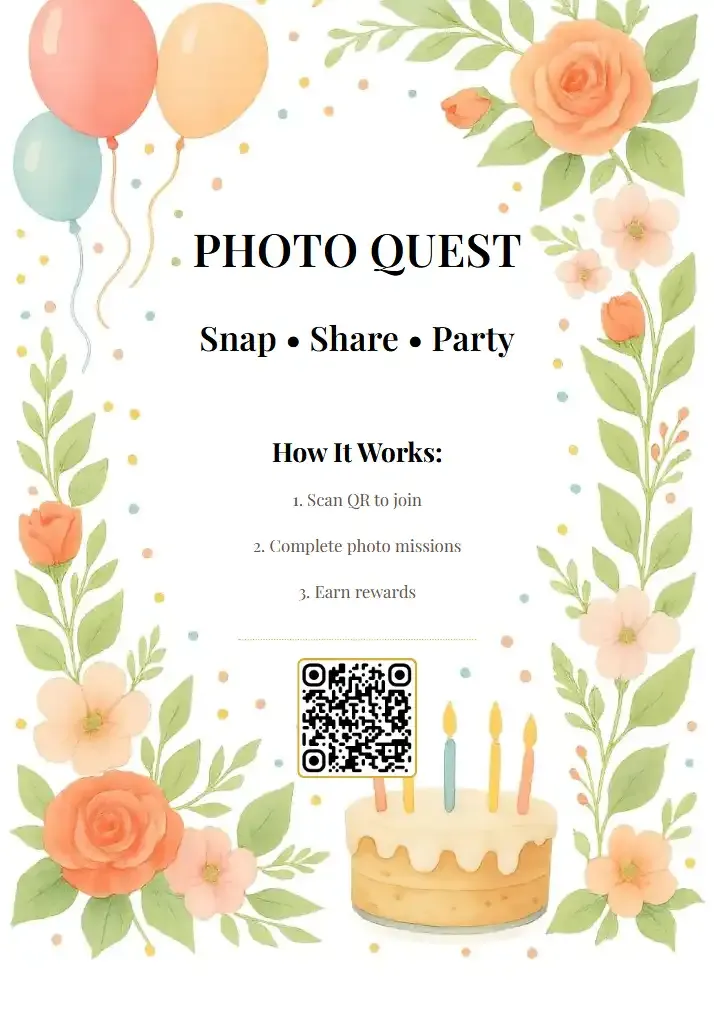
1.Scan and upload. No app, no sign-up.
The difference in participation is noticeable. When uploading takes 15 seconds instead of five minutes, people actually do it. Even the ones who "never share photos."
One thing worth acknowledging: a browser-based gallery won't match the quality of AirDrop for nearby iPhone-to-iPhone transfers. The trade-off is universal access. AirDrop only works between Apple devices within Bluetooth range. A QR gallery works on any phone, any platform, from any distance.
Combining Professional and Guest Photos
The real magic happens when you merge both streams. The photographer's polished shots and the guests' raw, unfiltered contributions end up in the same gallery. Suddenly you have 300 professional photos alongside 400 candid guest uploads, and the collection tells a complete story.
For corporate events specifically, this solves another problem: getting content for internal communications. Marketing teams love having a mix of professional and authentic employee-generated photos. The professional shots go in the annual report. The candid ones go on the company intranet. Both came from the same event.
If you're worried about inappropriate uploads (and at corporate events, you should be), content moderation is worth setting up. Photogala lets you assign a moderator who approves photos before they appear in the shared gallery. Hand that role to someone on the events team with a spare phone. One tap to approve, one to reject.
1.The moderation view: approve or reject before photos go live
Photo Walls: Worth It or Gimmick?
A photo wall is a live display (TV, projector, large monitor) that cycles through uploaded photos in real time. It sounds gimmicky until you see what it does to upload behavior.
Imagine a conference after-party. There's a 55-inch screen near the bar showing guest photos as they come in. Someone sees their photo appear on screen, laughs, shows a colleague. That colleague takes a photo and uploads it. Within an hour, you have a self-sustaining loop of uploads.
The screen placement matters more than you'd think. Near high-traffic areas (bars, food stations, entrances) works. A side room or behind a pillar? Nobody sees it, nobody cares. That's a lesson worth learning before the event, not during.
For event planners: Ask the venue about available screens and HDMI access before the event. Most conference venues have displays you can repurpose. A dedicated laptop running the photo wall in fullscreen is all you need on the technical side.
The Mistakes That Cost You the Best Shots
After watching dozens of event photography setups go sideways, certain patterns emerge. These aren't camera settings problems. They're planning problems.
Arriving when guests do. You should be there 30-45 minutes early. Capture the empty venue, test your settings in the actual lighting conditions, find the angles you'll use for group shots. As the FixThePhoto team notes, events are unrepeatable moments under time pressure. You can't pause a keynote to adjust your white balance.
Ignoring the lighting transitions. Corporate events often move from a bright conference room to a dim cocktail reception to a dark dance floor. Each transition requires different settings. If you're in aperture priority, you'll adapt automatically, but keep an eye on your shutter speed. It will drop in darker rooms, and blurry photos of the CEO are not the kind of memorable anyone wants.
Shooting only from standing height. Crouch for photos of seated guests at tables. Get slightly elevated for group shots. Shoot through doorways for candid framing. The single biggest improvement in amateur event photography isn't a better camera. It's moving your feet and changing your angle.
Not backing up during the event. Dual card slots exist for a reason. If your camera has one slot, bring a laptop and dump cards during breaks. Losing four hours of irreplaceable photos to a corrupt SD card is the kind of mistake you only make once.
A Quick Gear Reality Check
You don't need a $3,000 camera body for event photography. You need a lens that opens wide (f/2.8 or wider), a camera that handles high ISO without falling apart, and a fast-focusing autofocus system. A 5-year-old mirrorless body with a 35mm f/1.8 will outperform a brand-new kit lens in every indoor event scenario.
Smartphones, honestly, have gotten remarkably good at events. The computational photography in recent iPhones and Pixels handles low light better than some dedicated cameras from 2018. For guests contributing to a shared gallery, phone photos are more than good enough. The Digital Photography School basics guide makes a solid point: understanding how light works matters more than the equipment you use.
That said, a dedicated camera still wins for three things: shallow depth of field (that creamy background blur), burst mode for fleeting expressions, and reach (a 70-200mm lens captures a speaker on stage in ways no phone can).
Putting It All Together
Good event photography isn't one person with a perfect camera. It's a system. The professional photographer handles the planned shots, the difficult lighting, the must-capture moments on the shot list. The guests handle the spontaneous, personal, weird, wonderful angles that no hired photographer would ever think to capture.
The missing piece has always been collection. Getting all of those photos from all of those phones into one place, quickly, without friction. That's the part most photography guides skip because it's not a camera problem. It's a logistics problem.
And it's solvable. A QR code on a table tent, a shared gallery in the browser, a photo wall cycling through uploads on a screen near the bar. No app downloads. No shared album invitations that expire. No WhatsApp groups that fill up and get muted.
The next event you photograph (or organize, or attend), try thinking about both halves of the equation. Take better photos, yes. But also make sure the best photos from every phone in the room don't stay trapped there forever.
All of this comes with your own event.
Setting it up takes five minutes. You can build and view everything before you decide.
Starting from €39 one-timeOne-time payment — No subscription
- No App Required
- Setup in 5 Minutes
- 30-Day Money Back
“We were really thrilled, and everything went so much more smoothly, from the seating plan all the way to the photo games! Simply great! Highly recommended!”
Written by

I believe event photos should be more than static galleries. They should be live, playful, and unforgettable.
Categories
Related Posts

Bridal Shower Photo Sharing: Collect Every Sweet Moment in One Gallery
Bridal shower photos end up scattered across 15 phones. Here's how to get them all into one gallery before the mimosas wear off.

Maternity Photo Sharing: How to Keep Every Announcement, Bump Shot, and Memory in One Place
Pregnancy announcements land on 4 different apps. Maternity photos get lost in group chats. Here's how to keep every photo in one shared gallery your whole family can access.
Sales Kickoff Photo Sharing: How to Turn a Mandatory Meeting Into a Team Memory
Sales kickoffs are expensive. The photos from them usually disappear into 14 different camera rolls. Here's how to fix that.