How to Share Corporate Event Photos (So People Actually See Them)


Picture this: your company just wrapped a two-day offsite. The team-building activities were a hit, the keynote was genuinely good, and someone even got the CEO dancing at the afterparty. Marketing needs photos for the internal newsletter by Friday. The CEO wants LinkedIn content. And somewhere on 150 phones, all those moments are sitting in camera rolls, slowly sinking beneath selfies and grocery lists.
You send the email. "Please upload your photos to this Google Drive folder!" The link is in the email. It's right there.
Twelve people upload. Out of 150.
This isn't a made-up number. It's a pattern that plays out at conferences over and over: the gap between photos taken and photos actually collected is enormous. The friction isn't motivation. People wanted to share. The friction is the seven steps between "I should upload that" and actually doing it.
Why the Usual Methods Fall Short
Most corporate event organizers default to one of three approaches. All of them have the same fundamental flaw: they require effort after the event, when enthusiasm has already faded.
The Shared Drive
Google Drive, Dropbox, OneDrive. They're free, everyone has an account (in theory), and IT already approved them. The problem is getting people to actually open the link, navigate the folder structure, select their photos, and wait for them to upload. On a Monday morning, competing with 47 unread emails, that task is dead on arrival.
The WhatsApp Group
Quick to set up, familiar to everyone. But WhatsApp compresses images to roughly 1600×1200 pixels, which makes them useless for print, signage, or anything larger than a social media post. And once 80 people start dumping photos into a group chat, finding anything specific becomes an archaeological dig.
The "Send Them to Marketing" Email
This one's almost charming in its optimism. You ask 150 people to email photos to [email protected]. What you get: three emails, one with a 45 MB attachment that bounces, and a reply-all asking "which format do you want?"
The common thread: all three methods ask people to do something later. And later almost never happens.
The Fix: Capture Photos During the Event, Not After
The single biggest improvement you can make is removing the delay. Instead of asking people to share photos after they get home, give them a way to upload in the moment, while they're still at the event, phone in hand, energy high.
QR code-based photo sharing does exactly this. A QR code on each table, on the event badge, on the welcome screen. Scan it, browser opens, upload. No app install, no login, no folder navigation. The entire process takes about 15 seconds.
47% of event professionals already use QR codes for attendee engagement, according to Krofile's 2025 statistics. The format is familiar enough that even the least tech-savvy attendee knows how to point their camera at a black-and-white square.
Place QR codes where people already have their phones out: the registration desk, lunch tables, and the bar. A QR code tucked behind a plant stand won't collect anything.
Setting It Up: What Actually Works
Here's the practical side. Say you're organizing a 100-person corporate retreat with activities spread across two days. You need photos for internal comms, social media, and the post-event recap deck.
Photo sharing setup in 3 steps
Create a shared gallery before the event
Set up a browser-based gallery with your company branding. Upload the event logo, pick your colors, write a short welcome message. This takes about 5 minutes.
Print and place QR codes
Generate printable QR code cards. Place them on tables, lanyards, and near event signage. Each code links directly to the upload page.
Let the uploads roll in during the event
As attendees take photos, they scan the code and upload instantly. No app, no account, no friction. Photos appear in the shared gallery in real time.
That third step is where the magic happens. You're not asking anyone to do homework. They're already holding their phone, already at the event, already taking photos. The QR code just redirects those photos from a private camera roll to a shared gallery.
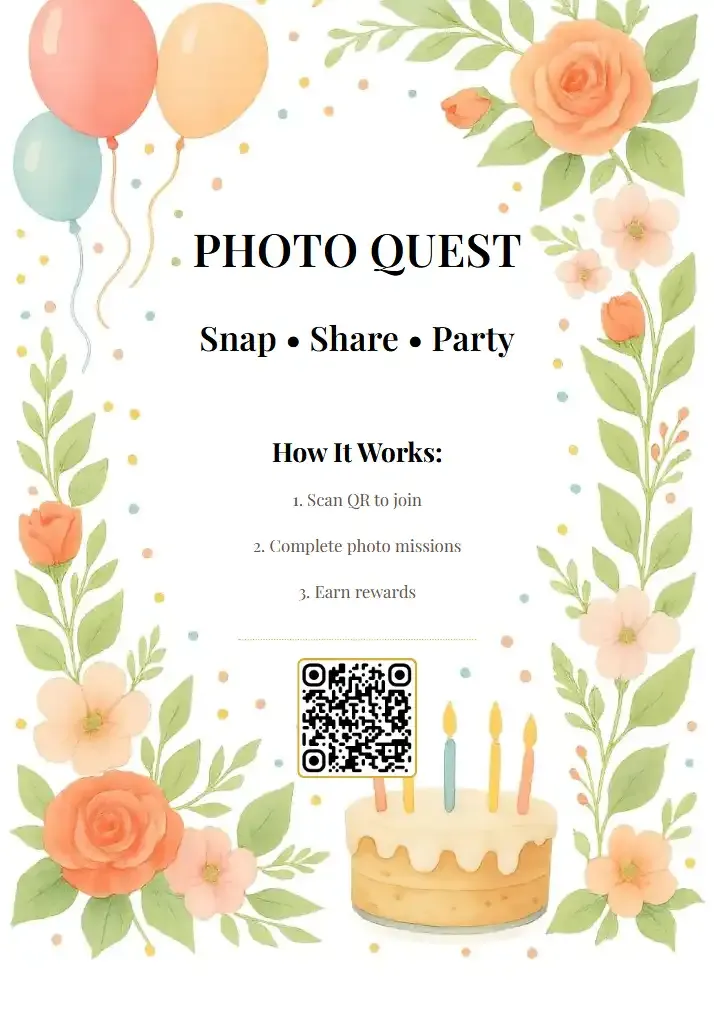
1.One scan opens the gallery. No app needed.
See it in action
Every guest photo in one album – no app.
Beyond Collection: Making Photos Actually Useful
Collecting photos is step one. But a folder with 400 unsorted images isn't much more useful than photos scattered across 100 phones. The real value comes from what happens next.
Moderation (because not every photo should make it to the CEO's screen)
At any corporate event, someone will upload a blurry photo of their shoe. Someone else will capture an unflattering mid-sneeze moment of the CFO. A moderation layer lets a designated person review uploads before they go live. One tap to approve, one tap to reject.
Photogala takes this further with an AI-powered NSFW filter that automatically flags inappropriate content. Configurable sensitivity, so you can decide how strict you want to be. For a buttoned-up annual meeting, crank it up. For a casual team outing, you might relax it.
1.Review and approve uploads before they go public.
The live photo wall
Connect a TV or projector to the gallery's photo wall feature. Approved photos cycle on screen in real time. Put it near the coffee station or behind the main stage.
This does two things. First, it creates a visual buzz. People see their photos on the big screen and immediately take more, because it's satisfying. Second, it quietly advertises the gallery to anyone who hasn't uploaded yet. "How did you get your photo up there?" "Scan the QR code on the table."
Gamification (yes, at a corporate event)
This sounds like it belongs at a birthday party. It doesn't. Photo challenges at corporate events work surprisingly well, because they give people a reason to participate beyond "please share your photos."
Research from TalentLMS and Zippia found that challenge-based gamification improved engagement by 89% compared to passive formats. That's a workplace study, not a party trick.
Imagine setting up challenges like "Best team photo at the workshop" or "Capture a candid keynote moment." With Photogala, you can include example preview photos for each challenge, so guests know exactly what you're after. Points stack up. A leaderboard tracks who's most active. Suddenly the quiet colleague from accounting has uploaded 12 photos because she wants to beat the sales team.
For higher-stakes events, Photogala's Deluxe plan includes real-world rewards: physical prizes that guests can claim at the event when they hit milestones. A branded power bank for the top uploader. Extra raffle tickets for completing three challenges. It turns photo collection into a team activity instead of an afterthought.
One honest limitation: Photogala is browser-based, not a native app. That means it's fast to access (no install), but push notifications require the browser tab to stay open. For multi-day events, remind attendees to scan the QR code again each morning.
What About Professional Photographers?
Most corporate events of any scale hire a professional photographer. That's the right call, and guest photo sharing doesn't replace it. A guide by corporate photography specialist Frederic Paulussen makes the distinction clear: professional photography captures polished, on-brand images for marketing materials. Guest photos capture candid moments the photographer missed.
The two complement each other. The photographer gets the stage shots, the posed group photos, the executive headshakes. Guests get the hallway conversations, the team selfies during lunch, the impromptu karaoke at the afterparty.
Some organizations upload the photographer's edited images to the same shared gallery after the event, giving everyone a single place to access all event content. Others keep them separate. Either way, the guest photos fill a gap that no hired photographer can: being everywhere at once.
Choosing a Platform: What to Look For
There are several QR-based photo sharing platforms now. PixelParty claims 40,000+ events served. Snapeen focuses on conferences and trade shows. Waldo Photos uses SMS codes alongside QR. They all solve the basic problem of collecting photos without an app install.
Where they diverge is what happens after collection. Most stop at the shared album. If all you need is a pile of photos, any of them will work. But if you want moderation, gamification, face recognition for sorting, or a live photo wall, the field narrows quickly.
Corporate event photo sharing: feature comparison
| Feature | Photogala | PixelParty | Snapeen |
|---|---|---|---|
| QR code upload | |||
| No app install | |||
| Content moderation | AI + manual | ||
| Photo challenges | with example photos | ||
| Leaderboard | |||
| AI face recognition | |||
| Live photo wall | |||
| Custom branding | full colors, logo, fonts | logo | logo |
| Gallery layouts | 4 layouts | ||
| Real-world rewards |
After the Event: Getting Value From the Photos
The photos are collected. Now what? Here's what the best corporate event teams do with them:
- Internal newsletter: Pull the top 10-15 photos within 48 hours. Speed matters. Two weeks later, nobody cares.
- Social media: Employee-generated content performs better than stock photos. Tag the team, credit the photographer.
- Recap decks: For leadership and stakeholders, a visual recap is worth more than a written summary.
- Employer branding: Career pages with real event photos outperform those with generic stock images. Every. Single. Time.
- Next year's promo: "Remember last year's offsite?" followed by a carousel of real photos is the most effective event invitation there is.
Face recognition (available on Photogala's Deluxe plan) speeds up the sorting step considerably. Instead of manually tagging 400 photos, the AI clusters them by person. Search for the CEO's face and get every photo she appears in. Hand those to the comms team and you've saved them an afternoon.
The difference between events that collect 12 photos and events that collect 300 isn't enthusiasm. It's friction. Remove the friction, and the photos follow.
All of this comes with your own event.
Setting it up takes five minutes. You can build and view everything before you decide.
Starting from €39 one-timeOne-time payment — No subscription
- No App Required
- Setup in 5 Minutes
- 30-Day Money Back
“Excellent service and great pictures! Photogala fully met our expectations at the event. The value for money is unbeatable. Absolutely recommended! The seating plan saved us a lot of hassle!”
Written by

I believe event photos should be more than static galleries. They should be live, playful, and unforgettable.
Categories
Related Posts

Sales Kickoff Photo Sharing: How to Turn a Mandatory Meeting Into a Team Memory
Sales kickoffs are expensive. The photos from them usually disappear into 14 different camera rolls. Here's how to fix that.
Customer Appreciation Event Photos: The Album Nobody Plans (But Everyone Wants)
Your best clients showed up, mingled, laughed. Then what? Here's how to turn a customer appreciation event into a shared photo gallery that keeps the relationship warm.
Store Grand Opening Photos: How One QR Code Captures the Ribbon Cutting and Everything After
The ribbon cutting lasts 3 seconds. The photos from your grand opening should last forever. Here's how to collect every guest photo with a single QR code.