How Festival Organizers Are Using Digital Photo Sharing to Boost Engagement

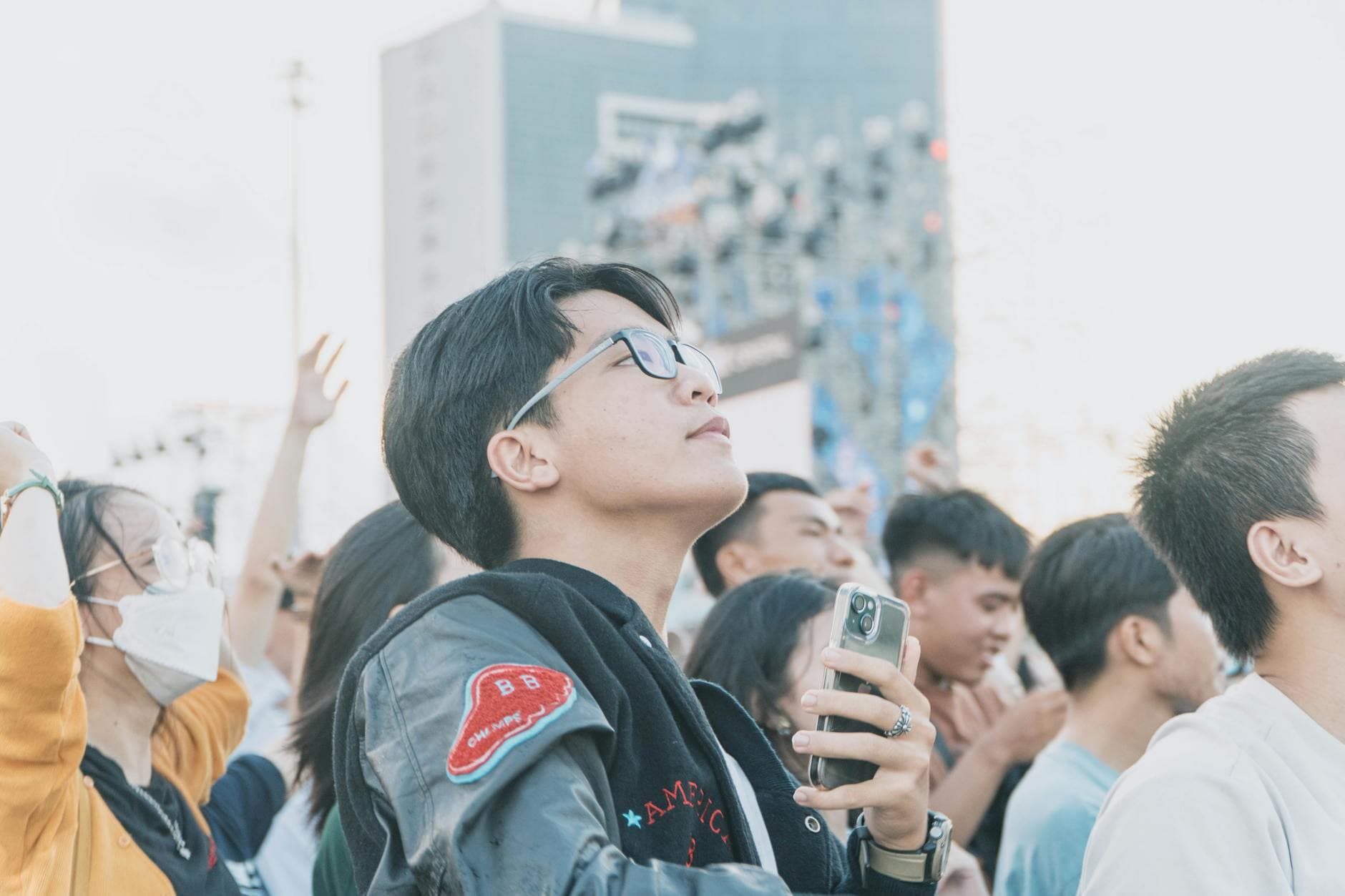
Picture 40,000 people at a three-day music festival. Every single one of them has a camera in their pocket. By Sunday night, there are probably half a million photos floating around on those phones. Crowd shots, blurry stage photos, golden hour selfies with friends, someone's terrible attempt at filming the headliner's encore.
Almost none of those photos will ever be seen by anyone other than the person who took them.
That's the part festival organizers are starting to pay attention to. Not the photography itself, but the gap between all that content being created and almost zero of it being collected, shared, or used. A LinkedIn analysis by KonfHub put it bluntly: traditional photo workflows fail because photographers deliver images days later, after attendees have already moved on. The value of those photos has a half-life measured in hours, not weeks.
Festival organizers who figured this out early are now treating photo sharing not as a nice afterthought, but as infrastructure. The same way you plan stages, sound, and security, you plan how photos move through the event.
The Engagement Problem Nobody Talks About
Festivals spend enormous budgets on experiences. Light shows, immersive art installations, surprise guest appearances. But once a set ends, what keeps people engaged between acts? What do they do during the two-hour gap between their favorite bands?
The honest answer: they scroll Instagram. They leave the festival mentally, even if they're still physically standing in a field.
Digital photo sharing gives organizers a tool to fill those gaps. When attendees can upload photos to a shared gallery, see what other people are capturing across the grounds, and compete in photo challenges, the dead time becomes active time. The festival stays in focus.
SocialWalls' research on event photo sharing found that collaborative photo approaches transform attendees from passive observers into active participants who document the event from their own perspectives. That shift matters more than it sounds. An attendee browsing a live gallery of crowd photos is still thinking about the festival. An attendee scrolling TikTok is not.
QR Codes Solved the Distribution Problem
The old approach to event photo sharing required an app download. And app downloads at festivals are terrible. Bad cell reception, crowded networks, people who don't want another app on their phone. By the time someone finds the app, installs it, creates an account, and figures out how to upload, the moment has passed.
QR codes skip all of that. A festival attendee scans a code on a banner near the main stage, the gallery opens in their browser, and they're uploading within 30 seconds. No app, no account, no friction.
The smart organizers put QR codes everywhere. On wristbands. On the back of drink tokens. On screens between sets. On the porta-potty doors (seriously, that's prime real estate at a festival). The more touchpoints, the more uploads.
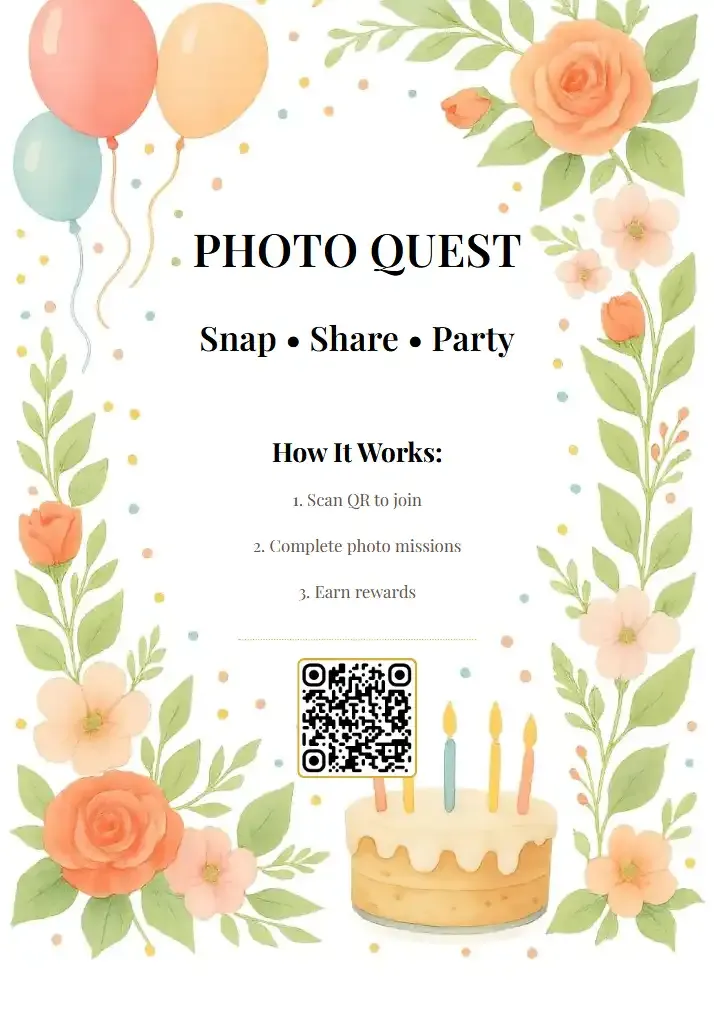
1.Guests scan and start uploading in seconds. No app needed.
Photo Challenges Turn Passive Crowds into Content Creators
Here's where it gets interesting. A shared photo gallery is useful. Photo challenges make it fun.
Imagine a festival with challenges like "Best Festival Outfit," "Weirdest Food Combination," or "Sunset Selfie from the Hill." Attendees aren't just uploading random shots anymore. They're hunting for specific moments, exploring different areas of the grounds, and competing with strangers.
Photogala's challenge system goes further than basic text prompts. Each challenge can include an example preview photo showing what to aim for. That opens up creative formats: photo roulette where attendees mimic a ridiculous pose, recreate a famous album cover, or snap a photo that matches a specific composition. The example photo turns a vague prompt into a specific, shareable game.
One format that works particularly well at festivals: themed challenges that change every few hours. "Golden hour challenge" at 7 PM. "Night mode challenge" at 11 PM. "Morning after challenge" at 8 AM. Each one pulls people back into the gallery and keeps the upload rate steady across the entire event, not just during headliner sets.
Challenge density matters. For a multi-day festival, 5-8 challenges per day is the sweet spot. Fewer feels empty. More feels overwhelming. Rotate them so there's always something fresh, but don't retire the popular ones too early.
See it in action
Every guest photo in one album – no app.
The Live Photo Wall Effect
A screen between the main stage and the food court, cycling through photos that attendees uploaded in the last hour. That's a live photo wall, and at festivals it does something screens playing sponsor logos never could: it makes people stop and look.
The psychology is straightforward. People want to see themselves on a big screen. They want to see if their photo made it up there. They'll gather in small crowds, pointing and laughing at candid shots from the mosh pit or a perfectly timed crowd surf. As FeatureBooth's 2025 event engagement guide noted, modern photo tech turns passive attendees into active participants, and the photo wall is the most visible version of that shift.
For organizers, the wall serves double duty. It's entertainment during downtime and it's a feedback loop that drives more uploads. Someone sees a funny photo on the wall, pulls out their phone, and uploads their own. The gallery grows, the wall gets better, and the cycle continues.
Worth noting: moderation matters here. A lot. A live photo wall without content review is asking for trouble at a festival with thousands of attendees and (let's be honest) a lot of alcohol. Pre-approval queues, where a moderator reviews each photo before it hits the screen, are non-negotiable. Photogala's AI NSFW filter catches the obvious problems automatically, but having a human moderator for borderline content is the safer bet.
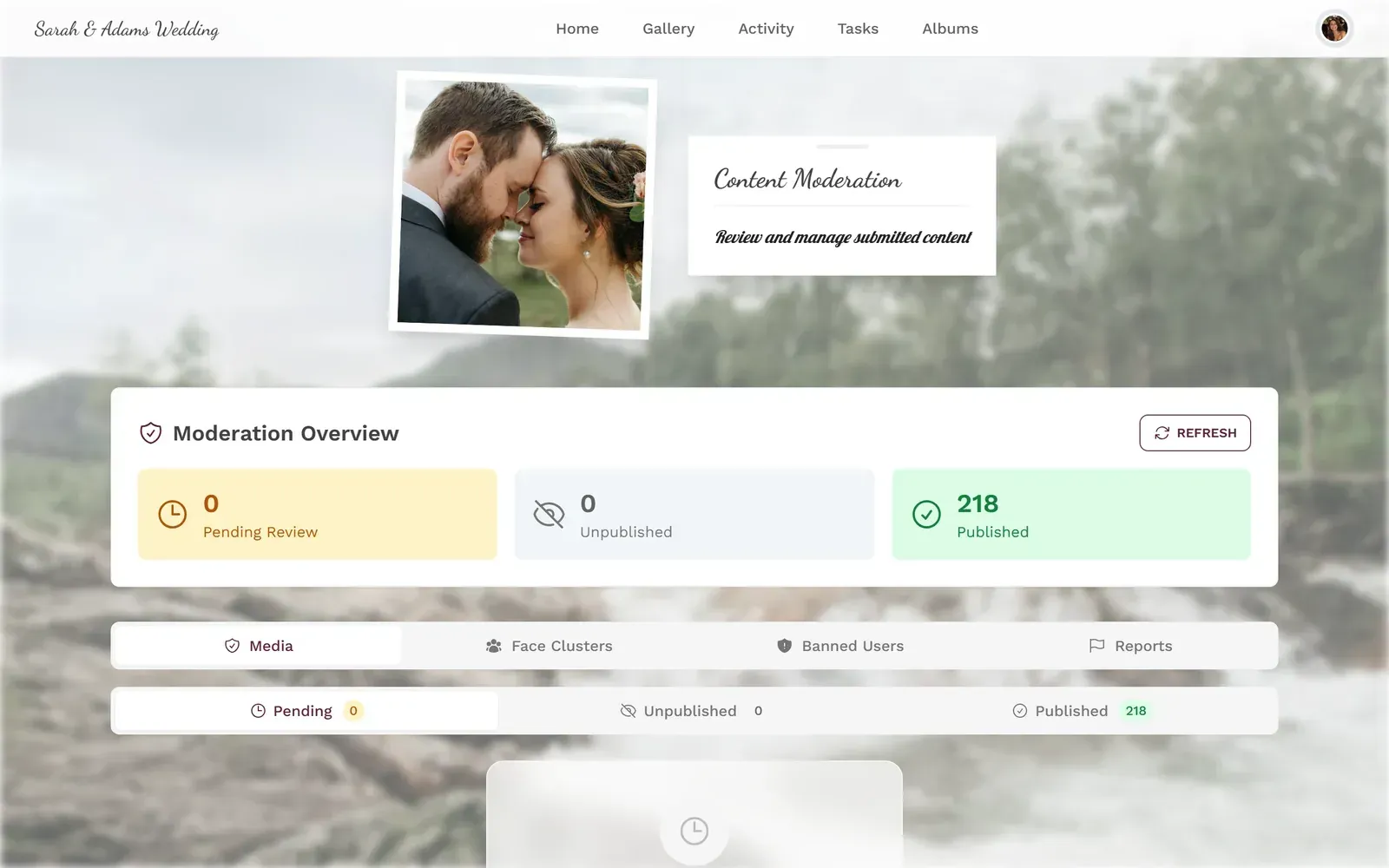
1.Every photo can be reviewed before it appears on the live wall.
Leaderboards and the Competitive Instinct
Festival crowds are competitive. They'll argue about which stage has the best sound, which food truck has the longest line, and whether the headliner was better last year. A photo leaderboard channels that energy.
The concept is simple: uploaders earn points for each photo, bonus points for completing challenges, and the leaderboard ranks everyone. At a festival, the leaderboard creates a meta-game running alongside the music. People check it between sets. Groups compete against each other. The person in first place becomes a minor celebrity among their camp neighbors.
For multi-day festivals, leaderboards solve a specific problem: day-two fatigue. By the second or third day, energy dips. A leaderboard with daily prizes (even small ones, like a free drink token or a meet-and-greet lottery entry) gives people a reason to keep engaging with the photo gallery instead of retreating to their tent.
If you're curious about the mechanics, the article on how photo challenges drive engagement goes deeper into challenge design and point systems.
What Organizers Actually Get Out of This
Let's talk about the organizer's perspective, because "engagement" is a vague word that doesn't justify a line item in a festival budget.
Here's what's concrete:
- User-generated content for marketing. A curated gallery of 2,000 attendee photos is worth more than a 50-photo set from a hired photographer for next year's promotional material. Real moments, real diversity, real energy.
- Social media amplification. When attendees share photos from the gallery to their own feeds, the festival reaches audiences organically. Pure Magazine's analysis of event photo tech found that digital photo tools help brands spark conversations and drive social sharing without additional ad spend.
- Post-event engagement. The gallery stays live after the festival. Attendees revisit it, download their favorites, and tag friends. That's weeks of continued brand contact.
- Sponsor integration. Branded challenges ("Best photo with the Red Bull stage") give sponsors measurable activation without being intrusive.
The Moderation Question at Scale
A 200-person wedding and a 10,000-person festival have very different moderation needs. At a wedding, maybe one bridesmaid reviews photos before they hit the photo wall. At a festival, you need a system.
Photogala handles this with role-based moderation. You can assign multiple moderators, each with their own login, working from their phones or a laptop backstage. The approval queue shows every pending upload with one-tap approve or reject. The AI NSFW filter runs automatically, flagging anything that shouldn't make it onto a public screen.
The one limitation worth mentioning: moderation requires the Premium plan or higher. If you're running a small local festival on a tight budget, the Plus plan gives you the gallery and challenges but not the moderation dashboard. For anything with more than a few hundred attendees and a live wall, the moderation tools are worth the upgrade.
A Practical Setup for Festival Organizers
Getting photo sharing running at your festival
Create the gallery early
Set up the event gallery 2-3 weeks before the festival. Upload your logo, choose a gallery layout, and configure branding to match the festival aesthetic.
Design the challenges
Plan 5-8 challenges per day. Mix easy ones (selfie at the main stage) with creative ones (recreate this album cover). Add example photos for each.
Print QR codes everywhere
Wristbands, drink tokens, stage banners, bathroom doors, camping area signs. The more touchpoints, the higher the upload rate.
Assign moderators
Brief 2-3 team members on moderation. They'll review uploads from their phones. Set the AI NSFW filter to medium sensitivity as a first pass.
As Waldo's guide for event photographers puts it, the value of photos has never been higher but their half-life has never been shorter. At festivals, that window is especially tight. Getting the sharing infrastructure right means those photos actually reach people while they still care.
The festivals that figured this out aren't treating photo sharing as a tech experiment. They're treating it the way they treat sound engineering or stage design: as core infrastructure that directly affects whether people have a great time or just an okay one.
All of this comes with your own event.
Setting it up takes five minutes. You can build and view everything before you decide.
Starting from €39 one-timeOne-time payment — No subscription
- No App Required
- Setup in 5 Minutes
- 30-Day Money Back
“We used the software at my mum's birthday party. It went down really well 😊”
Written by

I believe event photos should be more than static galleries. They should be live, playful, and unforgettable.
Categories
Related Posts
Bridal Shower Photo Sharing: Collect Every Sweet Moment in One Gallery
Bridal shower photos end up scattered across 15 phones. Here's how to get them all into one gallery before the mimosas wear off.

Maternity Photo Sharing: How to Keep Every Announcement, Bump Shot, and Memory in One Place
Pregnancy announcements land on 4 different apps. Maternity photos get lost in group chats. Here's how to keep every photo in one shared gallery your whole family can access.
Sales Kickoff Photo Sharing: How to Turn a Mandatory Meeting Into a Team Memory
Sales kickoffs are expensive. The photos from them usually disappear into 14 different camera rolls. Here's how to fix that.