How to Create a Shared Photo Album for an Event (That People Actually Use)


Picture this: your best friend's 30th birthday, 45 people, a rooftop bar, golden hour light. Everyone's snapping photos. Two weeks later, you've seen exactly four of them. Three on Instagram Stories (expired), one in a group chat buried under 200 messages about who's paying the tab.
The photos exist. They're sitting on 45 phones, slowly getting buried under screenshots and food pics. And unless someone does something about it, that's where they'll stay.
A Memorykpr guide on gathering event photos nails the core problem: the collection method matters more than asking nicely. The easier you make it, the more photos you get. The harder it is, the more photos rot on camera rolls forever.
This guide walks through every practical way to create a shared photo album for an event, from free options to purpose-built tools. Some work great for 10 people. Others scale to 200+ guests without breaking. By the end, you'll know which approach fits your event and how to set it up in under 10 minutes.
The Free Options (and Where They Break)
Google Photos Shared Albums
Google Photos is the go-to suggestion on every forum thread. Create an album, tap "Share," send the link. Done. And for a small group where everyone already uses Google Photos, it works fine.
The cracks show at scale. Half your guests might be on iPhones with no Google account. Some will see the link, tap it, get redirected to a sign-in page, and give up. Others will join but never upload because the album lives in an app they open once a month. For a dinner party with eight tech-savvy friends, Google Photos is perfect. For a wedding with 150 guests spanning three generations, it's a gamble.
There's also the ownership question. Whoever creates the album owns it. If they delete their Google account or accidentally remove the album two years from now, everything's gone. No export warning, no backup prompt.
iCloud Shared Albums
Apple's version has a similar problem in reverse: it only works smoothly if everyone's in the Apple ecosystem. Android users can technically view shared albums via iCloud.com, but uploading is clunky at best. And iCloud shared albums compress your photos, which matters if someone caught a genuinely beautiful candid.
The 5,000-photo limit per album sounds generous until a 200-person wedding fills it in a single evening.
Facebook Albums
Still surprisingly popular for older demographics. Create an event or group, let people post photos. The advantage: almost everyone has Facebook and knows how to use it. The disadvantage: Facebook compresses images aggressively, the privacy controls are confusing, and half the guests under 30 don't have active accounts anymore.
WhatsApp / Group Chats
The lazy default. Someone creates a group, says "drop your photos here," and within 24 hours the chat has 400 messages, half of which are reactions, voice notes, and someone asking "when are we doing brunch?" Photos get compressed. Finding a specific picture means scrolling through chaos. And anyone who joins the group late misses everything above.
All these free options share one fundamental flaw: they require guests to already have a specific app or account. The moment someone doesn't have Google Photos, iCloud, or Facebook, they're excluded. That's fine for friend groups. It falls apart at larger events.
Cloud Folders: The Middle Ground
A shared Google Drive or Dropbox folder is the tech-literate person's answer. Create a folder, set it to "anyone with the link can upload," print the link as a QR code, done. Eventoly's guide to sharing group photos recommends this approach as a solid low-cost option.
It works better than chat-based sharing because everything stays organized in one place. But it still has friction. Guests need to know how to upload to a cloud folder from their phone (not intuitive for everyone). There's no preview of what others uploaded. No social layer. No reason to come back and browse. It's a digital box you throw photos into and forget about.
For a hiking trip with 8 friends, a shared Drive folder is great. For a corporate offsite with 60 people, you'll get maybe 15 uploads from the 5 people who bothered.
Dedicated Photo Sharing Platforms: What Changed
Here's where things got interesting in the last few years. Dedicated event photo sharing tools solve the friction problem by stripping away accounts, app installs, and technical knowledge entirely. Guests scan a QR code, their phone's browser opens, and they upload. That's it.
DropEvent was one of the early players: no app, no sign-up, original quality uploads. GuestCam advertises setup in under 3 minutes. The space has matured from novelty to genuinely useful, with Fotny listing over a dozen options as of 2025.
The key difference between these platforms and a shared Google album isn't just convenience. It's participation rate. When the barrier drops from "download this app and create an account" to "point your camera at this QR code," you go from 15% of guests contributing to 60-70%.
See it in action
Every guest photo in one album – no app.
What a Good Shared Album Actually Needs
After looking at what works and what doesn't, the pattern is clear. A shared photo album that people actually use needs five things:
- Zero friction to join. No app, no account, no sign-up. QR code or link, browser opens, upload starts.
- A reason to come back. If guests upload once and never return, you miss the best stuff. Notifications, a live gallery, or a photo wall give people a reason to check in.
- Works on every phone. Android, iPhone, old Samsung from 2019. Browser-based beats app-based every time.
- Some form of organization. Albums, timestamps, or at minimum chronological sorting. A pile of 300 unsorted photos is barely better than no album at all.
- Content control. At a work event, you need to be able to remove inappropriate uploads before the CEO sees them on the big screen.
Free tools cover point 1 (sometimes) and point 4 (barely). Dedicated platforms cover all five.
Setting Up a QR Code Photo Album in 10 Minutes
Here's what the actual process looks like with a purpose-built tool like Photogala. No theoretical overview, just the real steps.
From zero to live gallery
Create your event gallery
Pick your event type, add a name and date. Choose a cover image. The whole setup takes about 2 minutes.
Customize your QR code
Photogala generates a unique QR code for your gallery. You can customize the design, download it as an image, or use printable templates for table cards and invitations.
Share it with guests
Print QR codes on table cards, project them on a screen, or send the link directly. Guests scan with their phone camera, the gallery opens in their browser, and they start uploading. No app install.
That's the basic flow. But here's where it gets more interesting than a shared Google album.
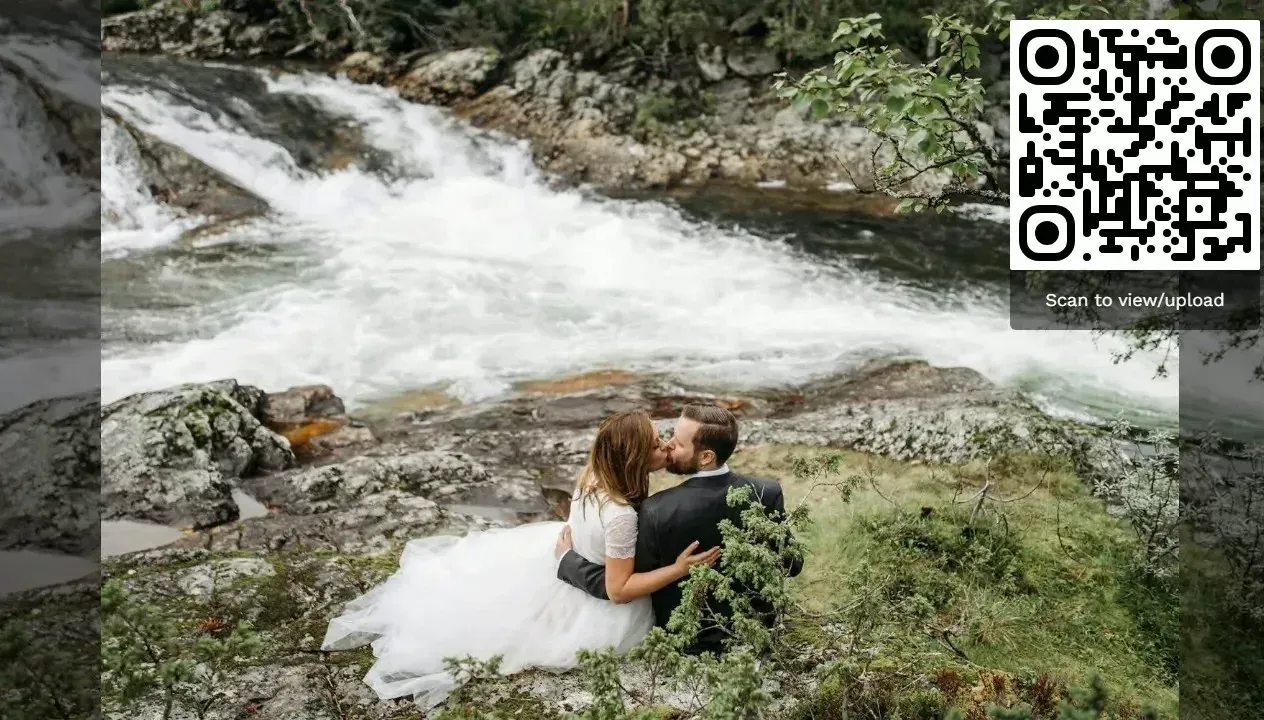
1.Guests scan the QR code with their phone camera. No app needed.
The Features That Actually Change Behavior
A shared album collects photos. That's table stakes. What separates a ghost-town album from one that fills up is giving people a reason to participate.
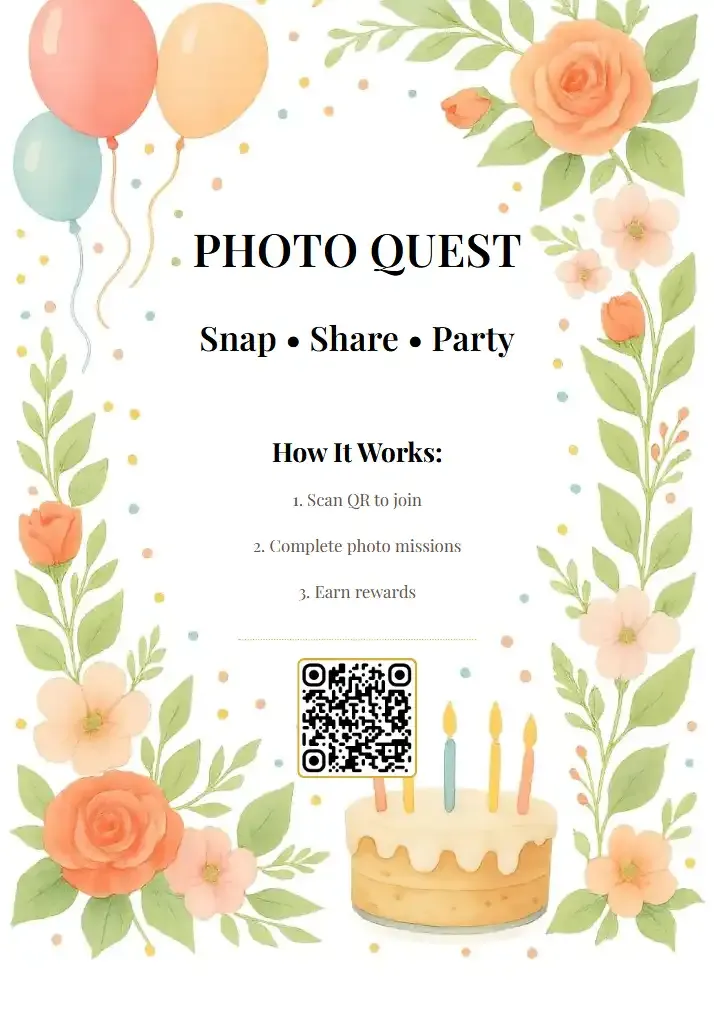
Photo challenges are the simplest example. Instead of hoping guests upload their best shots, you give them specific prompts: "Catch someone on the dance floor," "Best group selfie," "Find the weirdest decoration." Photogala lets you create unlimited challenges, each with its own QR code you can print on table cards. Guests scan, see the challenge, and upload their attempt. The challenge can even include an example photo, so guests know what you're going for. Think photo roulette: show them a funny pose, they recreate it. The results are usually better than anything the photographer captures.
Then there's the leaderboard. Points for every upload, every challenge completed. Sounds gimmicky until you see it in action. Imagine a 62-year-old uncle uploading photo after photo because he refuses to let his teenage nephew beat him on the ranking. Research from AmplifAI shows gamified environments increase engagement by 48% in workplace settings. At a wedding with cocktails involved, the effect is arguably stronger.
1.Photo challenges give guests specific, fun prompts to follow.
What About Moderation?
This is the part most shared album guides skip entirely. And it's the part that matters most at corporate events, school functions, or any event where someone could upload something inappropriate.
With a Google Photos shared album, you have two options: let everything through, or manually check every single photo yourself. With a dedicated platform, you can set up an approval queue. Every photo gets reviewed before it appears in the gallery or on the photo wall. Assign a trusted friend or colleague as moderator. One tap to approve, one tap to reject.
Photogala also includes an AI-powered NSFW filter on the Deluxe plan that automatically flags potentially inappropriate content. Is it perfect? No. But it catches the obvious stuff before a human ever sees it, which matters when you're running a live photo wall at a company event.
For corporate events: Set moderation to pre-approval mode. Every photo gets reviewed before it goes public. Assign 2-3 moderators so the queue doesn't pile up during peak moments.
The Honest Trade-offs
Dedicated photo sharing platforms aren't free. Photogala starts at €39 for a one-time payment (no subscription), which is more than a Google Photos album (free) but less than a photo booth rental (EUR 500+). If your event is a casual dinner with 8 friends, a shared iCloud album is all you need. Don't overspend.
The other trade-off: Photogala is browser-based, not a native app. That's a feature (no install required), but it means you won't get push notifications the way you would with a native app. There's an in-gallery notification system, but it's not the same as a badge on your home screen.
For events under 15 people where everyone uses the same phone ecosystem, free tools work. For anything bigger, the friction reduction of a QR-code-based gallery pays for itself in participation rates. If you want to see how different sharing methods compare in practice, we tested six approaches side by side.
All of this comes with your own event.
Setting it up takes five minutes. You can build and view everything before you decide.
Starting from €39 one-timeOne-time payment — No subscription
- No App Required
- Setup in 5 Minutes
- 30-Day Money Back
“We were really thrilled, and everything went so much more smoothly, from the seating plan all the way to the photo games! Simply great! Highly recommended!”
Written by

I believe event photos should be more than static galleries. They should be live, playful, and unforgettable.
Categories
Related Posts

Company Retreat Photo Sharing: How to Actually Keep the Memories
Most offsite photos die on individual phones. Here's how to collect, share, and actually use every photo from your next company retreat.
Neighborhood Block Party Photo Sharing: How to Turn 40 Strangers Into One Shared Album
Block parties create great photos — and zero way to share them. Here's how a QR code gallery turns your street into a connected community.

Why Upload Limits Ruin Event Galleries (and What Unlimited Actually Changes)
Upload caps at events create anxiety, reduce participation, and leave gaps in your photo collection. Here's what happens when you remove the ceiling.