The Best Way to Share Photos With a Group (Tested 6 Methods)


Picture this: a birthday dinner with 25 friends. Great food, great light, everyone pulling out phones. By the end of the night, there are maybe 300 photos spread across two dozen camera rolls. Someone starts a WhatsApp group. Three people upload a few shots. The rest say "I'll send mine later" and never do.
Sound familiar? It should. A Greenfly analysis puts it bluntly: collecting photos from a group is "not as trivial as it sounds," especially once you're dealing with more than a handful of people. The problem isn't that people don't want to share. It's that every method we currently use creates just enough friction to kill the follow-through.
I tested six common approaches for group photo sharing, from the obvious ones to a few you might not have considered. Here's what actually works, what fails, and why the answer depends on one specific question most people never ask.
The Question Nobody Asks First
Before picking a tool, you need to answer this: are you sharing photos you already selected, or collecting photos from other people?
These are fundamentally different problems. Sharing your best 15 vacation shots with your family is easy. Getting 80 photos from 25 different people at an event into a single place? That's the hard one. Most methods handle the first case fine and completely fall apart on the second.
Keep that distinction in mind. It changes everything about which method is right for you.
Method 1: The WhatsApp Group
The default. Someone creates a group, says "drop your photos here," and hopes for the best.
What works: Everyone already has WhatsApp. Zero setup. You get photos immediately. For 5-8 people sharing a handful of shots, it's honestly fine.
Where it breaks down: Once the group hits 15+ people, the chat becomes a wall of compressed thumbnails. WhatsApp compresses images heavily, so your carefully composed sunset shot becomes a blurry mess. Worse, people feel awkward dumping 30 photos into an active chat. So they pick 2-3 and leave the rest on their phone. You end up with a fraction of what was actually captured.
There's also the persistence problem. Six months later, good luck scrolling through 400 messages to find that one group shot.
Method 2: Google Photos Shared Album
Create a shared album, send the link, everyone adds their photos. In theory, this is great. Unlimited storage (at slightly compressed quality), automatic syncing, face-based grouping.
What works: If everyone in your group already uses Google Photos, this is smooth. The photos stay in full quality (or close to it), they're organized by date, and Google's search is genuinely impressive.
Where it breaks down: "If everyone already uses Google Photos" is doing a lot of heavy lifting in that sentence. Half your group uses iPhones and has never opened Google Photos. They need to download the app, create or sign into a Google account, figure out how to add photos to a shared album. That's three steps too many for a casual group event. The people who were already going to share will share. The rest won't bother.
For our comparison of photo sharing platforms, we found this is the single biggest barrier: requiring everyone to use the same ecosystem.
Method 3: Apple Shared Albums / AirDrop
AirDrop is magical when it works. Tap, tap, sent. Full quality, instant transfer.
What works: Between two iPhones standing next to each other, nothing is faster. Great for passing a few photos to the person sitting across the table.
Where it breaks down: Three words: not everyone has iPhones. At a mixed group, AirDrop covers maybe 50-60% of the room. And even for iPhone users, AirDrop is a one-to-one transfer. Sending 20 photos to 25 people means 500 individual transfers. Nobody is doing that. Apple's Shared Albums have the same ecosystem lock-in problem as Google Photos, just in reverse.
Method 4: Cloud Folder (Dropbox, Google Drive, OneDrive)
Create a shared folder, drop the link in the group chat, tell everyone to upload their photos.
What works: No ecosystem lock-in. Anyone with a browser can access a shared link. The files stay at original quality. Simple, universal, reliable.
Where it breaks down: Have you ever tried browsing 200 photos in a Dropbox folder on your phone? It's not a gallery. It's a file manager. There's no preview grid, no slideshow, no way to like or comment. Uploading from a phone is clunky: you have to select photos, wait for the upload, hope your connection holds. And there's zero reason for anyone to come back and look at the photos together. It's a storage solution pretending to be a sharing solution.
The pattern so far: Every method works for sharing a few photos between a few people. The challenge is collecting many photos from many people and putting them somewhere everyone actually wants to browse. That's where most tools fail.
Method 5: Dedicated Photo Sharing Apps
Apps like Cluster are built specifically for group photo sharing. They handle the album, the permissions, the notifications. Some work as websites and mobile apps, which helps with the "not everyone has the same phone" problem.
What works: Purpose-built tools are genuinely better than repurposing WhatsApp or Dropbox. They usually have a proper gallery view, upload notifications, and sometimes even moderation controls.
Where it breaks down: Most still require an account or an app download. That's fine for your family photo group that meets every Christmas. It's not fine for a one-time event where you need 50 people to upload within a few hours. Every extra step between "I took a photo" and "it's in the shared gallery" loses you people.
Method 6: QR Code Photo Galleries
This is the approach that surprised me. A QR code on a table, a sign, or a screen. Guests scan it, a browser gallery opens, they upload. No app, no account, no ecosystem requirement.
The reason this works better than everything above comes down to one thing: the friction is almost zero. Someone picks up their phone, points it at a code, and they're uploading. That's it. No "I'll send it later." No "what's the password for the shared album?" No "I don't have Google Photos."
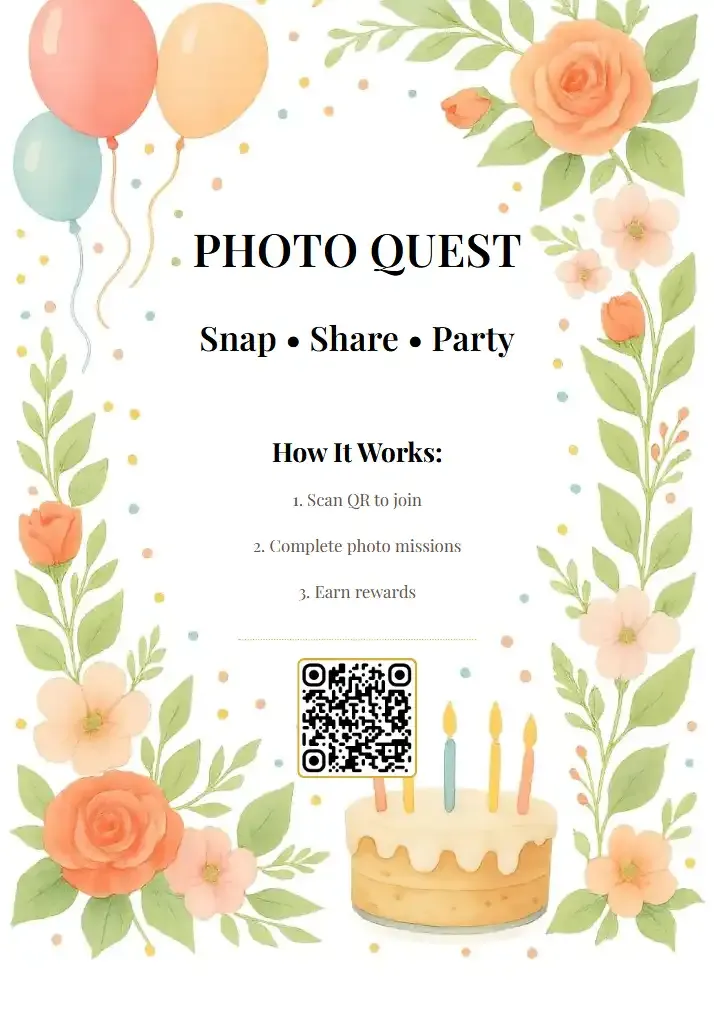
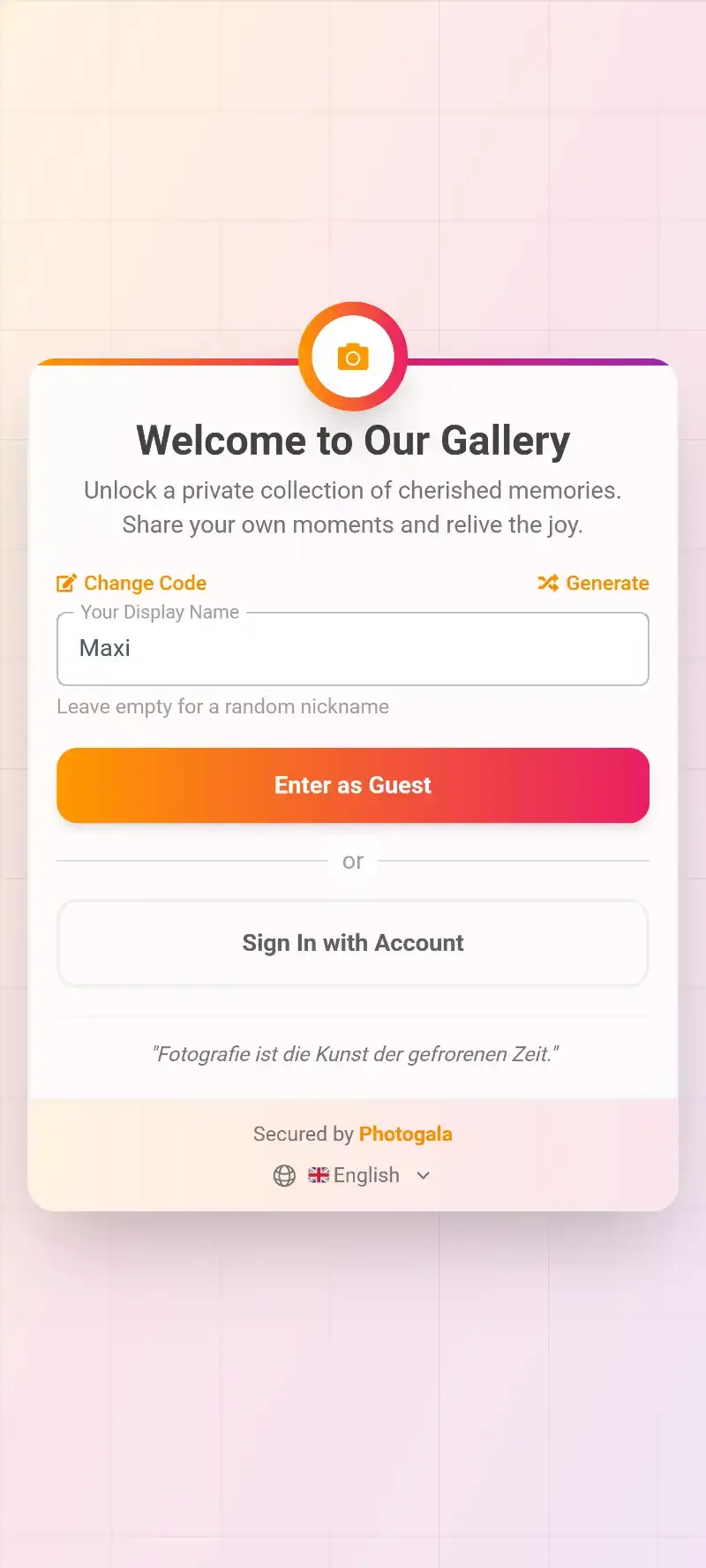
1.Scan, open, upload. No app needed.
For events specifically (weddings, company parties, reunions, birthday dinners), this is the most reliable method I've found. The upload rate is dramatically higher because the barrier to entry is just... scanning a code. 47% of event professionals already use QR codes for attendee engagement, and the number keeps climbing.
The trade-off? It's not free. Unlike a Google Photos album or a WhatsApp group, QR code galleries are usually a paid service. Whether that's worth it depends on how much you care about actually getting everyone's photos.
See it in action
Every guest photo in one album – no app.
The Real Problem: Making People Actually Upload
Here's what none of the method comparisons tell you. The tool matters less than the motivation. You can have the perfect sharing setup and still end up with 30 photos from 3 people while the other 22 guests kept their phones in their pockets.
The biggest factor isn't technology. It's timing. If you ask people to share photos the next day, you've already lost. The window is during the event, while people are still excited, still taking photos, still in the mood. A physical QR code on the table works because it catches people in that window. A WhatsApp message the next morning doesn't.
The second factor is visibility. Imagine a screen at the venue showing uploaded photos in real time. Suddenly people see their friend's photo appear on the big screen, and they think, "I want mine up there too." That competitive instinct is more powerful than any reminder text.
1.A live photo wall turns passive guests into active contributors
This is where tools like Photogala go beyond just collecting photos. Photo challenges ("take a selfie with the birthday person," "capture someone on the dance floor") give guests a reason to upload, not just a place to upload. A leaderboard adds friendly competition. At a 100-person company event, say, you'd expect maybe 80-150 photos with a basic shared album. Add challenges and a visible leaderboard, and that number can double. Research from AmplifAI shows gamified environments increase engagement by 48% in workplace settings. The same psychology applies at events.
That said, gamification isn't always the right call. At an intimate dinner for 12 people, a leaderboard would feel weird. Match the tool to the vibe. For small, casual groups: a simple shared album (Google Photos, Apple) works fine. For events with 20+ people where you want maximum participation: a QR code gallery with a live wall and optional challenges is hard to beat.
A Quick Decision Framework
After testing all six methods, here's how I'd decide:
- 2-8 people, ongoing group (family, close friends): Google Photos shared album or Cluster. Everyone can take the time to set up accounts.
- 5-15 people, one-time trip or dinner: WhatsApp group works. Keep it simple. Accept you'll get maybe 40% of the photos that exist.
- 20-50 people, event setting (birthday, reunion, team offsite): QR code gallery. The no-app-install factor is critical at this size.
- 50+ people, wedding or corporate event: QR code gallery with a live photo wall and engagement features. At this scale, passive collection won't cut it.
The frustrating truth is that there's no single best method. But there is a clear best method for each situation. And for group events (which is what most people mean when they search "best way to share photos with a group"), the answer increasingly points toward browser-based QR sharing.
For a step-by-step walkthrough of QR code photo sharing setup, we wrote a detailed guide that covers placement, timing, and how to get the highest upload rate.
What About Privacy?
One thing worth mentioning: not everyone is comfortable with their photos being uploaded to a shared gallery they don't control. This is especially relevant at corporate events or any gathering where not everyone knows each other well.
Good QR gallery tools include moderation features, where an admin can review photos before they go public. Photogala, for example, lets you assign a moderator who approves or rejects uploads with a single tap. For corporate events, there's also an AI-based NSFW filter that catches inappropriate content automatically. These aren't glamorous features, but they're the kind of thing that prevents the one awkward moment that ruins the whole idea for next time.
Worth considering: If you're collecting photos at a professional or mixed-audience event, pick a tool with content moderation. One bad photo on the live wall can turn the whole gallery from a hit into an HR incident.
The 30-Second Version
Most group photo sharing fails because of friction, not because people don't want to share. The fewer steps between "I took a photo" and "it's in the shared gallery," the more photos you'll actually collect. For casual small groups, a simple shared album works. For events where you genuinely want everyone's photos, a QR code gallery with no app requirement is the most reliable approach available right now.
That birthday dinner with 25 friends? Imagine a QR code on the table next to the candles. By dessert, you've got 180 photos from 19 different people. No WhatsApp group needed. No "I'll send them tomorrow" that never comes.
All of this comes with your own event.
Setting it up takes five minutes. You can build and view everything before you decide.
Starting from €39 one-timeOne-time payment — No subscription
- No App Required
- Setup in 5 Minutes
- 30-Day Money Back
“We were really thrilled, and everything went so much more smoothly, from the seating plan all the way to the photo games! Simply great! Highly recommended!”
Written by

I believe event photos should be more than static galleries. They should be live, playful, and unforgettable.
Categories
Related Posts

Bridal Shower Photo Sharing: Collect Every Sweet Moment in One Gallery
Bridal shower photos end up scattered across 15 phones. Here's how to get them all into one gallery before the mimosas wear off.

Maternity Photo Sharing: How to Keep Every Announcement, Bump Shot, and Memory in One Place
Pregnancy announcements land on 4 different apps. Maternity photos get lost in group chats. Here's how to keep every photo in one shared gallery your whole family can access.

Sales Kickoff Photo Sharing: How to Turn a Mandatory Meeting Into a Team Memory
Sales kickoffs are expensive. The photos from them usually disappear into 14 different camera rolls. Here's how to fix that.