QR Code Photo Sharing: A 3-Step Setup Guests Actually Use


Picture this: the party ended two hours ago. Your phone has 47 photos from tonight. Your best friend's phone has 63. Your cousin recorded the toast. Someone at table 7 caught the moment the flower girl grabbed a slice of cake. All those photos exist right now, scattered across about 40 different phones. You will probably never see most of them.
That gap between "photos were taken" and "photos ended up somewhere useful" is exactly what QR code photo sharing closes. Not the camera problem (every guest already has one). The collection problem. This guide covers the full setup: choosing a platform, generating the code, placing it where people actually notice, and the small tricks that push participation from 15% to over 90%.
The Friction Problem
The old approaches to collecting event photos didn't fail because they were bad ideas. They failed because they asked too much of the guest.
A shared Google Photos album sounds reasonable. Then half the guests don't have Google accounts, and the other half can't find the sharing link buried in their email. An iCloud link works beautifully for iPhone users and nobody else. WhatsApp groups get created with the best of intentions: four people post, the rest mute the chat by Tuesday morning. Each approach works for some guests and creates a wall for others.
QR codes sidestep all of it. Every smartphone made in the last eight years has a built-in QR scanner. No app download, no account creation, no group chat to join. According to Kamero's event QR guide, guests can go from scan to gallery view in under three seconds. That speed matters, because the window between "I should share this photo" and "eh, I'll do it later" is smaller than you think.
The numbers reflect this. GuestIcon tracked over 12,000 events using QR code photo sharing and reports a 93% guest participation rate. Compare that to the 10-20% you typically get from a shared album link dropped into a group chat. The difference isn't the technology. It's the absence of friction.
One caveat: the QR code itself is just a URL encoded as a square. Where you place it, what happens after the scan, and how you introduce it to guests makes the real difference. A QR code taped to the back of a door won't collect many photos no matter how good the platform behind it is.
DIY or Dedicated Platform?
You have two options, and both work. The question is how much setup and cleanup you want to handle yourself.
The free route: Create a shared Google Photos album or a Google Drive folder. Generate a QR code pointing to that link using any free QR generator (there are dozens). Print it. Done. For a casual dinner party with 10-15 people who all have Google accounts, this is perfectly fine. The trade-offs: guests need a Google login to upload, there's no moderation, no real-time gallery display, and you'll spend time after the event downloading and organizing everything by hand.
A dedicated platform: Tools like Photogala handle the full flow. Guests scan, land on a browser-based gallery, and upload directly from their camera roll. No account needed on their end. Photos appear in real time, you get a moderation dashboard, and you can add photo challenges to make sharing an activity rather than a chore. The trade-off: it costs money. Photogala starts at €39 as a one-time payment (no subscription), with unlimited photos and unlimited guests on every plan.
The right choice depends on your event size. JunebugWeddings found that a single QR code at weddings now powers everything from photo uploads to RSVPs to voice messages, all from one scan. If your event is big enough that you want broad participation, reducing friction to zero is worth the investment.
The Setup: Three Steps, Two Minutes
Regardless of which route you pick, the core process looks the same.
How It Works
Create your gallery
Pick your platform, name the event, and customize the look. With a dedicated tool, this takes about two minutes. Set a title, add a cover image, optionally choose a gallery layout.
Generate the QR code
Your platform creates a unique QR code linking to the gallery. Download it as a high-resolution file (SVG or PDF for print quality). Test it with your own phone before you send anything to the printer.
Print and place
Put the QR code on table cards, standing signs, and event invitations. Anything smaller than 5×5 cm is too small to scan reliably. Always add a short line of text for context.
Here's what the guest experience looks like on Photogala: scan the code, enter a name, start uploading. Three taps. No account, no app store detour, no password.
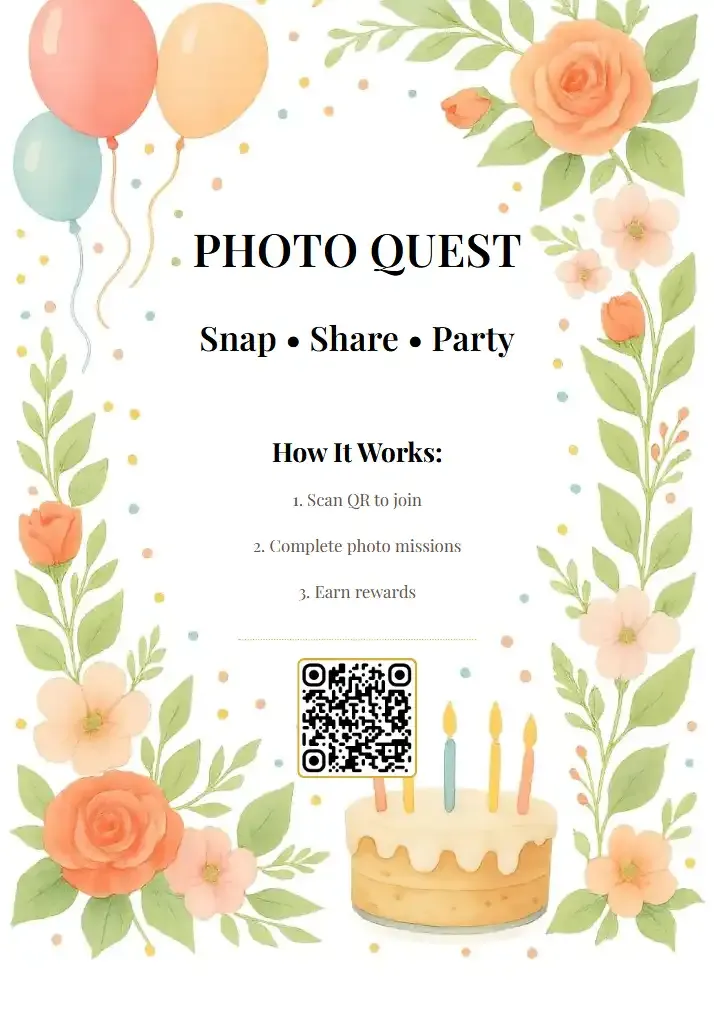
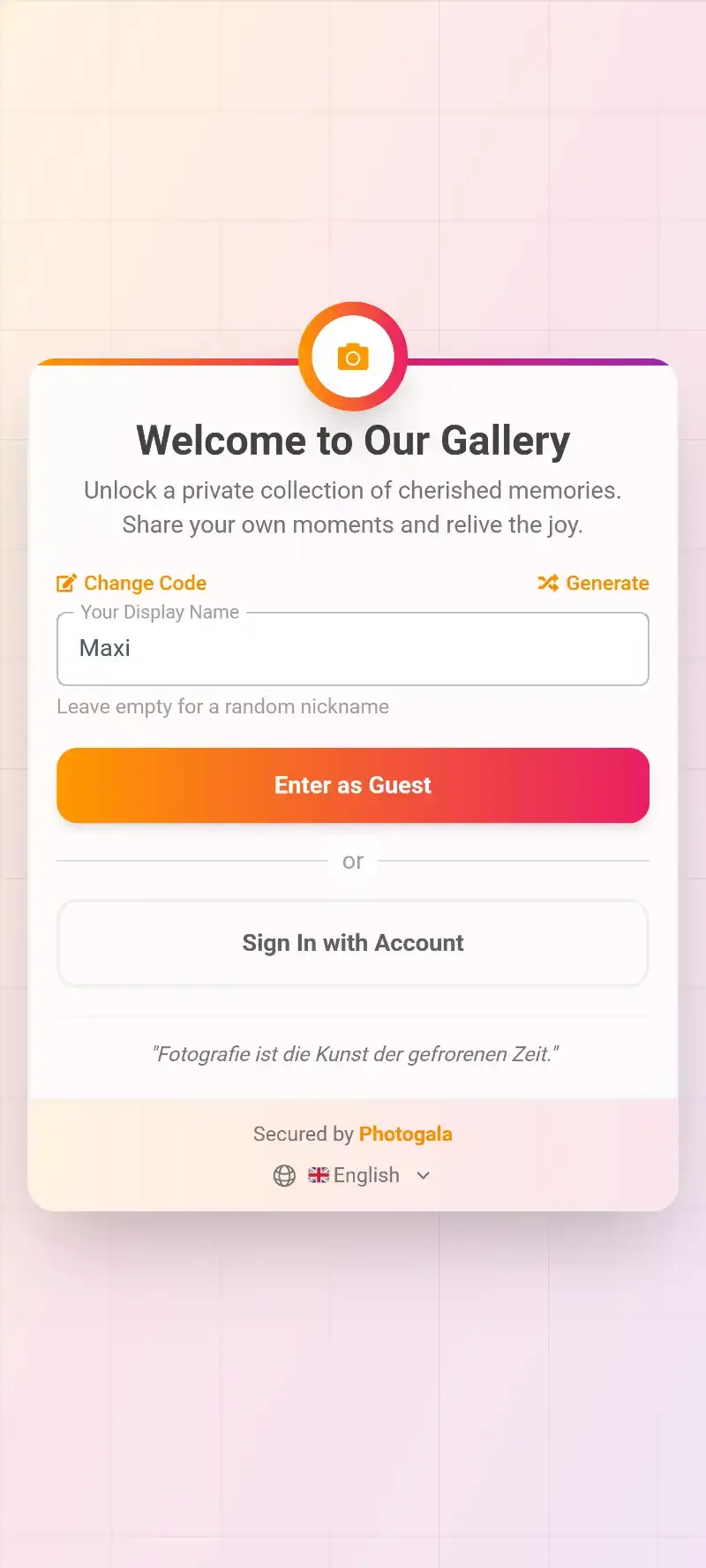
1.Scan the QR code with any smartphone camera
See it in action
Every guest photo in one album – no app.
Where You Put It Matters More Than What You Use
Here's where most people mess up. They create a beautiful QR code, print one copy, tape it near the entrance, and wonder why only 20 guests uploaded anything.
GatherShot's setup guide recommends at least one QR code per table, plus three to five larger signs in high-traffic areas. That sounds like overkill until you realize: people don't notice things the first time. They notice them the third time, when they're standing at the bar and the code is right there on a small acrylic stand next to the cocktail menu.
Best Placement Spots
- On every table (tent cards or coasters work well)
- Near the bar or drink station
- At the entrance and exit
- Next to the photo booth or photo wall screen
- On the back of the menu or event program
- In the restroom (people look at their phones there, guaranteed)
Print Sizes That Actually Work
- Table cards: 7×7 cm minimum (guests scan from about 30 cm away)
- Standing signs: 15×15 cm or larger for bar counters and side tables
- Posters: 20×20 cm QR code on an A3 or A2 poster for walls and easels
One detail that makes a surprising difference: always add a short line of text next to the QR code. Scan to share your photos is enough. A QR code without context is just a cryptic black square, and plenty of guests will walk right past it without a second thought.
Getting Guests to Actually Scan
Perfect placement helps, but some guests still need a nudge. Three approaches work consistently.
Make one announcement. Have the MC, DJ, or host mention it once early in the event. Keep it to a single sentence: there are QR codes on the tables, scan to share photos, no app needed. Don't turn it into a tutorial. The goal is awareness, not a product demo.
Seed the gallery first. Upload three to five photos yourself before the event starts. An empty gallery feels like an empty dance floor. Nobody wants to be first out there. A few setup photos or shots of the venue before guests arrived make contributing feel like joining something already happening, not starting from scratch.
Give people a reason beyond "share your photos." Set up specific photo challenges: best dance move, find something blue, selfie with the DJ. Bespoke Bride's coverage of the QR code trend highlights how these targeted prompts capture in-between moments that professional photographers tend to miss. Photogala lets you build challenges directly inside the gallery, and if you want to turn it into a real competition, you can add a leaderboard with actual prizes.
If you're using a live photo wall or TV screen at the event, place a QR code right next to it. Guests see photos appearing on the big screen and immediately want to add their own. It's the single most effective way to drive uploads.
Three Things That Can Go Wrong
Weak Wi-Fi. If your venue's internet is spotty, uploads will fail and guests will give up after one attempt. Test the Wi-Fi in advance, ideally with multiple devices uploading simultaneously. Some platforms queue photos and send them automatically when connection returns, but prevention beats recovery every time.
The "I'll do it later" trap. Most event photos never leave the phone they were taken on. The motivation to share drops sharply once guests walk out the door and back into their regular lives. This is exactly why real-time features matter so much: a live photo wall, instant likes, a leaderboard updating throughout the night. They create immediate gratification that keeps people uploading while they're still at the event. Afterward is too late.
A single QR code in one location. This is the most common mistake, which is why I keep coming back to it. One QR code near the entrance is not enough. Multiply your touchpoints. If you're spending money on a photo sharing platform instead of renting a photo booth, invest ten extra minutes and a few euros in additional prints. The return on that small effort is enormous.
Test everything the day before your event. Scan the QR code yourself. Upload a photo. Check that it appears in the gallery. Verify the Wi-Fi speed at the actual venue. Small technical hiccups become big problems when 150 guests try uploading at the same time.
The best QR code setup is the one guests barely think about. Scan, tap, done. No friction, no confusion. And those 40 phones full of scattered photos from the opening scenario? They all end up in one gallery before the night is over.
All of this comes with your own event.
Setting it up takes five minutes. You can build and view everything before you decide.
Starting from €39 one-timeOne-time payment — No subscription
- No App Required
- Setup in 5 Minutes
- 30-Day Money Back
“We were really thrilled, and everything went so much more smoothly, from the seating plan all the way to the photo games! Simply great! Highly recommended!”
Written by

I believe event photos should be more than static galleries. They should be live, playful, and unforgettable.
Categories
Related Posts

Bridal Shower Photo Sharing: Collect Every Sweet Moment in One Gallery
Bridal shower photos end up scattered across 15 phones. Here's how to get them all into one gallery before the mimosas wear off.

Maternity Photo Sharing: How to Keep Every Announcement, Bump Shot, and Memory in One Place
Pregnancy announcements land on 4 different apps. Maternity photos get lost in group chats. Here's how to keep every photo in one shared gallery your whole family can access.

Sales Kickoff Photo Sharing: How to Turn a Mandatory Meeting Into a Team Memory
Sales kickoffs are expensive. The photos from them usually disappear into 14 different camera rolls. Here's how to fix that.