How Real Rewards Turn Event Guests into Photographers

Picture a company summer party. Fifty people, catered food, a DJ who's doing his best. The event planner printed table cards with a QR code for the shared photo gallery. By 9 PM, the gallery has 23 photos. Eighteen of them are from the same person in marketing who photographs everything anyway.
Now picture the same party, but with one change: next to the DJ booth, there's a small sign that reads "Upload 10+ photos and claim a free drink at the bar." By 9 PM, the gallery has 187 photos from 31 different people. The guy from accounting who never posts anything on social media uploaded 14 shots of the cornhole tournament.
That's the difference a real reward makes.
The Upload Gap Nobody Talks About
Everyone at your event has a camera in their pocket. That's not the problem. The problem is the gap between taking a photo and actually sharing it. A Mixbook survey found that 50% of Americans do nothing with the photos on their phone. They sit in camera rolls, unseen, unshared, slowly buried under screenshots and grocery lists.
At events, this gap is even worse. Guests snap photos all night, then go home, get busy, and forget. Three weeks later someone sends a WhatsApp message: "Hey, can everyone share their pics?" Two people respond. The rest have already moved on.
Generic platforms like Google Photos or iCloud shared albums don't fix this. They solve the where (a shared folder) but completely ignore the why (motivation to actually upload). As TurtlePic's 2026 comparison of event photo platforms puts it, generic platforms create friction: guests can't find their photos, privacy feels unclear, and nobody wants to manually sort through hundreds of images.
Gamification Gets People Started. Rewards Keep Them Going.
The event industry has been talking about gamification for years. EventMobi lists 19 gamification strategies for events, from scavenger hunts to networking bingo. And it works. Photo challenges ("capture the best dance move," "find the hidden decoration") give guests a reason to pick up their phone. Leaderboards tap into competitive instincts. Points systems make progress visible.
But here's what most event planners miss: gamification without tangible incentives plateaus fast. Points on a screen are fun for the first 20 minutes. After that, only the naturally competitive guests keep going. Everyone else drifts back to the bar.
Visu Network's 2026 guide on event gamification makes this explicit: attendees expect "interactive experiences, quick reward loops and reasons to stay engaged." The key phrase is reward loops. Not just points. Not just badges. Something that closes the loop between effort and payoff in a way guests can feel.
That's where real, physical rewards change the equation.
What "Real Rewards" Actually Means
A real reward is something a guest can claim at the event itself. Not a digital badge. Not a "congratulations" notification. Something tangible they walk up and redeem.
Think: a free cocktail at the bar. A raffle entry for a gift basket. A signed print from the photographer. A small box of chocolates from the dessert table. The reward doesn't have to be expensive. It has to be immediate and physical.
The best rewards cost under €5 per person but feel special. A custom cocktail named after the event, a mini polaroid print, or a reserved seat at the next-round raffle. The perceived value matters more than the actual cost.
Say you're organizing a 150-guest wedding. You set up three achievements: upload 5 photos (earn a drink token), complete the "Capture the First Dance" challenge (earn a raffle entry), and hit the top 10 on the leaderboard by midnight (earn a small gift bag). The total reward budget might be €200. The result: a gallery with 600+ photos from dozens of different perspectives, instead of 80 photos from the same five guests.
The Psychology Behind It
This isn't just about bribing people. The psychology runs deeper than that.
InEvent's research on event gamification describes how task-based missions with corresponding rewards transform passive attendees into active participants. The reward creates what behavioral psychologists call a "completion trigger." Once someone starts a challenge, the visible progress bar and the promised reward make quitting feel like a loss. That's loss aversion doing the heavy lifting, not the €3 cocktail.
There's a social component too. When one guest walks up to the bar with a reward token, others notice. "How'd you get that?" "Oh, I uploaded 10 photos and unlocked a free drink." Suddenly three more people are scanning the QR code. The reward becomes a conversation starter and a social signal at the same time.
One thing I didn't expect: the leaderboard effect compounds with rewards. Without rewards, maybe 10-15% of guests check the leaderboard. With rewards tied to leaderboard positions, that number jumps. People who would never care about a digital ranking suddenly care a lot when the top 5 get a dessert voucher.
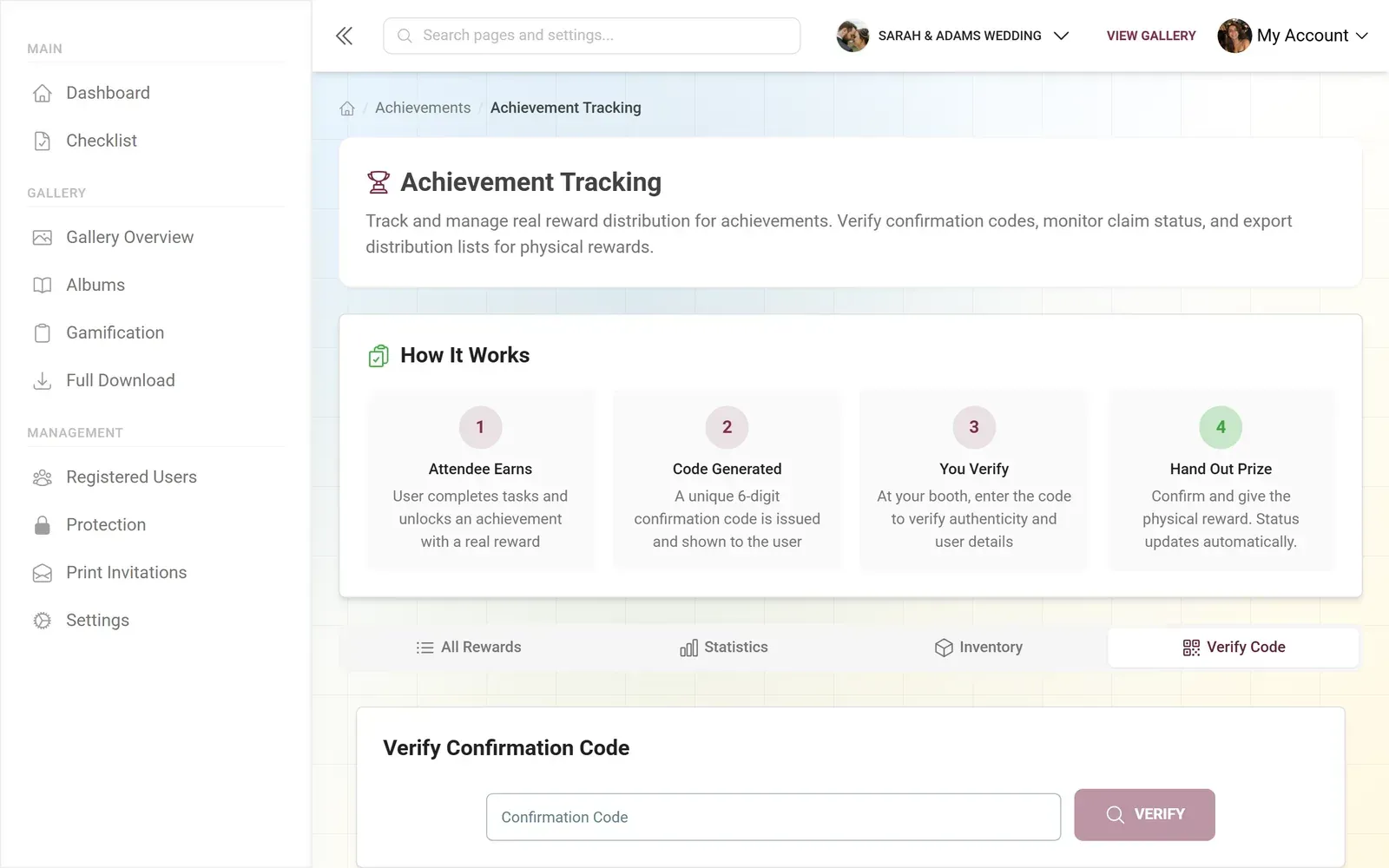
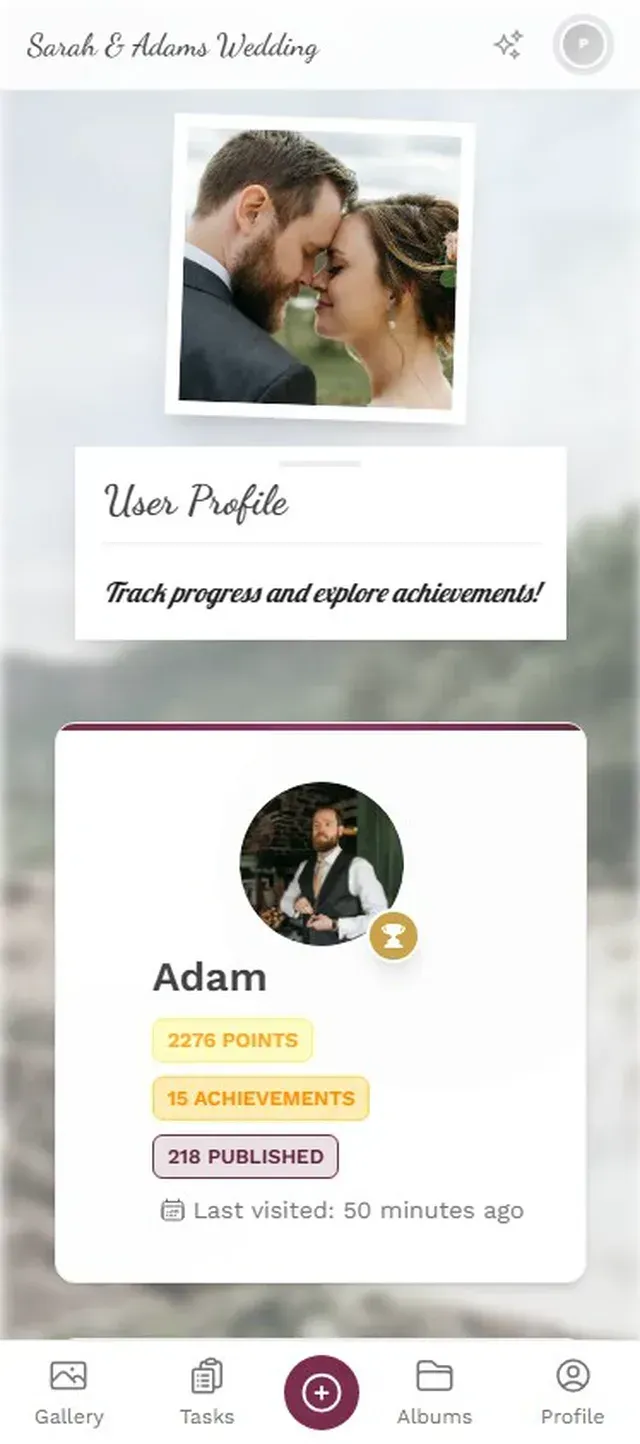
1.Guests claim rewards directly from their phone
How This Works in Practice
Setting up a reward system sounds complicated. It's not, if the platform handles the logistics for you. Here's how it works with Photogala's reward system:
Setting Up Real Rewards
Create your challenges and achievements
Set up photo tasks ("Best sunset shot", "Group photo with the couple") and achievements ("Upload 10 photos", "Complete 3 challenges"). Use templates to get started fast.
Attach rewards to milestones
Connect real rewards to specific achievements. Upload 5 photos = drink token. Top 10 on leaderboard = gift bag. Complete all challenges = raffle entry. Set inventory limits so you don't over-promise.
Print QR codes and table cards
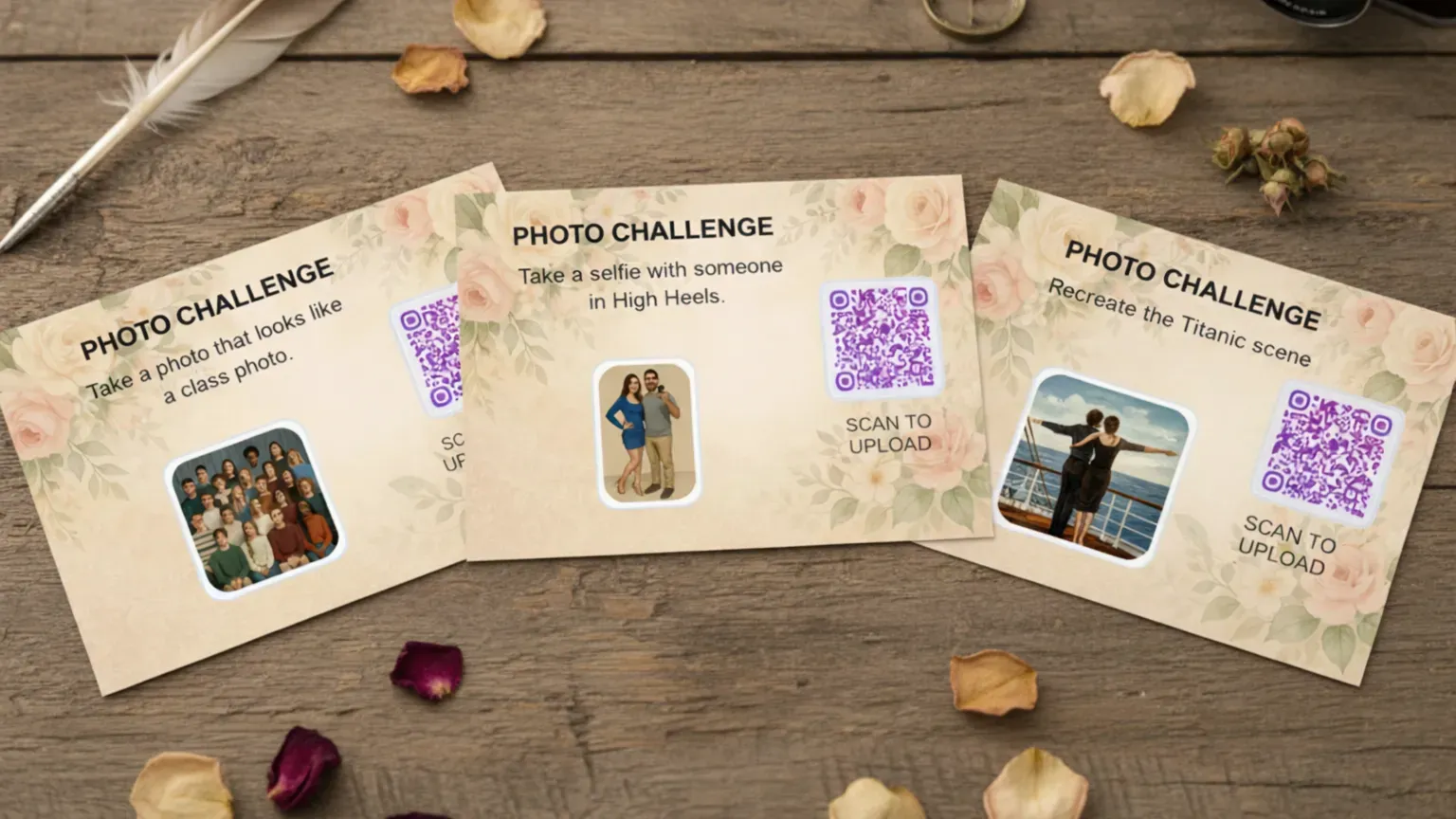
Place printable QR task cards on tables, at the bar, near the dance floor. Guests scan, see the challenge, and start uploading immediately.
Manage claims at the event
When a guest unlocks a reward, they show their phone screen at the redemption point (bar, host table, etc.). One tap to mark it as claimed. Real-time inventory tracking means you always know what's left.
The inventory management piece matters more than you'd think. Say you budgeted for 30 drink tokens. Photogala tracks how many have been claimed in real time, so you can see when you're running low and adjust. No awkward "sorry, we ran out" moments.
See it in action
Every guest photo in one album – no app.
What Rewards Work Best (And What Doesn't)
Not all rewards are created equal. After looking at how different event types use incentive systems, a pattern emerges.
Weddings
Drink tokens are the obvious choice, and they work. But the most effective wedding reward is something sentimental: a small printed photo from the gallery, a personalized thank-you card from the couple, or a spot in a "best photo" announcement during the speeches. Weddings have built-in emotional stakes. Lean into them.
A practical setup for a 150-guest wedding: three achievement tiers. Upload 3 photos (small thank-you), upload 10+ photos (drink token), and complete the "Capture the Bouquet Toss" challenge (raffle entry for a gift). Budget: around €150-200 total.
Corporate Events
Corporate events need rewards that don't feel childish. Extra raffle entries, early access to event swag, reserved parking for the next quarter, or a gift card work well. Skip the plastic trophies.
For a team-building day with 40 people, tie rewards to team leaderboard positions, not individual ones. "Team with the most creative photos wins lunch on the company" is simple and effective. It also gets people collaborating instead of just competing.
If your company is planning a holiday party, here's a related guide on collecting event photos at corporate celebrations that covers the logistics in more detail.
Festivals and Multi-Day Events
Multi-day events have a unique advantage: you can spread rewards across days. Day 1 achievement unlocks a perk for Day 2. This keeps engagement sustained instead of front-loaded. Rewards like backstage access, priority seating, or meet-and-greet entries work well because they're experiential, not material.
The one reward that never works: generic "points" with no redemption path. If guests earn points that don't convert to anything tangible at the event, engagement drops off a cliff after the novelty wears off. Always close the loop.
The Honest Trade-offs
Real rewards aren't free. There's a budget involved, even if it's modest. A 200-guest wedding with three reward tiers might cost €150-250 in drink tokens and small gifts. That's not nothing, but compare it to the €500+ you'd spend on a photo booth rental that captures 60 staged photos instead of 600 candid ones.
There's also a setup effort. Someone needs to decide the reward tiers, stock the physical items, and manage the redemption point during the event. Photogala's inventory system handles the tracking side, but you still need a person at the bar (or wherever) who knows the drill. It's 15 minutes of briefing, not a full-time job, but it's not zero effort either.
And one more thing: Photogala's full reward system (with inventory management, real-world redemption, and advanced unlock conditions) is only available on the Deluxe plan at €119. The Premium plan at €69 gives you challenges, achievements, and the leaderboard, but not the physical reward integration. For smaller events where digital badges and leaderboard bragging rights are enough, Premium works fine. For events where you want to close the loop with tangible incentives, Deluxe is the way to go.
Challenges That Drive the Most Uploads
The reward is the payoff. But the challenges are the engine. Some photo challenges generate way more engagement than others.
The best challenges are specific, slightly silly, and easy to understand in under 5 seconds. "Take a photo of the funniest dance move" beats "Capture a great moment" every time. Specificity removes decision paralysis. Silliness gives people permission to participate without feeling self-conscious.
Photo challenges and how they boost guest engagement goes deeper on this topic. The short version: aim for 5-8 challenges per event. Too few and there's nothing to do after the first 10 minutes. Too many and guests feel overwhelmed.
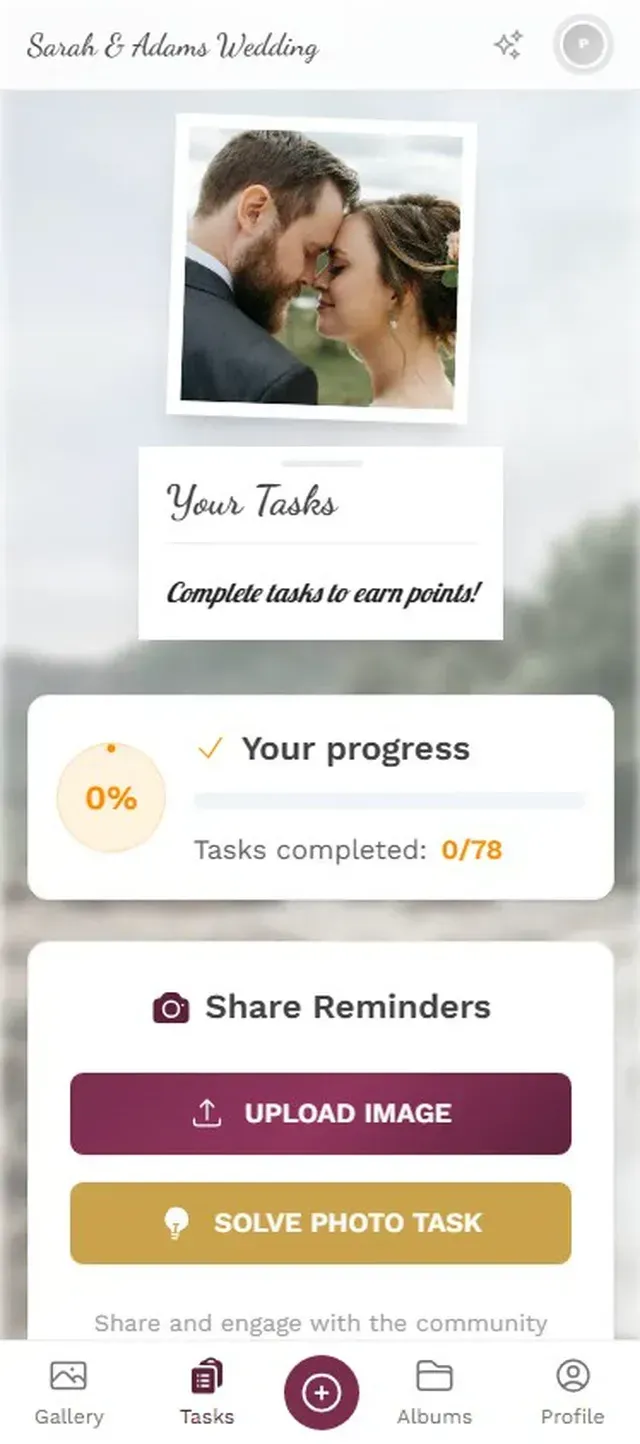
1.Guests browse available challenges from their phone
Bringing It Together
The formula is straightforward: QR code access (no app install, no friction) + photo challenges (specific, fun tasks) + leaderboard (visible progress and competition) + real rewards (tangible incentive to keep going). Each layer builds on the previous one. Remove any layer and the system still works, just less effectively.
The real rewards layer is what separates "we got some nice guest photos" from "we got 600 photos and guests were talking about the photo challenges at brunch the next morning." It's the difference between participation and enthusiasm.
Imagine setting up a gallery for your next event. Fifteen minutes to create it. Another ten to set up challenges and attach rewards. Print the QR codes, brief the bartender on drink tokens, and you're done. By the end of the night, you have a gallery full of moments no professional photographer would have captured: the kids' table food fight, the CEO doing karaoke, the quiet moment between two old friends catching up in the corner.
Those are the photos people actually want to look at again.
All of this comes with your own event.
Setting it up takes five minutes. You can build and view everything before you decide.
Starting from €39 one-timeOne-time payment — No subscription
- No App Required
- Setup in 5 Minutes
- 30-Day Money Back
“Excellent service and great pictures! Photogala fully met our expectations at the event. The value for money is unbeatable. Absolutely recommended! The seating plan saved us a lot of hassle!”
Written by

I believe event photos should be more than static galleries. They should be live, playful, and unforgettable.
Categories
Related Posts

Bridal Shower Photo Sharing: Collect Every Sweet Moment in One Gallery
Bridal shower photos end up scattered across 15 phones. Here's how to get them all into one gallery before the mimosas wear off.

Maternity Photo Sharing: How to Keep Every Announcement, Bump Shot, and Memory in One Place
Pregnancy announcements land on 4 different apps. Maternity photos get lost in group chats. Here's how to keep every photo in one shared gallery your whole family can access.

Sales Kickoff Photo Sharing: How to Turn a Mandatory Meeting Into a Team Memory
Sales kickoffs are expensive. The photos from them usually disappear into 14 different camera rolls. Here's how to fix that.