How to Organize and Sort Event Photos After the Party Is Over

The morning after a good party, you wake up with two things: a mild headache and 347 new photos on your phone. Your partner has another 200. The friend who appointed herself photographer? She's sitting on 300 more. And that's just the people you know about.
Between everyone who attended, there are probably 800+ photos scattered across a dozen devices. Most of them will never leave those devices. According to a Photobucket guide on event photo organization, the single biggest mistake people make is waiting. You tell yourself you'll sort through them "this weekend." Then three weekends pass. Then six months. Then you find 40 blurry shots of the cake while looking for something else entirely.
This guide is about what happens in the 48 hours after an event, when photos are still fresh, motivation is still high, and the window for actually doing something useful with them hasn't closed yet.
The 48-Hour Window
Here's a pattern you've probably seen. Someone creates a WhatsApp group called "Sarah's 30th PHOTOS!!" the night of the party. Twelve people join. Three post photos. By Tuesday, it's a ghost town.
Photo organization has a half-life. Every day you wait, the odds of actually doing it drop by roughly half. Not a scientific number, but ask yourself: how many event photo folders have you started and never finished?
The fix is unglamorous. You need a system, and you need to start within 48 hours of the event ending. Not because the photos expire, but because your memory of which shots matter does.
Step 1: Collect Everything Into One Place
This is where most people fail. The photos exist on 8, 12, maybe 20 different phones. Getting them into a single location is the hardest part of the entire process.
Your options, roughly ranked by how well they actually work:
- QR code gallery (set up before the event): Guests scan a code and upload directly to a shared gallery. Everything lands in one place in real time. No collection step needed afterward.
- Shared album (iCloud, Google Photos): Works if everyone uses the same ecosystem. Falls apart when half the group has Android and the other half has iPhones.
- AirDrop / Nearby Share: Great for 3 people sitting next to each other. Terrible for 30 guests after they've gone home.
- "Send me your photos" message: The classic. Gets about a 20% response rate on a good day.
The honest truth: the best time to solve the collection problem is before the event starts. If you set up a shared gallery with a QR code on the tables, every guest uploads throughout the night. No chasing people afterward. No WhatsApp group that dies after 48 hours.
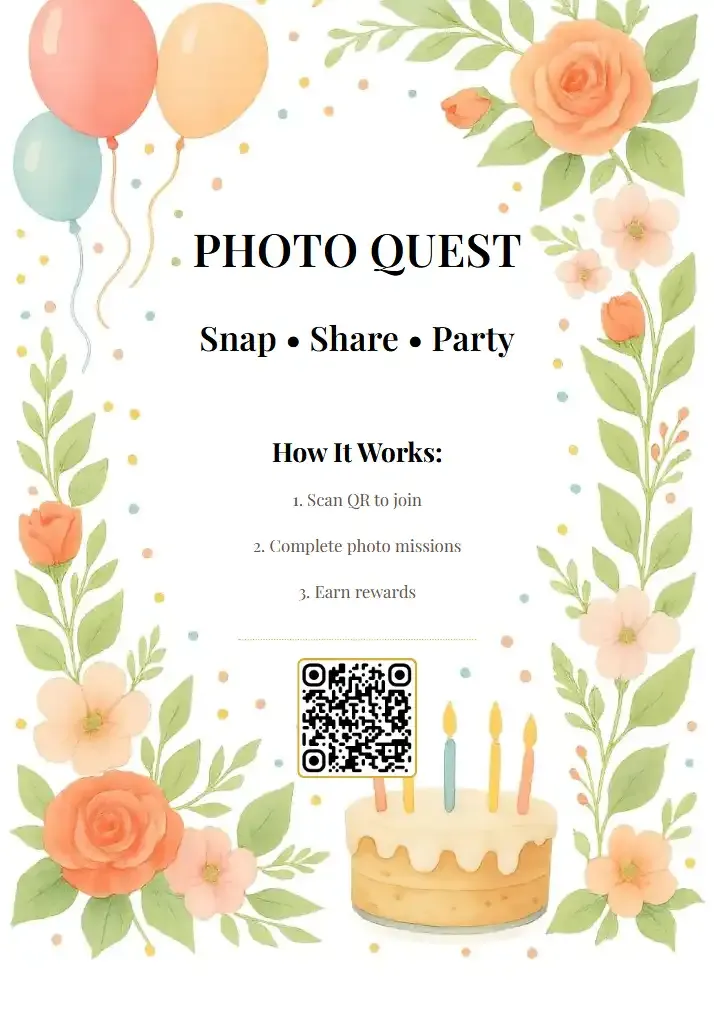
1.Guests scan and upload from their phones. No app install needed.
If you didn't set that up and you're reading this after the fact, go with a shared album or cloud folder. Create it now, send the link to attendees, and give them a specific deadline. "Drop your photos in here by Friday" works better than "whenever you get a chance."
The deadline trick: People respond better to specific deadlines than open requests. "Share your photos by this Friday" will get 3x the response of "send me your photos when you can." Add a reason: "I'm making a photo book and need them by Friday" works even better.
Step 2: The Brutal First Pass
You now have, say, 847 photos in one place. Time to cut.
This is where most people get stuck. They scroll through all 847, can't decide what to keep, and close the app. A professional photographer with over 1.2 million files in their collection uses software specifically designed for this, because manual culling at scale simply doesn't work.
You're not dealing with a million files, but 847 is still too many to evaluate one by one. So don't. Do a brutal first pass where you only delete the obvious junk:
- Blurry shots. If it's blurry, it's gone. No exceptions. You will never look at a blurry photo of the dance floor and think "I'm glad I kept this."
- Near-duplicates. Someone took 7 photos of the same toast. Keep the best one, delete the rest.
- Accidental shots. Pockets, floors, ceilings. You know the ones.
- Unflattering photos nobody wants. The mid-sneeze face, the unfortunate angle. Be kind.
This pass should take 15-20 minutes and cut your collection by 30-40%. You should be down to roughly 500-550 photos. That's still a lot, but it's a manageable lot.
Don't agonize over edge cases during this pass. If you hesitate for more than 3 seconds, keep the photo and move on. You'll catch it in the second round.
Step 3: Sort Into Moments, Not Categories
Here's where people make a mistake that sounds smart but isn't. They create folders like "Food," "Dancing," "Group Photos," "Decorations." Logical, right?
Wrong. Nobody revisits photos by category. You don't think "I want to see the food photos from Sarah's birthday." You think "remember that moment when her dad tried to carry the cake and almost dropped it?"
Sort by moments, not categories. A moment is a cluster of photos from the same scene, time, or emotional beat. The arrival. The toast. The dance-off. The late-night pizza run. The goodbye hugs.
Most events have 5-10 distinct moments. Create a folder or album for each. Some photos won't fit neatly into any moment. That's fine. Put them in a "General" folder and stop worrying about it.
Why moments work better: When you look back at event photos a year later, you're reliving a story, not browsing a database. Moments preserve the narrative arc of the evening. Categories flatten it into a filing cabinet.
See it in action
Every guest photo in one album – no app.
Step 4: Pick Your Highlights
Out of 500 photos, about 30-50 will be genuinely great. The ones that make someone smile, tell a story, or capture a feeling. These are your highlights.
Go through your moment folders and star or flag 5-10 photos per moment. Look for:
- Genuine emotion. Laughing, hugging, dancing, surprised faces. Not posed smiles.
- Context. A photo that shows the setting, the decorations, the vibe. Future-you will appreciate the scene-setters.
- Action. Someone mid-toast, mid-dance, mid-cake-cutting. Movement is more interesting than posing.
- The unexpected. The dog that crashed the party. The toddler asleep under the table. The accidental photobomb that turned out perfect.
These 30-50 highlights are the collection you'll actually share, print, or put in an album. The rest stay in the archive as B-roll.
Step 5: Share the Right Photos With the Right People
Nobody wants to scroll through 500 photos. Sharing the entire dump is lazy, and people won't look at it.
Share your curated highlights. But think about who wants what. The birthday person wants all the photos of themselves. The couple who left early wants the group shots from before they left. The parents want the family moments.
This is where a dedicated photo gallery pays off. Instead of sending different subsets to different WhatsApp groups, a shared gallery lets people browse everything and save what they want. If the gallery has face recognition, people can filter to find their own photos instantly, which solves the "find my photos" problem without you having to manually sort for 15 different people.
1.Face recognition lets guests find their own photos instantly.
A practical approach from PhotoWorkout suggests combining cloud storage with a clear folder structure, but for event photos specifically, a purpose-built gallery beats generic cloud folders. The browsing experience matters when 20 people are all trying to find their favorites.
The Long Game: Archive Properly
Six months from now, will you be able to find these photos? A year? Five years?
The U.S. National Archives' preservation guidelines stress one principle above all: preventing loss is easier than recovering from it. For digital photos, that means:
- Name the folder clearly. "2026-03-Sarah-30th-Birthday" beats "Party pics" or "IMG_folder_2."
- Back up to at least two places. Phone + cloud. Or cloud + external drive. One copy is no copy.
- Keep the originals. Don't compress or resize your archive copies. Storage is cheap. Original-quality photos are irreplaceable.
If you used a QR code gallery during the event, the archive problem is already solved. Everything lives in one gallery with the event name, date, and all uploads organized chronologically. You can bulk-download the entire thing as a ZIP whenever you need a local backup.
What If You're Planning the Next Event?
Everything above gets dramatically easier if the collection step happens during the event, not after it. Setting up a shared gallery with a QR code takes about two minutes. Guests scan it from their seat, upload from their phone's browser (no app to install), and by the time the party ends, you already have every photo in one place.
No WhatsApp groups. No "send me your photos" messages. No chasing people for weeks.
If you want to go further, photo challenges give guests prompts ("take a photo of the funniest dance move") that generate more interesting content than the usual posed group shots. The photos organize themselves by challenge, which means your sorting step is half-done before you even start.
The Quick Version
Collect within 48 hours
Get all photos into one place before motivation fades. QR gallery, shared album, or cloud folder.
Delete the obvious junk
Blurry, duplicate, accidental shots. Takes 15 minutes, cuts volume by 30-40%.
Sort by moments
Group photos by scenes and events, not categories. 5-10 moments per event.
Curate and share highlights
Pick 30-50 best shots. Share those, not the full dump. Let people browse and save their own.
If you're curious about what a shared event gallery actually looks like, we wrote a deeper guide on how to organize photos after an event that covers the tools side in more detail. And if you're weighing different ways to share photos with a group, this comparison of 6 methods breaks down what works and what doesn't.
All of this comes with your own event.
Setting it up takes five minutes. You can build and view everything before you decide.
Starting from €39 one-timeOne-time payment — No subscription
- No App Required
- Setup in 5 Minutes
- 30-Day Money Back
“Excellent service and great pictures! Photogala fully met our expectations at the event. The value for money is unbeatable. Absolutely recommended! The seating plan saved us a lot of hassle!”
Written by

I believe event photos should be more than static galleries. They should be live, playful, and unforgettable.
Categories
Related Posts

Bridal Shower Photo Sharing: Collect Every Sweet Moment in One Gallery
Bridal shower photos end up scattered across 15 phones. Here's how to get them all into one gallery before the mimosas wear off.

Maternity Photo Sharing: How to Keep Every Announcement, Bump Shot, and Memory in One Place
Pregnancy announcements land on 4 different apps. Maternity photos get lost in group chats. Here's how to keep every photo in one shared gallery your whole family can access.

Sales Kickoff Photo Sharing: How to Turn a Mandatory Meeting Into a Team Memory
Sales kickoffs are expensive. The photos from them usually disappear into 14 different camera rolls. Here's how to fix that.