How to Set Up Photo Sharing for a Destination Wedding Abroad


Thirty-seven guests flew to a village outside Positano. Three days of welcome dinners, the ceremony on a cliff terrace, a midnight swim nobody planned. The couple's photographer delivered 412 gorgeous, editorial shots six weeks later. Beautiful work.
But somewhere between those 37 phones, there were another 900+ photos. The candid ones. The groom's dad trying to figure out Italian sunscreen. Two flower girls asleep under a table. The best man's speech from six different angles because everyone was filming it.
Most of those photos never made it off the phones they were taken on. A few ended up in a WhatsApp group that died after two weeks. Some got AirDropped between iPhone users at breakfast the next morning. The Android guests? Out of luck.
Destination weddings have a photo problem that regular weddings don't. Your guests are leaving the country. Once they board that return flight, the window to collect their photos shrinks to almost nothing. A 2023 survey by Deseret News found that 80% of people have photos on their phone they haven't looked at since taking them. For destination wedding guests, that percentage is probably higher: the vacation ends, real life starts, and the photos just sit there.
This guide covers how to set up a photo sharing system for a destination wedding that actually works, even with spotty resort WiFi and guests who don't speak the same language.
Why Destination Weddings Break Normal Photo Sharing
A local wedding has built-in advantages. Guests drive home, sync their phones overnight, and have weeks to send photos through whatever channel works. Destination weddings strip all of that away.
The first problem is connectivity. That charming Tuscan villa or Thai beach resort probably doesn't have the kind of WiFi that lets 30 people upload high-resolution photos simultaneously. Cellular data might be expensive or nonexistent depending on roaming plans. Guests aren't going to burn through their international data to AirDrop photos to someone they met two days ago.
The second problem is the timeline. Destination weddings are compressed experiences. Guests arrive, there's a welcome dinner, the ceremony, maybe a day-after brunch, and then everyone scatters back to their home countries. You have maybe 48-72 hours where everyone is physically together. After that, collecting photos requires chasing people across time zones via text messages they'll forget to answer.
The third problem is the mix of devices and platforms. Your British friends have iPhones. Your partner's German colleagues use Android. The photographer's assistant shoots on a mirrorless camera with an SD card. iCloud Shared Albums? Only works if everyone has Apple IDs. Google Photos shared library? Half your guests don't use Google accounts. WhatsApp groups work until you realize it compresses every image down to roughly the quality of a screenshot.
WhatsApp compresses photos significantly when sent through chat. A 12-megapixel photo drops to roughly 1-2 megapixels. If you want original quality guest photos, WhatsApp isn't the answer.
The Setup That Actually Works
The simplest approach for destination weddings is a browser-based photo gallery with a QR code. No app installs, no account creation, no platform lock-in. Guests scan a code, open a webpage, and upload. The photos appear in a shared gallery in real time.
This matters more at destination weddings than local ones because you can't assume anything about your guests' phones, data plans, or willingness to download yet another app while they're on vacation. A QR code works on every smartphone with a camera, which in 2026 is every smartphone.
Destination weddings have surged 32% year-on-year according to The Knot's 2024 Global Wedding Trends Report. And QR codes are already a wedding staple, identified as a key technology trend. The combination makes sense: guests who flew internationally for your wedding are tech-comfortable enough to scan a code. They just don't want friction.
Set Up Your Photo Gallery in 3 Steps
Create the gallery before you travel
Set up your event gallery, customize the branding to match your wedding theme, and generate the QR code. Do this at home where you have reliable internet, not at the venue.
Print QR codes and place them everywhere
Table cards, welcome bags, ceremony programs, the bar counter, bathroom mirrors. Anywhere guests will see them. Include a short instruction in the languages your guests speak.
Let guests upload on their schedule
Guests scan and upload whenever they have WiFi or data. Photos appear in the shared gallery in real time. No app downloads, no sign-ups.
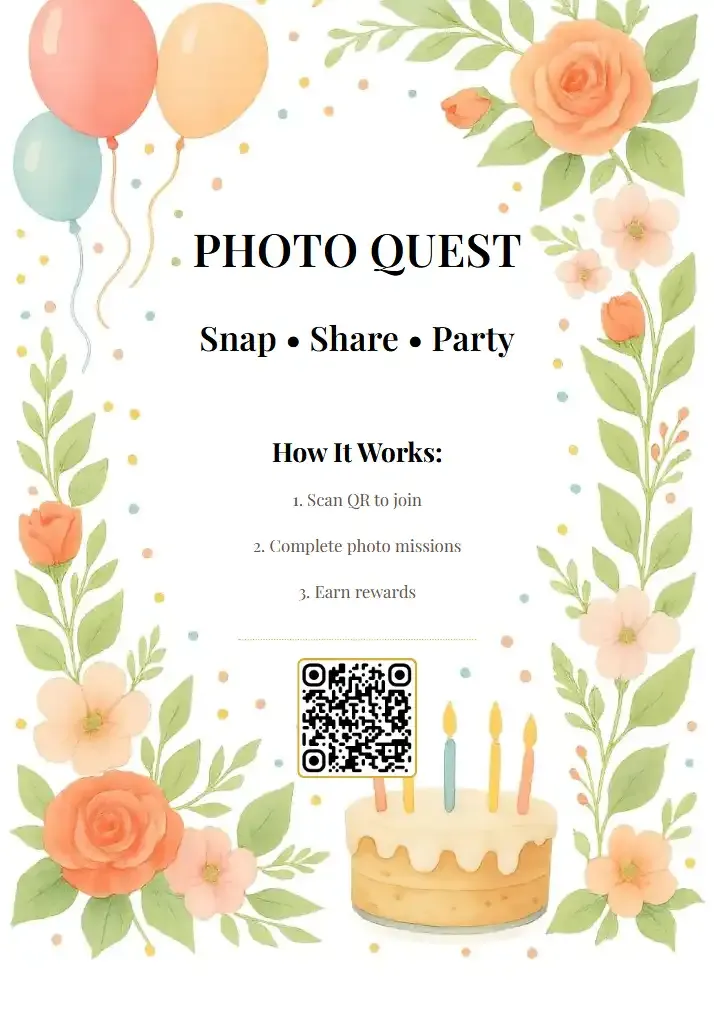
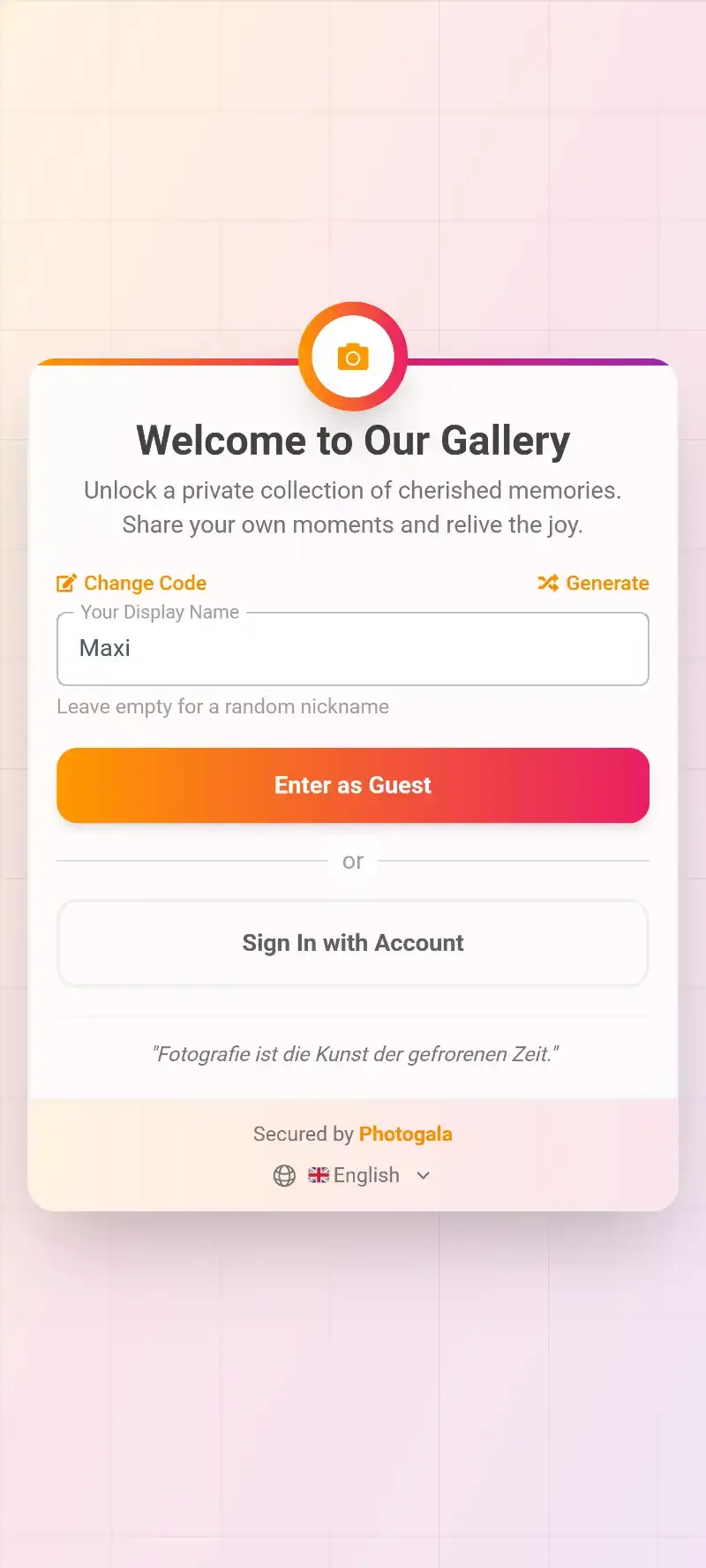
1.Guests scan the QR code from any printed material
Timing Is Everything (And You Have Less of It)
At a local wedding, you can send a reminder email a week later asking guests to upload their photos. At a destination wedding, that email lands when guests are already back in their routines, buried under a week of missed work emails. The photos on their phone feel like they belong to a different timeline.
The trick is to get guests uploading during the event, not after. Set up the gallery and QR codes before the welcome dinner on day one. Not the ceremony day. Day one.
Here's why that matters: by the time guests sit down for dinner, they've already taken photos at the airport, the hotel, the first walk around town. Those casual pre-wedding shots are often the most fun ones. If the gallery is already live, the early uploaders create momentum. Other guests see photos appearing and think, "I should add mine too."
Place a QR code in the welcome bag. Guests usually open these in their hotel room where they have WiFi. It's the perfect low-pressure moment to scan the code and upload a few arrival photos. By the ceremony, they already know how the system works.
For the ceremony and reception, physical QR placements do the heavy lifting. Table cards are obvious. But the spots that get the most scans tend to be where people are standing around waiting: the bar, the buffet line, the bathroom. A small sign that says "Share your photos" with a QR code next to the soap dispenser sounds ridiculous. It works.
See it in action
Every guest photo in one album – no app.
Dealing with Terrible WiFi
This is the part that catches people off guard. You've found the perfect cliffside venue in Santorini. The sunset is unreal. The WiFi is a single router shared between the kitchen, the front desk, and 40 wedding guests trying to upload photos simultaneously.
A few practical fixes:
- Ask the venue about bandwidth before you book. Not just "do you have WiFi" but "can 30 people upload photos at the same time?" Most venues will be honest about their limitations.
- Consider a portable hotspot. A local SIM card in a pocket WiFi device can handle 10-15 connections. Cost: usually €20-40 for a few days of data in most European countries.
- Tell guests they can upload later. This is the real advantage of a persistent gallery link. Photos don't have to be uploaded at the venue. Back at the hotel, at the airport, from home the next week. The gallery stays open.
- Stagger the uploads. If WiFi is truly limited, encourage guests to upload their favorites first (5-10 best shots), then add the rest when they have better connectivity.
The browser-based approach helps here too. Native apps often try to sync everything at once, which chokes a weak connection. A web upload lets guests select specific photos and upload them one batch at a time.
The Photo Wall Trick for Small Destination Weddings
Destination weddings tend to be smaller, more intimate affairs. That intimacy actually makes a live photo wall more impactful, not less. At a 200-person local wedding, a photo wall is a nice background element. At a 30-person dinner on a terrace in Provence, it becomes the centerpiece of the evening.
Picture this: a single screen or projector showing guest photos in real time during the reception dinner. Someone uploads a photo of the sunset ceremony. It appears on screen. The table erupts. Someone else uploads that embarrassing airport selfie from day one. Laughter. The photo wall turns a shared gallery into shared entertainment.
1.Guest photos appear on screen in real time
The technical setup is simpler than it sounds. Most modern smart TVs can open a browser. Open the photo wall URL, go full screen, done. If the venue has a projector, even better. You just need one device with an internet connection showing the gallery's live view.
Photo Challenges Work Differently Abroad
Photo challenges (pre-set prompts like "capture the best sunset shot" or "find something blue") work at any wedding. But at destination weddings, they take on a different character because the location itself becomes part of the game.
Think about what's unique to your destination. Getting married in Portugal? Challenge guests to photograph the most colorful tile they can find. A Thai beach wedding? "Best underwater photo" or "capture a street food moment." These location-specific challenges turn the wedding trip into a shared adventure, not just a ceremony with travel attached.
What makes Photogala's challenges interesting for this is the example photo feature. You can attach a reference image to each challenge showing guests what you're looking for. Set a photo of a classic Italian hand gesture as the example, and challenge guests to recreate it with locals. Or use photo roulette mode, where guests get a random reference photo and have to mimic it. At a destination wedding, where everyone's already in an adventurous mood, these creative challenges can produce genuinely hilarious results.
One honest caveat: the gamification features (leaderboard, achievements, points) require the Premium plan. The Plus plan includes unlimited basic photo challenges, which is enough for most small destination weddings. But if you want the competitive element that really drives uploads, you'll need to step up a tier.
What About the Alternatives?
Several tools exist for wedding photo collection. Memento offers QR code collection with photo moderation and original quality downloads. Kululu has a photo wall feature that works via web link on any device. Both are solid options for basic collection.
The gap shows up when you want more than a shared folder. Most alternatives handle the "collect" part fine but don't give you tools to make guests want to share. No challenges, no leaderboard, no way to turn photo sharing into an activity rather than a chore. For a destination wedding where you have a captive audience for 2-3 days, that engagement layer can be the difference between 80 photos and 400.
There's also WedUploader, which takes a different approach: uploads go directly to Google Drive. Smart idea, but it means every photo lives in your Google storage, and guests need a Google account, which circles back to the platform lock-in problem.
Related: Your Destination Wedding Photos Are Trapped on 60 Phones
Why destination wedding photos get lost and how to prevent it
VisitThe Pre-Flight Checklist
Do all of this before you leave for the destination. Not at the venue. Not the night before the ceremony. Before you pack your suitcase.
- Create your gallery and generate the QR code. Customize the branding, set up albums (welcome dinner, ceremony, reception, day-after), enable moderation if you want to filter what hits the photo wall.
- Print QR materials. Table cards, welcome bag inserts, a poster for the ceremony entrance. Bring more than you think you need. Laminate them if it's an outdoor wedding; Mediterranean wind is unforgiving.
- Test the upload flow yourself. Scan the QR code with your own phone. Upload a photo. Make sure it works. Do this on both iPhone and Android if possible.
- Brief your maid of honor or best man. Give one person the job of pointing guests to the QR code during the welcome dinner. A single nudge from a real person beats ten printed signs.
- Set up photo challenges that match your destination. Write them before you leave so you're not doing it over hotel WiFi at midnight.
If you're using a photo wall, add one more step: test the display URL on whatever device you plan to use at the venue. Ask the venue if they have a TV or projector available, and whether it can connect to WiFi.
Destination weddings create memories that feel different from anything else. The combination of travel, intimacy, and unfamiliar surroundings produces photos with a character you can't replicate at a hometown venue. The only question is whether those photos end up in one place or scattered across 37 phones on three continents.
Set up the gallery before you pack. Print the QR codes. Put one in every welcome bag. Then forget about it and enjoy your wedding. The photos will take care of themselves.
All of this comes with your own event.
Setting it up takes five minutes. You can build and view everything before you decide.
Starting from €39 one-timeOne-time payment — No subscription
- No App Required
- Setup in 5 Minutes
- 30-Day Money Back
“I use PhotoGala Deluxe and I'm absolutely thrilled. It was the perfect solution for documenting a sports event. Uploading and downloading via the link is a breeze for every participant. What won me over most were the photo wall and the slideshow – both are quick to set up and look really professional. Big praise also to Peter from the PhotoGala team: he's very easy to reach by email, replies quickly and even took my suggestions on board and added new features that made my slideshow even better. You rarely get support this dedicated. A clear 5-star recommendation!”
Written by

I believe event photos should be more than static galleries. They should be live, playful, and unforgettable.
Categories
Related Posts

Bridal Shower Photo Sharing: Collect Every Sweet Moment in One Gallery
Bridal shower photos end up scattered across 15 phones. Here's how to get them all into one gallery before the mimosas wear off.

Company Retreat Photo Sharing: How to Actually Keep the Memories
Most offsite photos die on individual phones. Here's how to collect, share, and actually use every photo from your next company retreat.

Neighborhood Block Party Photo Sharing: How to Turn 40 Strangers Into One Shared Album
Block parties create great photos — and zero way to share them. Here's how a QR code gallery turns your street into a connected community.