Your Destination Wedding Photos Are Trapped on 60 Phones


Sixty Phones, Three Countries, Zero Shared Photos
Picture a villa in southern Italy. Sixty-five guests, four days of celebrations. A welcome dinner under string lights on the terrace. The ceremony surrounded by olive trees with a sunset that no one could have planned. A lazy pool day the morning after, where half the group is still in wedding mode and the other half is pretending they didn't drink that much. The couple hired an excellent photographer who captures the ceremony beautifully: 400 polished shots, delivered three weeks later. But the terrace dinner, the morning yoga, the pool? Those moments live on 65 phones belonging to people who are about to scatter back to London, Melbourne, and Toronto.
Someone starts a WhatsApp group: Marco & Julia Wedding Pics 🥂. Eight people upload a handful of photos. Two send compressed videos that look like they were shot through a screen door. The rest promise to share theirs later. They don't. Three months pass. The couple has the photographer's album and roughly 35 guest photos. Four hundred other candid moments from the best week of their lives? Trapped on phones across three time zones.
This is the collecting-guest-photos problem on hard mode. Destination weddings amplify every friction point: different carriers, international roaming, unreliable venue wifi, and guests who are genuinely on vacation and not thinking about photo logistics.
Why the Usual Fixes Fall Apart Abroad
Shared iCloud albums sound reasonable until you remember that roughly half of any international guest list uses Android. Google Photos requires a Google account, and not every guest has one or wants to create one for your wedding. Both solutions demand that each person downloads something, signs in, navigates a sharing interface, and then actually remembers to add their photos. At a destination wedding where people are juggling sunscreen, passports, and unfamiliar taxi apps, that's a lot to ask.
WhatsApp is the universal fallback, but at destination weddings it becomes a mess. International roaming throttles data speeds. Villa wifi barely handles email. That 45-second video of the first dance sits at uploading... until 2 AM when the guest finally gets back to the hotel. Multiply that across 65 people over four days and you end up with five fragmented group chats, heavily compressed images, and a thread so long that nobody will ever scroll through it.
Wifi at destination wedding venues (villas, castles, beach resorts) is notoriously unreliable. A destination wedding planning guide recommends checking connectivity months in advance. If the venue wifi can barely handle email, it can't handle 65 guests uploading photos simultaneously.
There's no perfect solution when connectivity is limited. But the approach that gets closest is one that works on any phone, requires no app install, and lets guests upload whenever they find a decent connection. Even if that's at midnight from the hotel lobby.
A QR Code Works in Puglia, Bali, and Banff
QR code photo sharing cuts through the logistical mess. You create a gallery, get a QR code, and share it. Guests scan with their phone camera, the gallery opens in the browser, and they upload. No app, no account, no what's the password? conversations over dinner. Platforms like WedTrove have shown that QR-based photo collection works across countries and cultures, with over a million guest photos gathered across 50+ countries.
How it works
Create your gallery
Pick a name, upload a cover photo, choose your colors. Two minutes from your couch before you fly.
Print the QR code
Slip it into welcome bags, print it on table cards, or add it to the back of the ceremony program.
Photos arrive from anywhere
Guests upload from the venue, the hotel, or the airport lounge. Everything lands in one shared gallery.
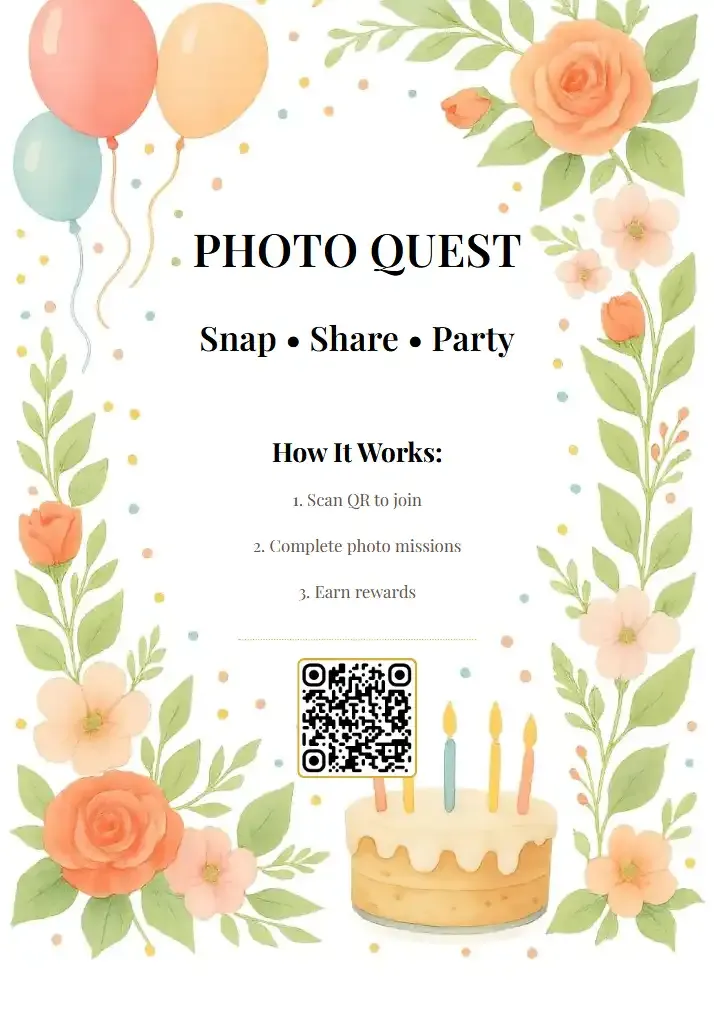
1.No app needed. Guests scan with their phone camera and start uploading.
The browser-based approach matters more at a destination wedding than anywhere else. You're asking guests to do something while on vacation, in a foreign country, possibly on expensive roaming data. The fewer steps between I took a great photo and it's in the shared gallery, the more photos you'll actually collect. When the entire process is scan, tap, upload, people do it between courses at dinner without thinking twice.
One honest limitation with Photogala specifically: it's browser-based with no native app, which means there's no offline upload queue. If a guest has zero connectivity at the ceremony site, they need to wait until they're on wifi. For most destination weddings, that means photos arrive in the evening from the hotel rather than in real time at the altar. Worth knowing, but rarely a dealbreaker.
See it in action
Every guest photo in one album – no app.
One Gallery for the Entire Trip
Here's where destination weddings actually have an edge over traditional one-day celebrations. A regular wedding generates photos across 8-10 hours. A destination wedding generates photos across 2-4 days. The welcome dinner, the rehearsal, the ceremony, the morning-after brunch, maybe a group boat trip. Each moment has its own energy, and guests who feel shy about photographing the ceremony will happily snap 20 photos of everyone jumping into the pool the next day.
A single shared gallery captures all of it. You can create albums for each event so guests can browse by moment rather than scrolling through 400 unsorted photos. The digital guestbook approach works especially well here: guests leave short messages alongside their uploads, turning the gallery into a scrapbook of the whole trip, not just the ceremony.
Think about the guest who flew 18 hours from Melbourne. She took beautiful photos of the rehearsal dinner that nobody else captured because most guests hadn't arrived yet. Without a shared gallery, those rehearsal photos stay on her phone indefinitely. With one, they're in the collection before the ceremony even happens.
What to Get Right Before You Fly
Put the QR code in the welcome bags
Most destination weddings include welcome bags at the hotel or rental. A small card with the gallery QR code is the single most effective placement. Guests unpack, see the card, scan out of curiosity, and they're in. POV.Camera's overview of wedding photo apps highlights that removing friction is the biggest factor in guest participation. Catching people right when they arrive, excited and phone-in-hand, is the lowest-friction moment of the entire trip.
Set up the gallery at home
Don't wait until you're at the venue battling a spotty wifi connection. Create your gallery at home, customize the branding, generate the QR codes, print everything. Test it with a friend. The gallery link works from anywhere in the world, so it doesn't matter where you set it up. One less thing to stress about during wedding week.
Give one person moderation access
Ask a bridesmaid or a trusted friend to keep an eye on the gallery. Photogala's moderation tools let them approve or reject uploads before anything goes public. At a multi-day celebration with pool time and open bars, a light filter is worth having. That said, destination wedding guest lists tend to be tight circles of close friends and family. Moderation here is a safety net, not a full-time job.
Send a reminder on the morning after the wedding. Most destination weddings have a farewell brunch or airport shuttle, and that's when people realize they haven't uploaded their photos yet. A quick message in the group chat with the QR code image gets one final wave of uploads before everyone scatters.
Be realistic about the photo wall
Live photo walls look spectacular at venue weddings where you control the AV setup and have a dedicated internet line. At a destination villa with questionable connectivity, the risk is real: the wall goes blank during the first dance because the wifi dropped. Unless you've verified the connection can handle it, skip the live wall and enjoy a private slideshow at home with all the collected photos after the trip. Focus on collection first.
Managing destination wedding logistics is already complex enough with RSVPs, travel, and accommodation blocks. Photo sharing should be the part that runs itself: set it up once before you fly and let it quietly collect memories while you focus on actually being present for your wedding week.
That couple with the villa in southern Italy? With a QR code in every welcome bag, a quick reminder at the farewell brunch, and a gallery that stays open for months afterward, they could realistically end up with 300-500 guest photos alongside the photographer's album. Not because they turned their guests into photographers. Because they removed the one barrier that stops people from sharing: effort.
All of this comes with your own event.
Setting it up takes five minutes. You can build and view everything before you decide.
Starting from €39 one-timeOne-time payment — No subscription
- No App Required
- Setup in 5 Minutes
- 30-Day Money Back
“I use PhotoGala Deluxe and I'm absolutely thrilled. It was the perfect solution for documenting a sports event. Uploading and downloading via the link is a breeze for every participant. What won me over most were the photo wall and the slideshow – both are quick to set up and look really professional. Big praise also to Peter from the PhotoGala team: he's very easy to reach by email, replies quickly and even took my suggestions on board and added new features that made my slideshow even better. You rarely get support this dedicated. A clear 5-star recommendation!”
Written by

I believe event photos should be more than static galleries. They should be live, playful, and unforgettable.
Categories
Related Posts

Bridal Shower Photo Sharing: Collect Every Sweet Moment in One Gallery
Bridal shower photos end up scattered across 15 phones. Here's how to get them all into one gallery before the mimosas wear off.

Maternity Photo Sharing: How to Keep Every Announcement, Bump Shot, and Memory in One Place
Pregnancy announcements land on 4 different apps. Maternity photos get lost in group chats. Here's how to keep every photo in one shared gallery your whole family can access.

Sales Kickoff Photo Sharing: How to Turn a Mandatory Meeting Into a Team Memory
Sales kickoffs are expensive. The photos from them usually disappear into 14 different camera rolls. Here's how to fix that.