The Psychology of Event Photos: Why Guests Share More When It's Easy


Picture a corporate summer party. Eighty people, great weather, a DJ who actually reads the room. By 11 PM, hundreds of photos exist across dozens of phones. Selfies with colleagues. The CEO attempting the limbo. Someone's kid asleep under a table. Three weeks later, maybe twelve of those photos have surfaced in a Slack channel. The rest? Buried in camera rolls, slowly sinking beneath screenshots and grocery lists.
This isn't a technology problem. Everyone at that party had a phone with a camera, a messaging app, and a cloud account. The photos were taken. They just never went anywhere.
That gap, between photos taken and photos shared, is one of the most predictable patterns in event planning. And it has almost nothing to do with laziness. It's psychology.
The Sharing Intention Gap
Smartphones account for 94% of all photos taken globally as of 2024. The average person stores roughly 2,800 photos in their camera roll. And yet, most of those images never get shared with anyone. Not because people don't want to. Because by the time they get around to it, the moment has passed.
Psychologists call this the intention-action gap. You fully intend to do something (send those wedding photos to the bride), but the friction between intention and action is just large enough that you don't. Not today. Maybe tomorrow. Tomorrow becomes next week. Next week becomes never.
At events, this friction is surprisingly specific. It's not one big barrier. It's a stack of small ones:
- Finding the right app or channel. Is there a WhatsApp group? A shared album? Did someone send a link?
- Selecting which photos to share. Nobody wants to dump 40 unfiltered shots. So they plan to curate later. Later never comes.
- Privacy hesitation. Will everyone in the group chat see my photos? Do I look okay in this one? Is it weird to post the one where the boss is dancing?
- Technical friction. iCloud shared albums require Apple IDs. Google Photos needs a Google account. AirDrop only works within arm's reach.
Each of these alone is trivial. Stacked together, they're enough to kill sharing for most people. The photos stay on the phone.
Three Psychological Drivers That Actually Work
Understanding why people share photos at all reveals how to get more of it. According to research from Photomea, the urge to share photos is rooted in fundamental human needs that predate photography entirely. Three drivers matter most at events.
1. Social Belonging
Sharing a photo from an event says: "I was here. I'm part of this." It's a belonging signal. When guests see other people's photos appearing in real time on a shared gallery or a screen at the venue, the social proof kicks in. If everyone else is uploading, not uploading feels like opting out.
This is why live photo walls work so well. Not because the technology is impressive (it's a slideshow), but because seeing your photo appear on a big screen in front of everyone triggers a small dopamine hit. You contributed. You belong.
2. Reciprocity
When someone shares a great photo of you, you feel a pull to share one back. This is basic reciprocity, one of the strongest social forces we have. At events where a shared gallery already has content flowing in, newcomers feel an almost automatic urge to add their own. The gallery isn't empty, so contributing feels natural rather than awkward.
The worst thing you can do is launch a shared gallery and leave it empty. Nobody wants to be the first person to post in an empty room.
Seed the gallery early. Upload 5-10 photos yourself before guests arrive. A gallery with existing content gets 3-4x more contributions than an empty one. People add to momentum; they rarely start it.
3. Low-Cost Self-Expression
Uploading a photo is one of the lowest-effort ways to express yourself at an event. You don't have to write anything clever. You don't have to perform. You just tap a button. For introverts, for people who don't know many others at the event, for the uncle who's not on Instagram: a shared photo gallery is the most accessible form of participation available.
But only if it's actually easy. The moment you introduce a login screen, an app download, or a multi-step sharing process, you've turned a low-cost action into a medium-cost one. And medium-cost actions don't happen at parties.
Friction Is the Enemy, Not Motivation
Here's the thing most event planners get wrong: they try to motivate guests to share. Announcements from the stage. Printed signs. "Don't forget to share your photos!" messages in the invitation.
Motivation isn't the problem. Guests already want to share. The photos are already on their phones. What kills sharing is friction.
Research on event engagement confirms what anyone who's organized an event knows intuitively: post-event engagement drops off a cliff. Photos create emotional connections, but only if attendees can see them while the emotions are still fresh. A shared album link sent via email on Monday morning is already too late. The magic window is during the event itself.
The formula is simple. Reduce friction to near zero, and sharing takes care of itself.
The upload screen guests see after scanning
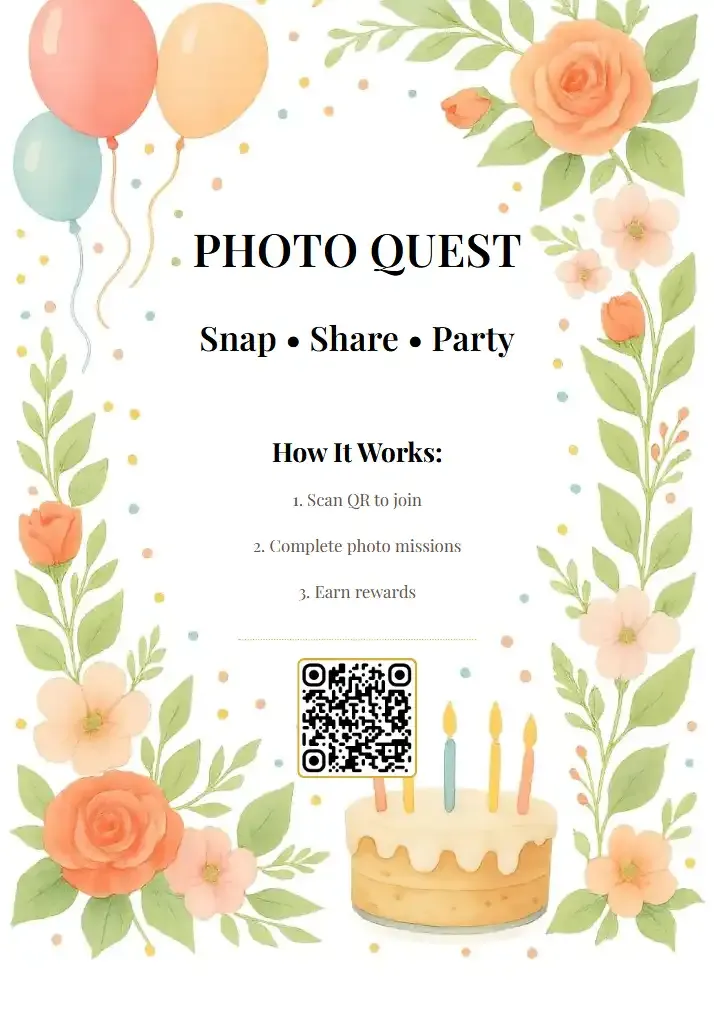
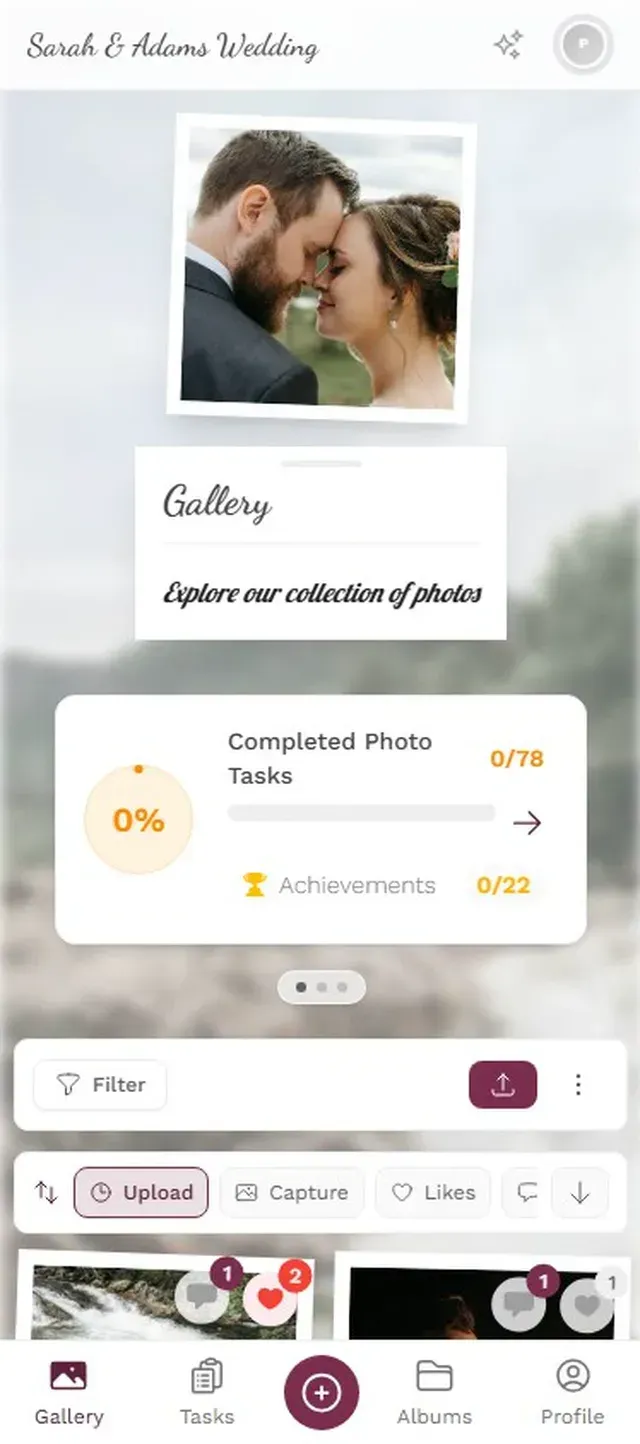
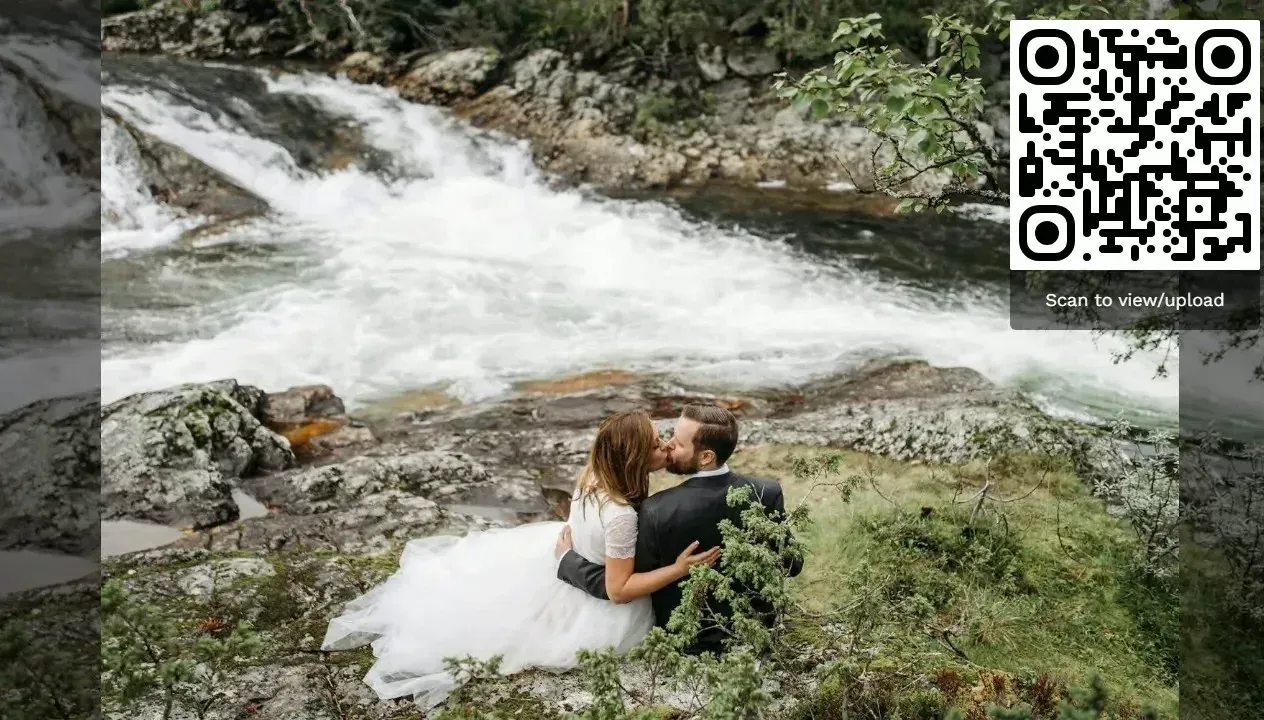
A QR code on a table card is about as frictionless as it gets. Guest scans it with their phone camera, a browser gallery opens, they tap to upload. No app download. No account creation. No password. The entire process takes under 30 seconds, and that includes the time spent deciding which photos to share.
Ready to create your gallery?
The Leaderboard Effect (and Why It Works on Your Dad)
Reducing friction gets people to share. Gamification gets them to share more.
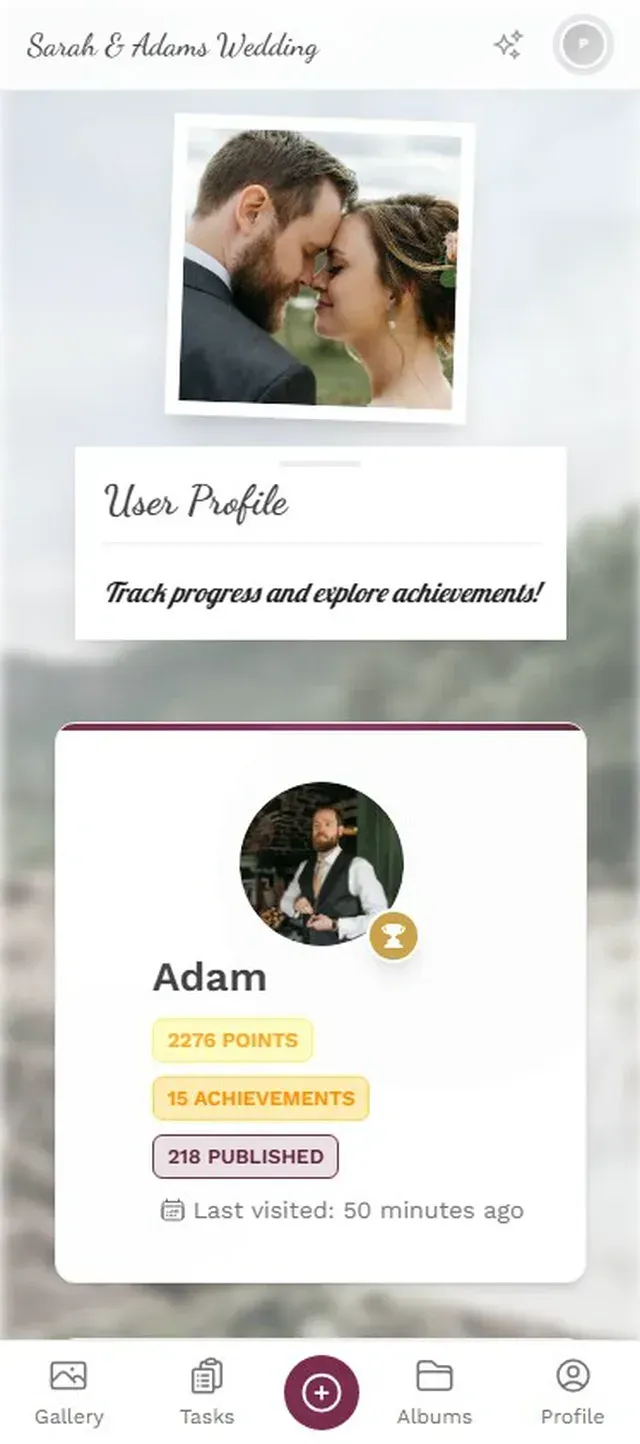
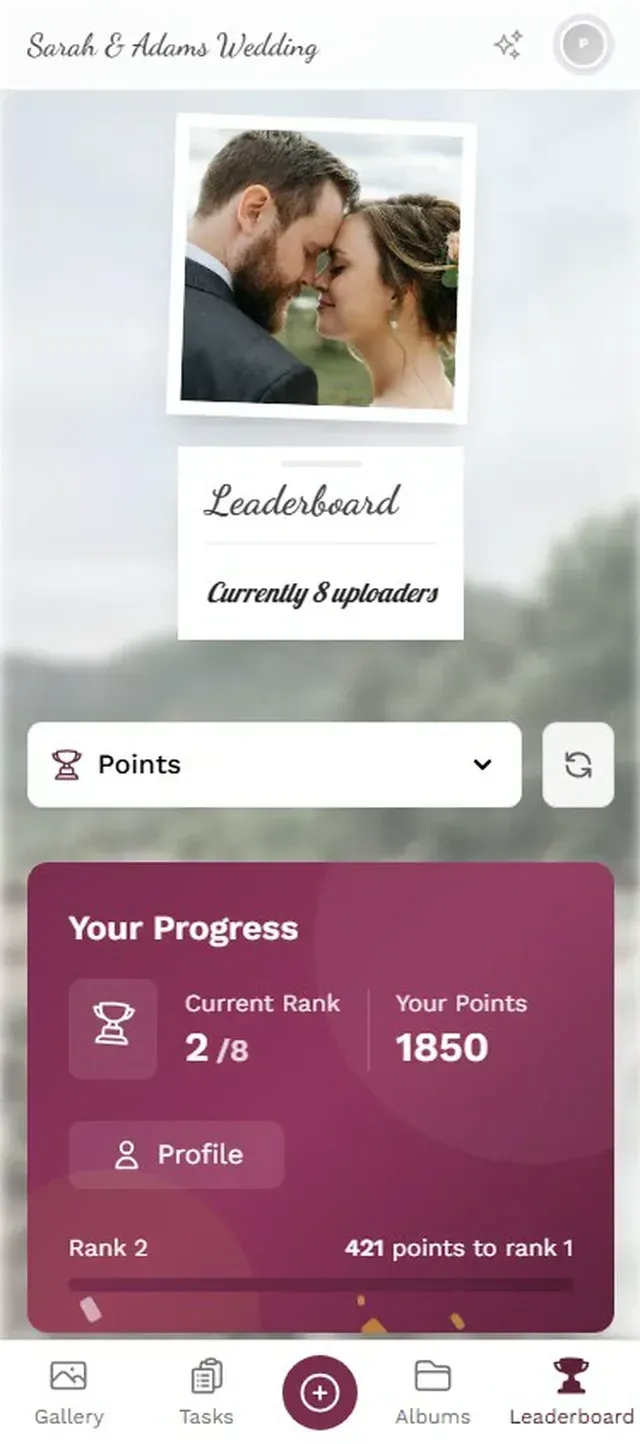
Imagine a 150-guest wedding. The couple sets up photo challenges: "Best dance floor shot," "Funniest face," "Catch someone mid-bite." There's a leaderboard showing who's uploaded the most. Points for completing challenges. Maybe a small prize for the top contributor.
Now picture the bride's father, a 58-year-old accountant who hasn't posted on social media since 2019. He sees his name on the leaderboard. He's in fourth place. His daughter's college roommate is in first. This will not stand.
Event activation research from Swoogo shows that gamified challenges consistently boost participation because they tap into something deeper than wanting to win. They give people a reason to do something they already wanted to do. The challenges provide structure. The leaderboard provides social comparison. Together, they transform "I should probably share some photos" into "I need three more uploads to pass Karen."
This works across demographics in ways that surprise people. Photo challenges with example preview photos (where guests see a reference image and try to recreate it) generate some of the most creative, hilarious content at events. A "recreate this movie poster" challenge at a company party will produce photos that get passed around for months.
Challenges give guests a creative prompt
What 'Easy' Actually Means (It's Not What You Think)
When event planners say they want "easy photo sharing," they usually mean easy for themselves to set up. But the ease that matters is the guest's experience in the first 10 seconds after they encounter the sharing mechanism.
Those 10 seconds break down like this:
The Guest's 10-Second Decision
See the prompt
A QR code on the table, a sign near the bar, a mention from the host. The guest notices that photo sharing exists.
Assess the effort
Do I need to download something? Create an account? Find a link? If the answer to any of these is yes, most guests stop here.
Act or abandon
If it's scan-and-go, they upload. If it requires more than one extra step, they tell themselves they'll do it later. They won't.
That middle step is where most solutions fail. Shared iCloud albums require everyone to have an Apple device and an Apple ID. WhatsApp groups need phone numbers. Google Photos shared albums need Google accounts. Even "simple" solutions like Dropbox links require guests to navigate a file browser interface on mobile, which is clunky enough to lose half your audience.
The only approach that truly clears the friction bar: a QR code that opens a browser-based upload page. No download, no login, no account. This isn't a Photogala pitch; it's just physics. The fewer steps between "I want to share this photo" and "it's shared," the more photos you get. Every additional step loses roughly half the potential contributors.
One honest trade-off: browser-based sharing means guests need an internet connection at the venue. If your event is in a remote barn with no cell signal, plan ahead. A portable WiFi hotspot (around $50-100 to rent) solves this, but it's an extra thing to organize.
Real-Time Visibility Changes Everything
There's a feedback loop that most event organizers miss: guests share more when they can see that sharing is happening.
A photo wall (a TV or projector displaying uploaded photos in real time) doesn't just entertain guests. It creates what engagement researchers call a participation loop: someone sees a photo on the screen, realizes they can contribute, uploads their own, and watches it appear. Other guests see that photo, and the cycle continues.
This is the same mechanism that makes social media feeds addictive, but compressed into a physical space and a single evening. The dopamine loop is: action (upload) → reward (seeing your photo on the big screen) → social validation (someone points at it, laughs, takes a photo of the screen). It's powerful enough to get people who "never share photos" uploading a dozen times in one night.
The placement of that screen matters more than you'd think. Near the bar or the dance floor, where people naturally congregate and have downtime, works best. A screen tucked in a corner hallway won't trigger the loop because nobody sees it. If you want the psychology to work, the visibility has to be effortless too.
The Post-Event Window You're Probably Missing
Most shared albums die the moment the event ends. But the sharing impulse doesn't.
The 24-48 hours after an event are actually the second peak of photo sharing. Guests get home, scroll through their camera roll, find shots they forgot about, and think "oh, I should share this one." If the gallery is still accessible (same QR code, same link, no expiration), they will. If the link has expired or the WhatsApp group has moved on to other conversations, those photos are gone forever.
For weddings, this window is even more important. Guests who were too busy dancing on Saturday night will sit down on Sunday morning, look through their photos, and upload the best ones. That Sunday batch often contains some of the most thoughtful, well-composed shots of the entire event, because the guests had time to be intentional about what they chose.
Keep the gallery open for at least a week after the event. The cost is zero. The additional photos are a bonus you'd never get otherwise. If you want even more context on getting great guest photos, this guide on guest photography tips covers the practical side.
Making the Psychology Work for You
None of this is complicated. The psychology is straightforward: people want to share, friction stops them, visibility encourages them, and a little competition amplifies everything. The mistake most organizers make is overcomplicating it. They create elaborate sharing systems, multiple channels, detailed instructions.
The best approach is almost embarrassingly simple. One QR code. One gallery. Photos visible in real time. Maybe a few challenges to give people a nudge. That's it.
Imagine the next event you're planning. Say it's a company anniversary with 60 people. You print QR codes on the table cards, set up a screen near the buffet, and create three photo challenges: "Best team photo," "Most creative dessert shot," and "Catch the CEO off-guard." By the end of the night, you have 180 photos from 35 different contributors. No WhatsApp groups. No "I'll send you the photos" promises that never materialize. Just a full gallery, ready to download and share the next morning.
That's what happens when you stop trying to motivate people and start removing the reasons they don't.
Ready to create your gallery?
Start sharing your event photos with guests in minutes.
Create GalleryWritten by

I believe event photos should be more than static galleries. They should be live, playful, and unforgettable.
Categories
Related Posts
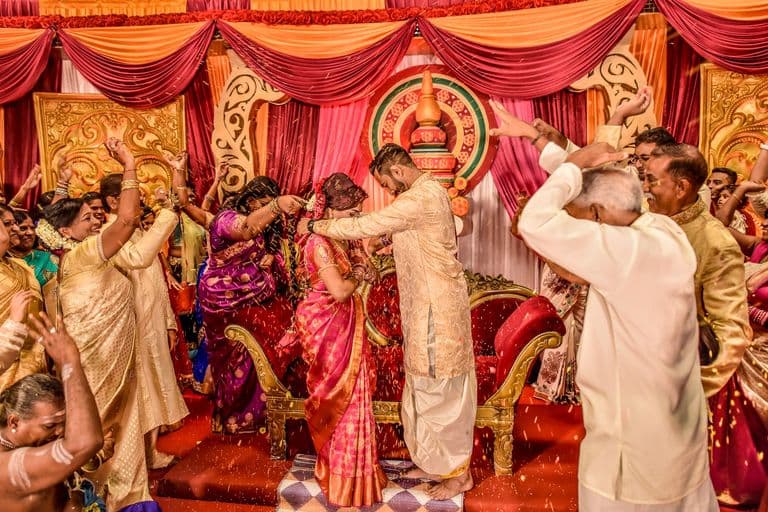
Multicultural Wedding Photo Sharing: Honoring Every Tradition in One Gallery
When your wedding blends two (or more) cultures, collecting guest photos gets complicated fast. Here's how to make it work without losing a single moment.
Free Event Planning Tools Every Organizer Should Bookmark
The best free tools for budgets, guest lists, timelines, photo sharing, and more. No subscriptions, no bloated software suites.

Milestone Birthday Photo Sharing: 30th, 40th, 50th and Beyond
At milestone birthdays, decades of relationships converge in one room. Here's how to collect every guest's photos before they vanish into 40 separate camera rolls.