The GDPR Problem With Event Photos (And How to Actually Solve It)

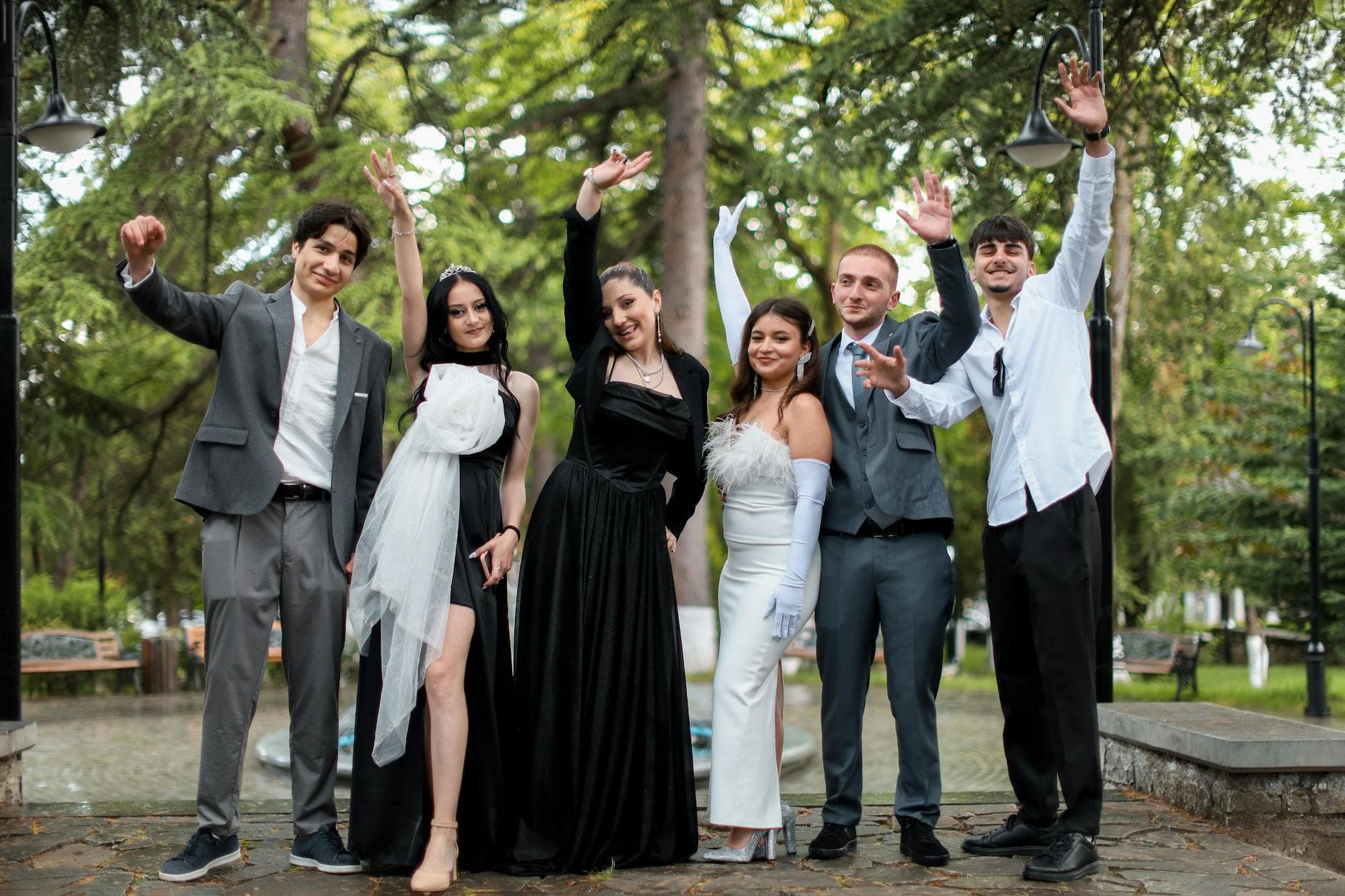
Picture this: a marketing manager posts a handful of photos from the annual company summer party on LinkedIn. Team smiles, good energy, branded backdrop. Two days later, HR forwards an email. Someone in the background of photo number three wants it taken down. They never agreed to be photographed, let alone featured on a corporate social account.
Under GDPR, that complaint is entirely valid.
Most event organizers never think about photo privacy until a situation like this surfaces. The good news: the rules around event photos aren't nearly as confusing as the legal jargon suggests. This article covers what you need to know, whether you're planning a wedding, running a corporate offsite, or throwing a milestone birthday. (Quick caveat: this is practical guidance, not legal advice. For specific situations, consult a data protection professional.)
Event Photos Are Personal Data. Full Stop.
Here's the part most people get wrong. Under GDPR, a photo of a recognizable person is personal data. Not sometimes. Not under certain conditions. Always. The definition covers obvious identifiers like faces, but extends to distinctive clothing, visible tattoos, or even recognizable surroundings that narrow down who's in the frame.
The moment someone at your event points a camera at a group of guests, they're creating personal data. And processing personal data requires a legal basis. For events, that basis usually comes down to one of two options: legitimate interest or explicit consent.
Private Events vs. Corporate: Two Different Worlds
A wedding and a company retreat are legally different animals.
At a private wedding or birthday party, you have more flexibility. GDPR includes a "household exemption" for purely personal activities. Guests expect photos at a celebration. The couple or host will share them afterward. Courts across the EU have generally recognized this implicit understanding.
That flexibility has limits, though. Sharing photos only with the guest list? Generally fine. Posting a guest's karaoke performance to your public Instagram with 4,000 followers? Different story. The household exemption evaporates the moment content goes public.
The dividing line: Private sharing among event guests generally falls under GDPR's household exemption. The moment photos go public (social media, company websites, newsletters), full GDPR rules kick in, regardless of whether the event itself was private.
Corporate events sit squarely in the stricter category from day one. When a company organizes a team event, conference, or client reception, it acts as a data controller under GDPR. That means formal obligations: informing attendees about photography, explaining how images will be used, and providing a way to object. As privacy analysts have documented, GDPR and CCPA compliance isn't optional when event photos end up in newsletters, on LinkedIn, or in marketing materials.
One photo of an identifiable person in a company newsletter, sent without consent, can trigger a formal complaint. And in a corporate context, the consequences scale up fast.
Getting Consent Right (Without Killing the Mood)
Nobody wants to hand out clipboards at the door of a wedding reception. And the consent forms at corporate events usually end up unread in the recycling bin. But practical approaches exist that satisfy both the law and your guests' patience.
Four Steps to Photo Privacy Compliance
Inform before the event
Mention in the invitation or registration that photos and videos will be taken and shared. Set expectations early.
Put up signage at the venue
Place visible notices near entrances stating that photography is happening. Simple, socially clear, and legally useful.
Offer an opt-out mechanism
Give people a way to signal they'd rather not be photographed. Colored wristbands at some events, an email contact at corporate gatherings.
Use a moderated sharing platform
Collect photos in a moderated gallery where someone reviews uploads before they go public, instead of posting directly to social media.
Privacy regulations don't always demand a signed form. For many events, clear advance notice combined with an accessible opt-out mechanism is enough to satisfy the legal standard.
For corporate events specifically, consider adding a line to your registration page: "Photos and videos will be taken at this event for internal communications. If you prefer not to be photographed, contact [name] or wear a red lanyard at the event." Three sentences. Easy to implement. Documented for your records.
Discover what Photogala can do
Why Your Sharing Tool Matters More Than You Think
Here's what most GDPR guides skip entirely: the platform you use to share event photos shapes your compliance posture just as much as the consent you collect.
Send photos through WhatsApp and they're instantly downloaded to every recipient's camera roll. No moderation. No way to retract. No centralized control. If someone exercises their GDPR Article 17 right to erasure, you'd need to individually message every person in the group and ask them to delete a specific photo from their phone. Good luck coordinating that at a 150-person event. (There's a reason dedicated sharing platforms beat group chats for event photos.)
A purpose-built photo sharing platform changes the equation. Photos live in one centralized gallery. The organizer controls who has access. And if someone requests removal, a single deletion handles it for everyone, on every device.
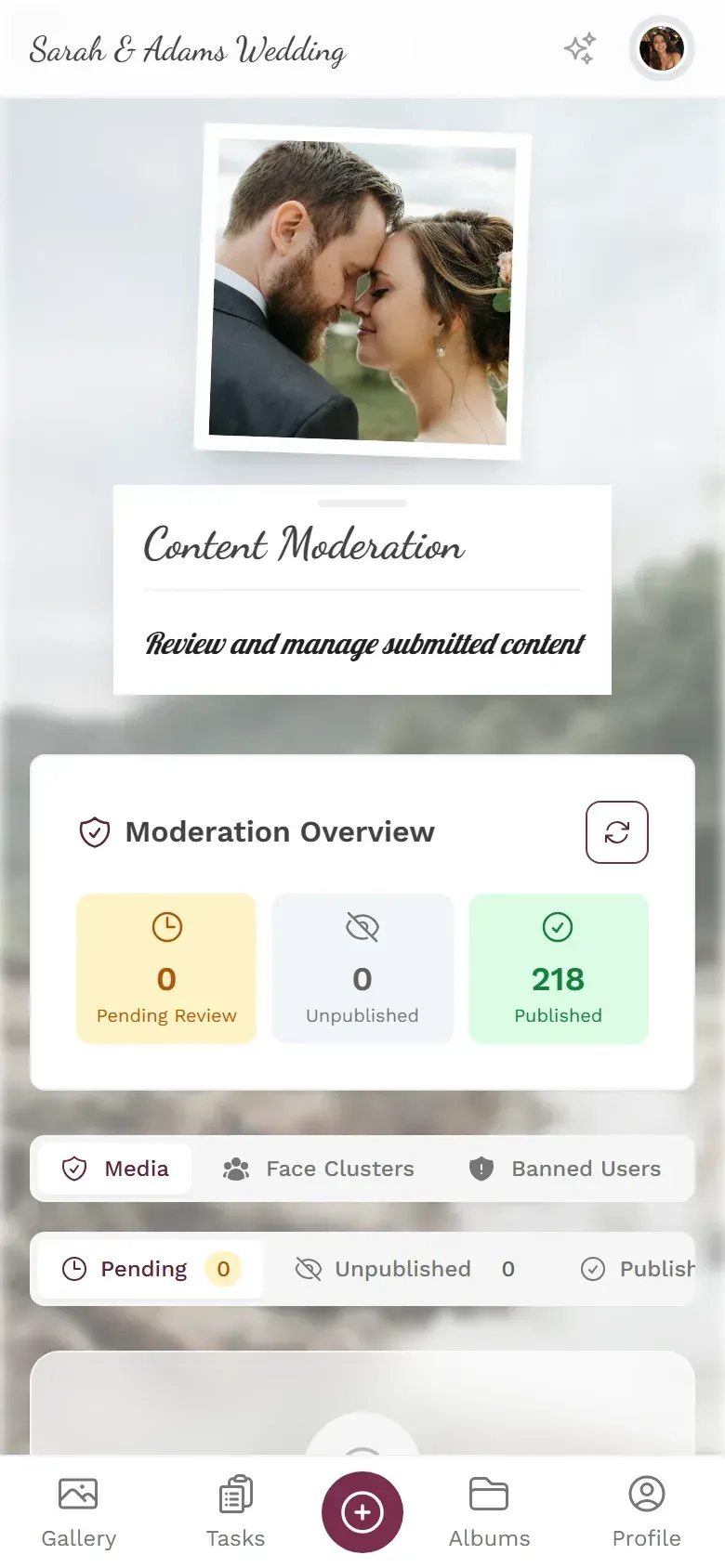
Full moderation dashboard with approve/reject controls for every upload
The Moderation Layer Most Organizers Miss
Content moderation isn't just about filtering inappropriate uploads (though at corporate events with open bars, that feature earns its keep). It's your GDPR safety net.
With a platform like Photogala, every uploaded photo can pass through a moderation queue before appearing in the shared gallery. A designated moderator reviews each upload: one tap to approve, one tap to reject. That simple workflow means photos of anyone who opted out never reach the public gallery in the first place.
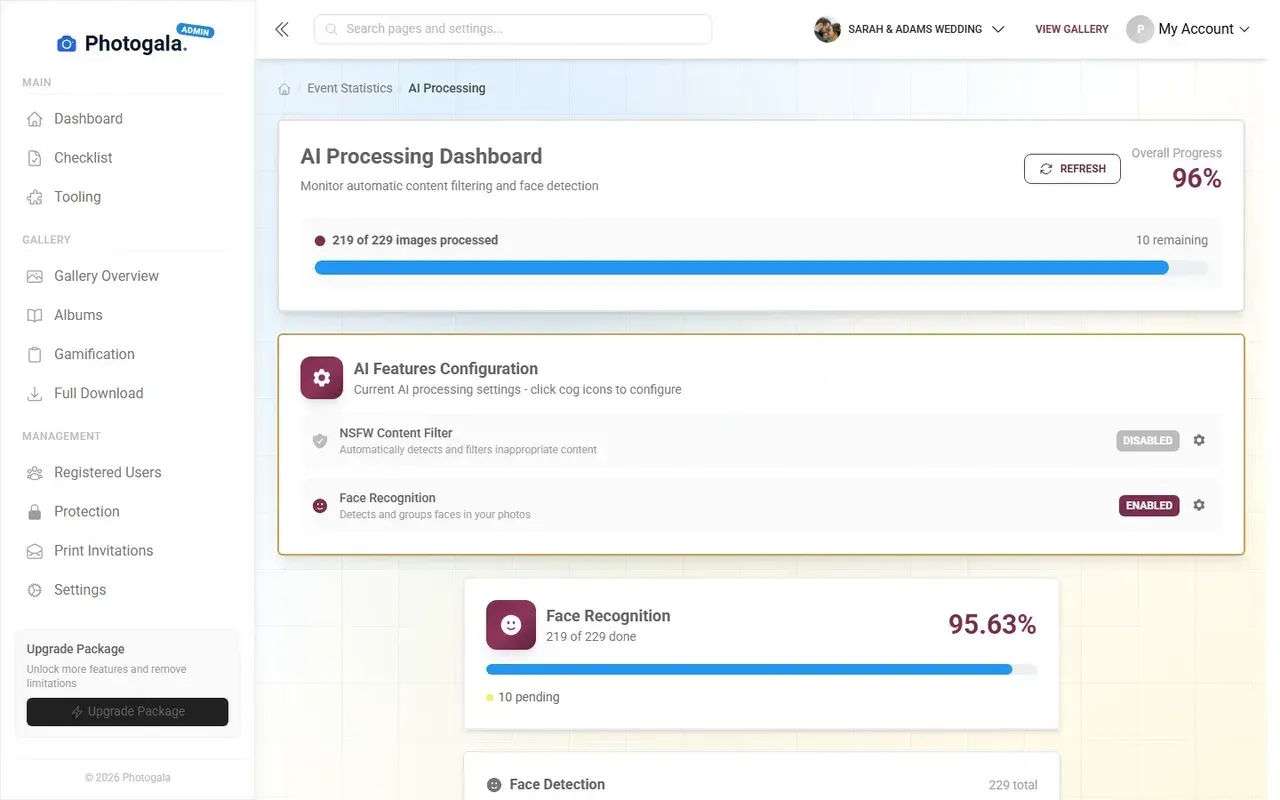
The Deluxe plan also includes an AI-powered NSFW filter that automatically flags potentially inappropriate content before a human moderator even sees it. For corporate events where brand reputation is on the line, that extra layer removes a real source of stress for the communications team.
Assign moderation to someone who isn't busy hosting. At a wedding, a tech-savvy friend at a quiet table is ideal. At a corporate event, hand the role to someone from communications or marketing who already has an eye for what should (and shouldn't) go public.
One honest trade-off: Photogala is browser-based, not a native app. For privacy, this is actually a positive (no persistent app sitting on your camera roll). But the moderator doing real-time approvals needs a reliable Wi-Fi connection at the venue. Plan for that.
If you're organizing a corporate conference and want the full logistics breakdown, our guide to sharing photos at corporate events goes deeper on setup, roles, and moderation workflows.
The Copyright Angle Nobody Mentions
Photo privacy has a second dimension that catches organizers off guard: copyright. The person who takes a photo owns the copyright by default. Your hired wedding photographer owns those images until they explicitly license them to you. The event photographer at a corporate gala owns their work too.
The Association of Corporate Counsel recommends that companies secure work-made-for-hire agreements or licensing contracts before any event photography. Without that paperwork, you technically need permission to repost the photographer's images in your own materials.
Guest photos shared through a platform typically fall under the platform's terms of service, which grant the event organizer a display and download license. But the guest who snapped the photo retains copyright. Worth understanding if you plan to use those candid shots in marketing campaigns later.
Planning Beats Panic
Photo privacy at events boils down to one principle: respect people's control over their own image. That marketing manager from the opening? With a note about photography in the event invitation, a visible opt-out mechanism on site, and a moderated sharing platform instead of a direct LinkedIn upload, that complaint likely never happens.
None of this requires a law degree. It takes maybe 30 minutes of planning before the first camera comes out. The payoff is an event where everyone (including your legal team) can relax and actually enjoy the photos.
Ready to create your gallery?
Start sharing your event photos with guests in minutes.
Create GalleryWritten by

I believe event photos should be more than static galleries. They should be live, playful, and unforgettable.
Categories
Related Posts
Multicultural Wedding Photo Sharing: Honoring Every Tradition in One Gallery
When your wedding blends two (or more) cultures, collecting guest photos gets complicated fast. Here's how to make it work without losing a single moment.

Free Event Planning Tools Every Organizer Should Bookmark
The best free tools for budgets, guest lists, timelines, photo sharing, and more. No subscriptions, no bloated software suites.

Milestone Birthday Photo Sharing: 30th, 40th, 50th and Beyond
At milestone birthdays, decades of relationships converge in one room. Here's how to collect every guest's photos before they vanish into 40 separate camera rolls.