Religious Festival Photo Sharing: Diwali, Eid, Hanukkah, and Beyond

The Moment You Can't Reshoot
Picture a Diwali gathering at your aunt's house. Forty people. Diyas flickering on every surface. Your cousin's daughter lights her first lamp, and six phones go up simultaneously. The professional rangoli in the courtyard gets documented from nine different angles. By the end of the night, there are maybe 400 photos scattered across three dozen camera rolls.
Two weeks later, you've seen exactly twelve of them. The rest? Trapped in WhatsApp groups that died after three days, or sitting on Uncle Raj's phone because he "doesn't do cloud stuff."
This isn't a Diwali problem. It happens at Eid al-Fitr dinners, Hanukkah gatherings, Chinese New Year celebrations, Easter lunches, and Vaisakhi festivals. Religious celebrations are some of the most photographed events in family life, and simultaneously some of the worst at actually collecting guest photos afterward. The ceremony happens once. The prayer is said once. The candles are lit once. You can't ask everyone to do it again because someone's phone was on portrait mode.
Why Religious Festivals Break Normal Photo Sharing
Most photo-sharing approaches assume a single photographer or a small, tech-savvy group. Religious festivals don't work that way.
The crowd is multigenerational. Your 78-year-old grandmother and your 14-year-old nephew are both taking photos, but they operate in completely different tech universes. Grandma doesn't have Google Photos. Your nephew doesn't use email. A 2025 comparison of photo sharing methods highlights the core tension: every platform requires something (an account, an app, Apple devices, proximity) that excludes part of your guest list.
Then there's the cultural layer. As SiahiStudio's guide on ceremony photography points out, religious ceremonies carry deep significance, and the people documenting them need to understand which moments are sacred, which are celebratory, and where the line sits. When everyone is a photographer, that line gets crossed more often.
A shared iCloud album sounds simple until half your family uses Android. A Google Photos link works until the three people who matter most don't have Google accounts. AirDrop is useless at a gathering of 60. WhatsApp compresses everything into potato quality. None of these tools were built for what religious festivals actually look like: big groups, mixed tech literacy, sacred content that deserves original quality, and a timeline that includes both a two-hour prayer service and a five-hour party afterward.
One QR Code, Every Generation
The simplest fix is removing every barrier. No app to download. No account to create. No operating system requirement. Just a QR code that opens a browser gallery where anyone can upload photos at original quality.
This is how QR-based photo sharing works in practice: you print a QR code (on a card, a table sign, or even tape it to the buffet table), guests scan it with their phone camera, and they're uploading within seconds. No sign-up forms. No passwords. The gallery lives in the browser, so it works on every phone made in the last decade. Need to create the QR code itself? Photogala's free QR code generator handles that in a few clicks.
QR Code Generator
Create custom QR codes for your event — link guests directly to your photo gallery.
For religious festivals specifically, this matters more than you'd think. Imagine an Eid al-Fitr celebration with 80 guests across three generations. The youngest guests scan the code without thinking twice. The older guests need a quick demo ("just point your camera at this square"), but once they see the gallery load, they get it. We've written about this exact multigenerational dynamic in our guide to multi-language event galleries, and the pattern holds: the simpler the entry point, the more people participate.
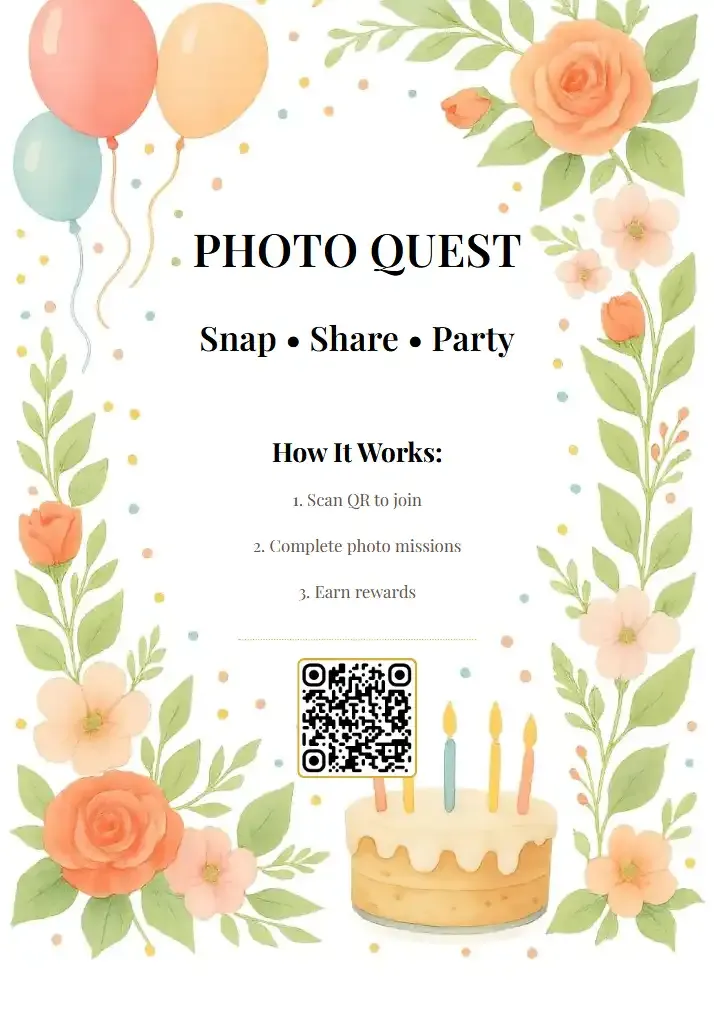
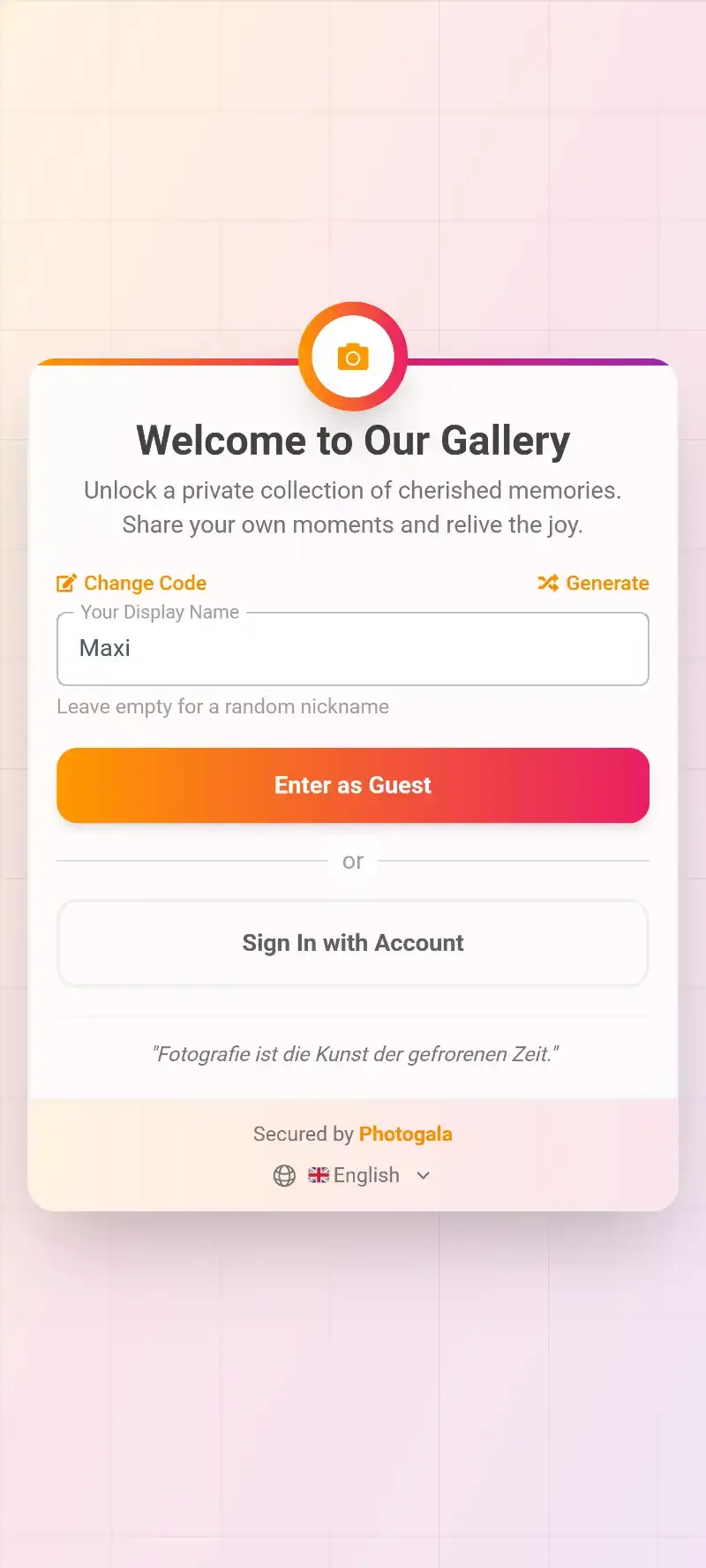
1.Scan, upload, done. No app needed.
By the end of a Diwali evening with 50 guests, a realistic expectation is 150-300 photos in the gallery. Not because everyone uploads dozens, but because enough people upload 3-8 each that it adds up. The uncle who never shares photos? He uploaded four. Your tech-savvy cousin? Twenty-two. The gallery captures angles and moments the hired photographer never saw.
実際の画面
ゲストの写真をすべて1つのアルバムに。アプリは不要です。
Sacred Moments Need Guardrails
Here's the part nobody talks about until it's too late: not every photo belongs in a shared gallery.
Religious ceremonies have boundaries. Some moments are deeply private. Some attendees don't want their photo shared publicly. And at any gathering with alcohol (or just with teenagers), there's always a risk of inappropriate content slipping in. Ethical photography guidelines emphasize researching cultural restrictions and respecting personal space, but when 40 people are all shooting simultaneously, you can't control what gets uploaded to a shared space.
This is where content moderation stops being optional. With pre-approval mode turned on, every photo goes through a review queue before appearing in the gallery. Assign a trusted family member as moderator. One tap to approve, one tap to reject. The prayer ceremony photos from a respectful angle? Approved. The blurry selfie someone took during the sermon? Rejected with a polite reason.
For larger celebrations, an AI-powered NSFW filter adds another layer. It won't catch everything (it can't judge cultural appropriateness), but it catches the obvious problems before a human moderator even sees them. If you're running a live photo wall on a screen during the event, moderation isn't a nice-to-have. It's mandatory.
Pro tip for religious events: Create a brief "photo etiquette" note and include it with your QR code card. Something like: "Photos welcome during the celebration. Please be mindful during prayers and ceremonies." Setting expectations upfront reduces the need for moderation later.
Making the Gallery Feel Like Your Celebration
A generic white gallery doesn't feel like Diwali. It doesn't feel like Eid. It feels like a corporate file share.
Gallery customization lets you match the gallery's look to the celebration. Choose colors that reflect the festival: deep golds and magentas for Diwali, greens and silvers for Eid, blues and whites for Hanukkah. Upload your own cover image (a photo of your rangoli, a shot of the decorated table, the menorah from last year). Pick a header style that fits the mood. The gallery should feel like an extension of the event, not an afterthought.
If your celebration spans multiple communities or languages, multi-language support makes a real difference. A Diwali gathering might include family members more comfortable in Hindi, Gujarati, or Tamil alongside English speakers. The interface adapts, so nobody feels locked out. Similar thinking applies to multicultural wedding celebrations where multiple traditions share one event.
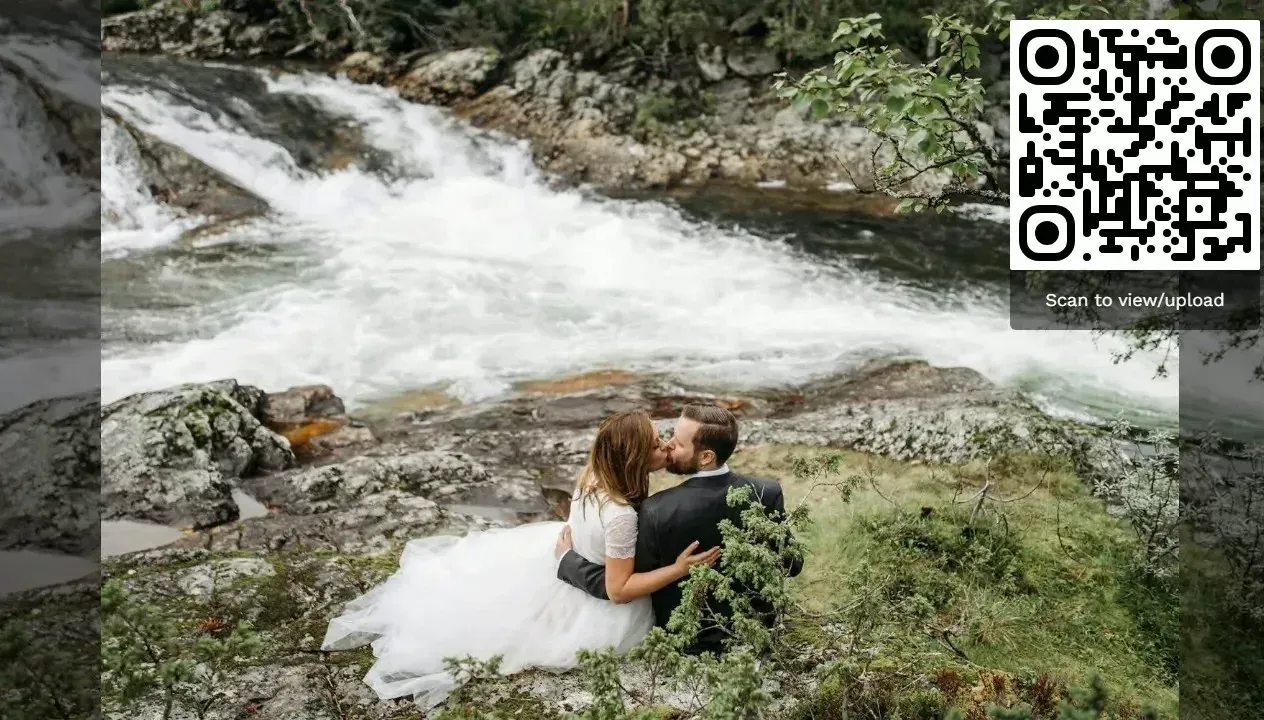
1.Match colors and style to your celebration
Photo Challenges That Respect the Occasion
Gamification at a religious festival sounds wrong. Nobody wants a leaderboard during Friday prayers.
But photo challenges aren't inherently disrespectful. It depends entirely on what you ask for. During the celebration portion of the evening (after the ceremony, during the meal, at the party), gentle prompts can capture moments people wouldn't think to photograph otherwise.
For a Diwali party: "Capture your favorite rangoli detail," "Photograph the best-dressed person at your table," "Find the most creative diya arrangement." For Eid: "Share a photo of your favorite dish on the table," "Capture someone's henna design," "Photograph the most elaborate outfit you can find." For Hanukkah: "Snap the menorah from an unusual angle," "Photograph your family's latke technique."
The key is timing. Keep challenges deactivated during sacred portions of the event. Activate them when the mood shifts to celebration. Photogala even lets you include example preview photos in each challenge, so guests know exactly what kind of shot you're looking for. A reference photo of a close-up rangoli detail inspires much better submissions than a text-only prompt. We covered similar creative challenge ideas for christenings and baptisms, and the principle applies across religious celebrations: match the energy of the moment.
One honest limitation: Photogala doesn't have a scheduling feature for challenges. You can't pre-set them to activate at 8 PM when the ceremony ends. Someone needs to manually turn them on. A small inconvenience, but worth knowing.
What 300 Festival Photos Actually Look Like
Say you set up a QR gallery for a Hanukkah gathering of 35 people across two evenings. Night one is intimate: candle lighting, prayers, latkes. Maybe 60 photos trickle in. Night two is the big party with extended family. That's where the gallery fills up. Kids running around with chocolate gelt. The dreidel tournament getting weirdly competitive. Great-aunt Miriam's legendary sufganiyot.
By the end, you might have 120-180 photos total. Not a massive number. But these are 180 photos from 20 different perspectives, in one place, at original quality. Compare that to the usual outcome: twelve photos in a WhatsApp group, three Instagram stories that disappear in 24 hours, and a vague promise from your cousin to "send them later."
For larger celebrations like open-air religious festivals or community Eid prayers with 200+ attendees, the numbers scale accordingly. At that size, face recognition becomes a real time-saver: guests upload a selfie and instantly find every photo they appear in, across hundreds of uploads. No manual scrolling through the entire gallery. The same approach works well for any large-scale event photo sharing scenario.
Beyond the Single Event
Religious festivals are recurring. Diwali comes every year. Eid comes twice a year. Hanukkah, Christmas, Lunar New Year, Vaisakhi, Passover. If your family builds a tradition of using a shared gallery, each year's collection becomes part of a larger archive.
With bulk ZIP downloads, the host can download every photo at full resolution after the event and keep a permanent backup. Print a photo book. Create a slideshow for next year's gathering. The gallery stays active for 6-12 months depending on your plan, which is plenty of time for that one relative who takes three months to upload anything.
If your family celebrates across religious traditions (and many do), the same approach works for Easter gatherings, bar and bat mitzvahs, first communions, and Thanksgiving dinners. One gallery per celebration. Same QR code principle. Different colors and cover photos each time.
Religious celebrations are about presence, connection, and tradition. The photos people take at these events aren't just documentation. They're the visual memory of something that mattered. Getting those photos out of 40 separate camera rolls and into one shared space shouldn't require a computer science degree. A QR code on the dessert table does the job.
これらすべてが、ご自身のイベントで使えます。
作成は5分で完了。決める前に、すべてを設定して確認できます。
料金 €39 ~(1回払い)1回払い — サブスクリプションなし
- アプリ不要
- 5分で準備完了
- 30日間返金保証
執筆者

I believe event photos should be more than static galleries. They should be live, playful, and unforgettable.
カテゴリー
関連記事
Bridal Shower Photo Sharing: Collect Every Sweet Moment in One Gallery
Bridal shower photos end up scattered across 15 phones. Here's how to get them all into one gallery before the mimosas wear off.

Maternity Photo Sharing: How to Keep Every Announcement, Bump Shot, and Memory in One Place
Pregnancy announcements land on 4 different apps. Maternity photos get lost in group chats. Here's how to keep every photo in one shared gallery your whole family can access.

Sales Kickoff Photo Sharing: How to Turn a Mandatory Meeting Into a Team Memory
Sales kickoffs are expensive. The photos from them usually disappear into 14 different camera rolls. Here's how to fix that.