How to Get Non-Tech-Savvy Guests to Share Photos at Your Event


Picture a wedding reception winding down. The bride's father spent the entire evening capturing candid moments on his phone. The look on his daughter's face during the first dance. A group of college friends squeezed into a booth. His wife wiping away tears during the toast. Forty-seven photos, some of them genuinely beautiful. And not a single one will ever leave his camera roll.
Not because he doesn't want to share them. He'd love to. But the WhatsApp group has 83 messages he hasn't read, the iCloud link his son-in-law texted requires an Apple ID he can't remember the password for, and he's already exhausted from being social all night. So the photos stay on his phone. Months later, they're buried under screenshots and grocery lists.
This happens at every event. As Bespoke Bride put it: "Priceless, silly, off-the-cuff moments from the dance floor and the cocktail hour were just trapped on everyone's phones, lost to the abyss." The gap between photos taken and photos actually collected is enormous. And the guests you lose first are always the ones who aren't comfortable with technology.
Here's the thing: those guests often take the best photos. They're not curating for Instagram. They're just capturing what they see. And getting those photos doesn't require teaching anyone new technology. It requires removing every possible barrier.
The Real Problem Isn't Age. It's Friction.
It's tempting to frame this as a generational issue, but that's not quite right. A TacBoard analysis found that the biggest barrier to photo sharing isn't technical skill. It's complexity. "The moment you ask someone to download an app or create an account, friction builds." That applies to a 25-year-old who doesn't want another app on their phone just as much as it applies to a 70-year-old who finds the App Store confusing.
Every additional step you add to the sharing process cuts your participation rate. Download an app? You've lost 30-40% of guests. Create an account? Another chunk gone. Enter a code, verify an email, accept permissions? By the time you're done, you're left with the ten most tech-savvy people at the event sharing photos with each other.
The solution isn't to "teach" less technical guests how to use complex tools. It's to choose a tool so simple that no app is required in the first place.
QR Codes Changed Everything
QR codes have one massive advantage over every other sharing method: people already know how to use them. Restaurant menus trained an entire generation of non-tech-savvy adults to point their phone camera at a square and tap the link. According to Eventiere's 2026 event photography research, QR-code-based access is now the preferred method of gallery discovery at live events. No app store. No account creation. No typing in URLs.
That's why QR code photo upload tools have become the standard for event photo sharing. A guest points their camera at the code, taps the link, types their name, and starts uploading. Three taps total. The gallery opens in their browser, so there's nothing to install, nothing to sign up for, and nothing to figure out.
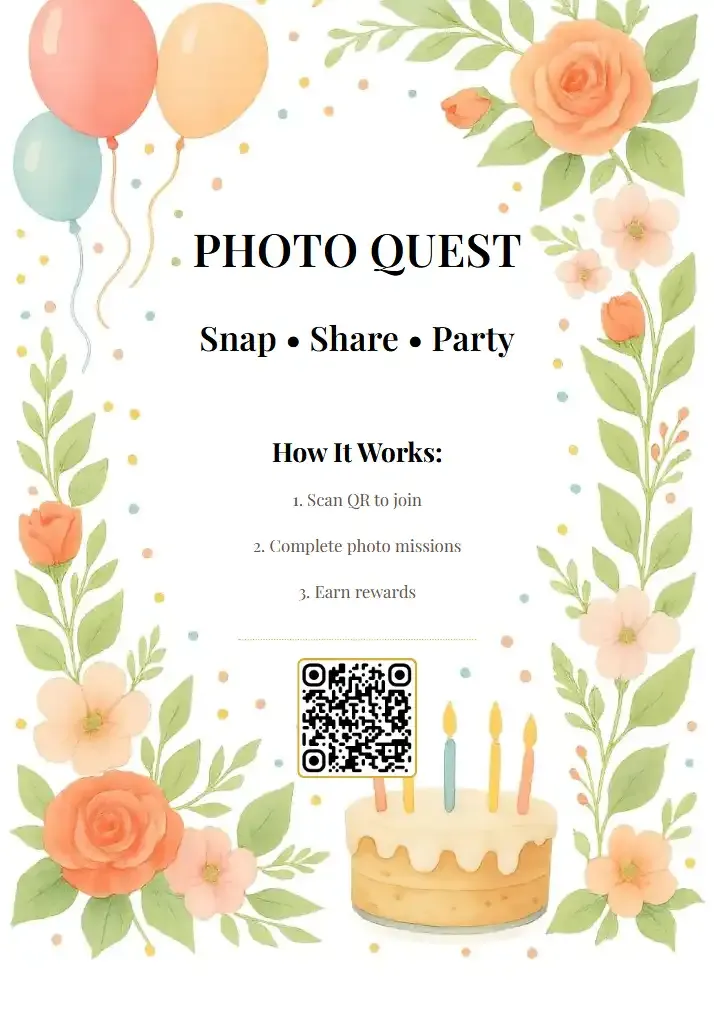
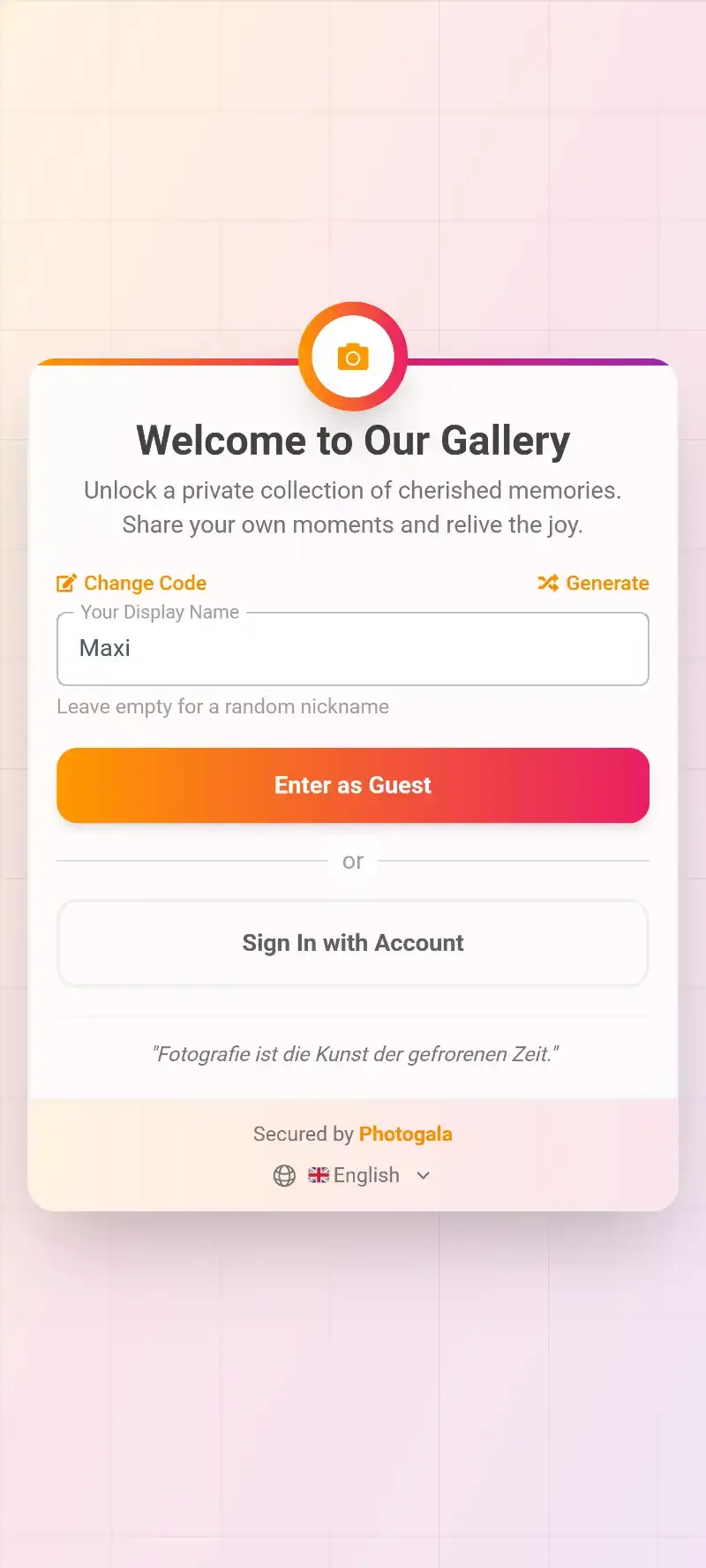
1.Point, scan, done. No app needed.
The three-tap flow matters more than any feature list. If someone who has never shared a photo digitally can do it without help, you've solved the problem. Everything else is a bonus.
Where You Put the QR Code Matters More Than You Think
Here's a mistake people make: they print one QR code poster, stick it by the entrance, and assume everyone will see it. They won't. Guests who arrive during the rush walk right past it. People who enter through side doors never see it. And nobody is going to walk back to the entrance mid-party to scan a code they vaguely remember seeing.
The fix is repetition. Put the QR code everywhere guests naturally pause and look down. Table cards are the obvious one, but think about where people actually spend time. The bar. The dessert table. The bathroom mirror (seriously, people check their phones in there anyway). Near the gift table. On the back of the menu or program. If you're running a corporate event, put it on lanyards, on the presentation slide deck, and next to the coffee station.
The napkin trick: At sit-down events, slip a small card with the QR code under the napkin at each place setting. Guests discover it when they sit down, before the food arrives, while they're looking for something to do. It's the single best conversion moment at a seated dinner.
If you want inspiration for creative placements, our article on QR code guest uploads at restaurant and bar events covers a dozen specific ideas.
Assign a Photo Ambassador
This is the single most underrated tactic, and it has nothing to do with technology.
Pick one or two people at the event (a bridesmaid, a coworker, a teenage nephew) and give them one job: walk around during the first hour and help anyone who looks confused scanning the QR code. Not in an aggressive way. More like, "Have you tried the photo thing? Here, let me show you, it takes ten seconds."
Imagine a 72-year-old aunt watching her niece do it in front of her. She pulls out her phone, the niece points the camera at the code, the gallery opens, and suddenly she's uploading the photo she took of the groom's face during the vows. She didn't need a tutorial. She needed someone to stand next to her for thirty seconds.
This works because the technical barrier for most non-tech-savvy guests isn't ability. It's confidence. They're afraid of "doing it wrong" or "breaking something." A friendly face saying "just tap that button" removes the hesitation entirely. It's the same psychology behind why people are more likely to share photos when the experience feels low-pressure.
See it in action
Every guest photo in one album – no app.
Show Photos on a Screen and Watch Uploads Triple
Nothing motivates participation like seeing other people participate. A photo wall displayed on a TV or projector near the main area creates a visible feedback loop. Someone uploads a photo, it appears on the big screen within seconds, everyone sees it, and suddenly three more people pull out their phones.
New photos appear in real time. Guests love seeing their shots on the big screen.
For non-tech-savvy guests specifically, the screen does something important: it proves the system works. They can see with their own eyes that other people's photos showed up. That visual proof eliminates the "will this even work?" doubt that stops hesitant people from trying.
Place the screen where people congregate naturally. Near the bar or the dance floor, not tucked in a corner. The wedding photo sharing etiquette guide has more on placement and timing that works.
Keep Instructions Absurdly Simple
If your QR code card says "Scan this QR code to access our shared event gallery and upload your favorite moments from today!" you've already lost the less technical guests. Too many words. Too vague.
Say this instead:
- Open your phone camera
- Point it at this code
- Tap the link that appears
- Pick your photos and hit upload
Four steps. No jargon. No ambiguity. "Tap the link that appears" is better than "follow the URL" because non-tech-savvy people don't think in terms of URLs. They think in terms of "that blue thing that popped up."
One honest limitation worth mentioning: Photogala runs entirely in the browser, which means it works on every phone without an install. But it also means the experience depends on the venue's WiFi or the guest's mobile data. If you're at a venue with spotty reception (a barn, a basement, a rural estate), let guests know they can upload later from home. Their photos won't disappear. This is something our guide on collecting photos from 200+ wedding guests covers in more detail.
Gentle Nudges Beat Guilt Trips
There's a temptation to send multiple reminder messages or make a big announcement asking guests to share photos. Resist it. Nobody wants to feel nagged at a party. And publicly calling out "we only have 30 photos, come on everyone!" creates pressure that makes people less likely to participate, not more.
Better approaches:
- Mention the photo gallery once during a natural pause (after a toast, between courses)
- Have the DJ or MC casually say "and if you've taken any great photos tonight, scan the QR code on your table to add them to the shared gallery"
- Include a line in the event invitation mentioning the shared gallery so guests know before they arrive
- Send a thank-you message the day after with the gallery link, asking for any photos people forgot to upload
That post-event message is crucial. Some guests, especially older ones, prefer to share photos from home where they can sit down, take their time, and ask a family member for help if needed. Give them that option. Event photography research shows that the first two hours after an event are critical for photo collection, but a next-day reminder catches everyone else.
Add a Fun Reason to Participate
Here's something that surprised me about Photogala's photo challenges feature: it works on non-tech-savvy guests better than on younger ones. Challenges like "photograph the oldest person on the dance floor" or "capture the best dessert close-up" give people a specific reason to take out their phone. They're not just uploading random photos into a void. They have a mission.
You can even print challenge cards alongside the QR code. A card that says "Challenge: Snap a photo of someone who's lost a shoe on the dance floor" is immediately understandable. No technology required to grasp the concept. The tech part (scanning and uploading) becomes a means to an end rather than the point. If you want ideas, the photo scavenger hunt article has 15 challenges sorted by event type.
Pair challenges with a leaderboard and you get something magical. Imagine the bride's uncle checking his ranking between courses, uploading three more photos because he's one point behind his wife. Competitive spirit has no age limit.
What About Guests With Really Old Phones?
This comes up more than you'd think. QR code scanning works natively on any iPhone running iOS 11 or later (that's from 2017) and any Android phone from roughly the same era. So the vast majority of smartphones people carry today can scan QR codes right from the camera app.
For the rare guest with a truly ancient phone that can't scan QR codes, the simplest solution is to have the gallery's short link printed alongside the QR code. Something like "Can't scan? Visit photogala.net/g/your-event." Typing a short URL is something anyone can do. You can also share the link via text message before the event, which is exactly what our guide on sharing event photos without an app recommends as a backup strategy.
Accessibility note: Photogala galleries work on any modern browser. No app install, no account signup, no permissions to accept. This matters for older devices with limited storage that can't install new apps. The customization options include dark mode on every plan, which helps with readability on smaller screens.
The Real Goal: Zero Guests Left Behind
The point of all this isn't to force everyone to participate. Some people genuinely don't want to share photos, and that's fine. The goal is to make sure that nobody who wants to share gets stopped by a technical barrier. The uncle with 47 great photos should be able to add them to the gallery in under a minute, without downloading anything, without creating an account, and without asking for help.
When you remove every friction point, something interesting happens. You don't just get more photos. You get photos from people you wouldn't expect. The colleague who never posts on social media. The grandmother who barely uses her phone. The quiet friend who noticed a moment nobody else caught. Those are the photos that end up mattering most.
If you're planning a wedding or any event where guest photos matter, start by choosing a tool that requires zero technical knowledge. Then put the QR code in six places instead of one. Assign an ambassador. Show the screen. And send that next-day reminder. You'll be surprised how many photos come from the people you thought would never figure it out.
All of this comes with your own event.
Setting it up takes five minutes. You can build and view everything before you decide.
Starting from €39 one-timeOne-time payment — No subscription
- No App Required
- Setup in 5 Minutes
- 30-Day Money Back
“Excellent service and great pictures! Photogala fully met our expectations at the event. The value for money is unbeatable. Absolutely recommended! The seating plan saved us a lot of hassle!”
Written by

I believe event photos should be more than static galleries. They should be live, playful, and unforgettable.
Categories
Related Posts

Bridal Shower Photo Sharing: Collect Every Sweet Moment in One Gallery
Bridal shower photos end up scattered across 15 phones. Here's how to get them all into one gallery before the mimosas wear off.

Maternity Photo Sharing: How to Keep Every Announcement, Bump Shot, and Memory in One Place
Pregnancy announcements land on 4 different apps. Maternity photos get lost in group chats. Here's how to keep every photo in one shared gallery your whole family can access.

Sales Kickoff Photo Sharing: How to Turn a Mandatory Meeting Into a Team Memory
Sales kickoffs are expensive. The photos from them usually disappear into 14 different camera rolls. Here's how to fix that.