How to Build a Wedding Day Timeline That Runs on Schedule


Picture this: the ceremony was supposed to start at 3 PM. The florist ran late, the groomsmen are still pinning boutonnieres, and the string quartet has been vamping for 22 minutes. By the time the bride walks down the aisle at 3:20, portraits are squeezed into 25 minutes instead of 50. Cocktail hour starts late. Dinner gets pushed. The caterer is reheating the main course. And the first dance? It happens at 9:30 PM, when a third of the guests are already eyeing the exit.
Every single one of those problems traces back to a timeline. Or more precisely, to a timeline that looked perfect on paper but had zero breathing room built into it.
A typical wedding day spans about 14 hours from morning prep to grand exit. That's a lot of moving pieces. Professional coordinators don't just list events in order. They build timelines that absorb chaos, because chaos is guaranteed. The difference between a smooth wedding and a stressful one is almost never the venue or the vendor quality. It's the schedule.
Why Most Wedding Timelines Fall Apart
The most common mistake couples make is working forward from the ceremony time. "Ceremony at 3, so cocktails at 4, dinner at 5..." It seems logical, but it ignores every upstream dependency: hair and makeup timing, travel between locations, first-look logistics, group photos with family members who wander off.
Professional wedding coordinators plan backward from the end time. If you want everything wrapped by 10 PM, your first dance needs to happen by 8:30, which means dinner service starts at 6:30, which means cocktail hour kicks off at 5:30. Work backward through every block until you arrive at the morning schedule. Suddenly, you realize the bride needs to be in the chair at 9 AM, not 10.
The backward method in practice: Write down your hard end time (when the venue kicks you out, or when you want your last song). Then subtract each event duration, working backward. When you reach the morning, add 30 minutes. That's your real start time. Photogala's free Event Timeline Builder does this math for you.
Run sheet for your event
Every step with its time — and guests always see the current version, not an old printout.
The second killer? No buffers. A Bliss and Bone analysis puts it bluntly: a ceremony that runs 20 minutes late pushes portraits into cocktail hour, which causes dinner to run cold. Every minute lost compounds. The fix is almost insultingly simple: build 5 to 10 minutes of buffer into every major transition. Not just one big buffer at the end. Small buffers between every block.
The Six Time Blocks of a Wedding Day
Think of your wedding day not as a list of events but as six distinct phases. Each one has its own rhythm, its own risks, and its own buffer needs. If you've already started building your event budget, this is the next planning step that turns money into an actual day. And if you're still in the early research phase, our wedding planning overview covers the full picture.
Block 1: Getting Ready (3-4 hours)
Hair and makeup is almost always the longest block, and the one most likely to run over. Professional hair takes 45-60 minutes per person. Multiply that by the bride plus four bridesmaids, and you're looking at 4+ hours if you have one stylist. Two stylists cut it in half. Build this math into your timeline before you book anyone.
This is also when detail shots happen: rings, dress, shoes, invitation suite. Your photographer needs 20-30 minutes with these items in good light, ideally before the getting-ready chaos peaks.
Block 2: First Look or Traditional Reveal (30-90 min)
This single decision reshapes your entire afternoon. A first look before the ceremony buys you 60-90 minutes of portrait time that you'd otherwise lose to cocktail hour. No first look means all couple portraits happen between ceremony and reception, which is tight. Neither option is wrong, but you need to commit early because this decision determines where two-plus hours of the schedule go.
Block 3: Ceremony (30-45 min)
The ceremony itself is the most predictable block. It runs 20-40 minutes for most non-religious ceremonies, longer for religious ones. The unpredictable part is the 15 minutes before: seating stragglers, mic checks, last-minute wardrobe fixes. Plan for guests to be seated 15 minutes before the listed start time, and communicate that clearly on the invitation.
Block 4: Cocktail Hour (60-75 min)
Cocktail hour does double duty: it entertains guests while the couple finishes portraits and the venue flips the room. Give it a full 60 minutes minimum. If you're doing all portraits after the ceremony (no first look), stretch it to 75 and have someone keep the energy up. Our drinks calculator helps nail the quantities so you don't run dry at minute 40.
Block 5: Reception (3-4 hours)
Dinner, toasts, first dance, cake cutting, bouquet toss, open dancing. This is where timelines either hold or collapse. The key insight from professional coordinators: put all the formal moments (toasts, first dance, cake) in the first 90 minutes of reception. After that, the schedule loosens into open dancing, and it doesn't matter if things drift by 10 minutes.
Why front-load the formalities? Because guests leave. By 9 PM at a 5 PM reception, 20-30% of your crowd has gone home. If your father-daughter dance is scheduled for 9:15, dad might be dancing to a half-empty room.
Block 6: The Grand Exit (15-30 min)
Sparklers, confetti, vintage car, whatever your exit looks like. Plan it 30 minutes before the venue's hard cutoff. That gives you a cushion for the inevitable "wait, one more photo" requests.
The Photo Problem (and How to Solve It)
Here's something that surprises a lot of couples. The photographer's timeline and the wedding timeline are not the same thing. Your photographer has a separate shot list with lighting dependencies, location moves, and family combination shots that need specific people rounded up at specific times. If these two timelines don't sync, you end up with a stressed photographer and a group photo where the groom's mother is missing because nobody told her to stay.
The fix: share one unified timeline with every vendor, including exact arrival times and location details. Professional coordinators build vendor-specific columns into their master schedule so each vendor sees their own call times alongside the overall flow.
But here's the other photo problem nobody talks about until the next morning. Your photographer captures 300-400 polished shots, delivered weeks later. Meanwhile, your 180 guests took somewhere between 400 and 800 photos on their phones. Those photos? They scatter across camera rolls, never to be shared. A guest photo sharing setup solves this, but it needs to be built into the timeline, not bolted on as an afterthought. If you want a deeper look at the guest photo problem at weddings, we've written about it extensively.
The best time to introduce a QR code photo gallery is during cocktail hour. Guests are relaxed, phones are out, and there's natural downtime. Place QR codes on cocktail tables and the bar. By the time dinner starts, you'll have 50+ uploads already rolling in.
Every step with its time — guests always see the current version
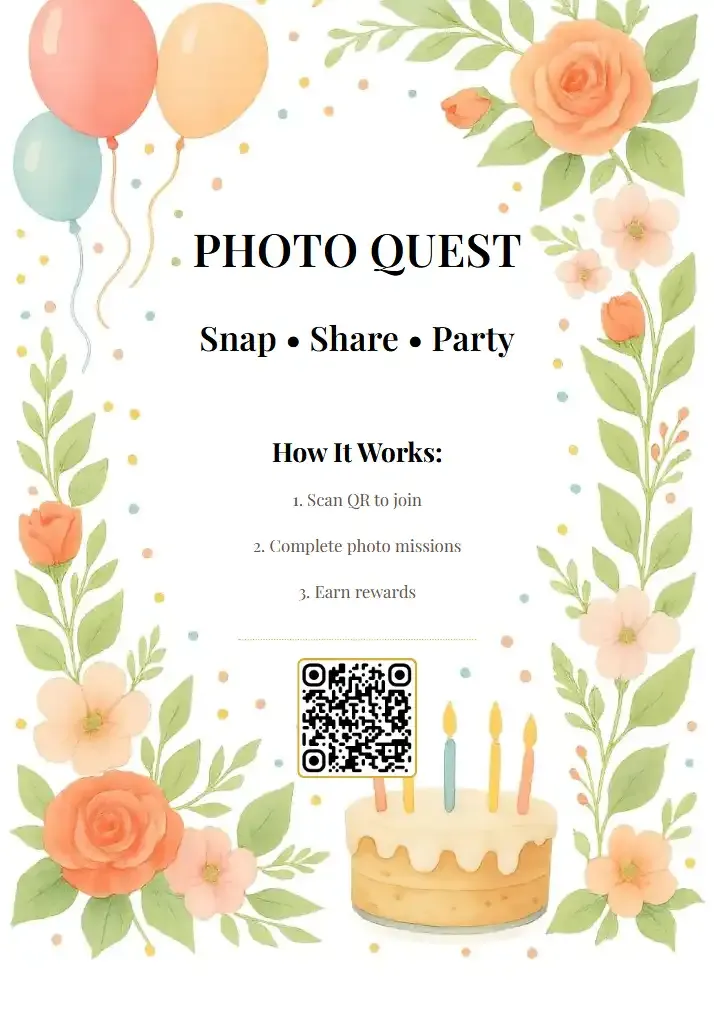
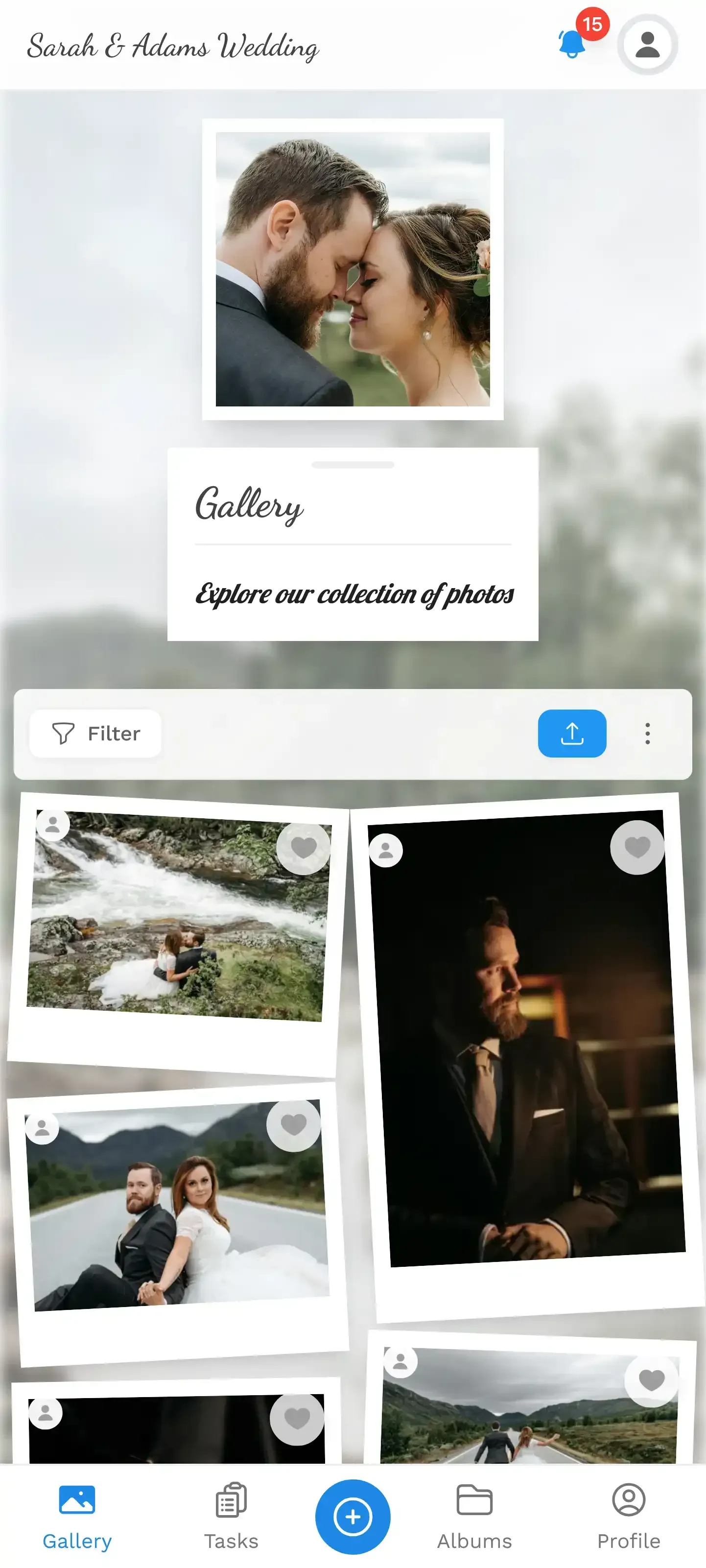

That photo wall on the TV screen? It becomes a conversation piece during dinner. Guests see their photos appear live and start uploading more. The live photo wall replaces the awkward slideshow of baby photos that nobody asked for. And if you add a few photo challenges, "best candid of the flower girl" or "capture the groom's face during the cake smash," the upload count climbs fast. You can even set up challenge cards with example photos guests need to recreate, which makes things genuinely fun rather than just another upload request.
Ready to create your gallery?
Fitting Photos Into Your Timeline: A Minute-by-Minute Guide
Most couples allocate zero timeline minutes to guest photo logistics. Here's what I'd suggest weaving into your existing blocks:
Photo Timeline Integration
Morning: Set up the gallery
Create your event gallery and generate QR codes. Assign a bridesmaid or coordinator to test-scan one. Takes 5 minutes. Print QR table cards the day before.
Cocktail hour: Launch the gallery
Place QR codes on tables, bar, and near the photo wall screen. Announce it once through the MC or a small sign. Guests start uploading during natural downtime.
Reception: Add photo challenges
Activate 5-8 photo challenges when the dance floor opens. The leaderboard keeps guests engaged and uploading through the evening.
Next morning: Download everything
Wake up to a gallery of 300+ guest photos. Download the full ZIP in original quality and share with family who couldn't attend.
The key is that none of these steps interrupt the wedding flow. You're not asking guests to stop and pose. You're giving them a channel for photos they're already taking. If you're also thinking about how to share those photos with family afterward, the gallery handles that too: just share the link.
What Goes Wrong (and How to Recover)
Even with buffer windows, things will go sideways. A few scenarios and their fixes:
Hair and makeup runs 45 minutes over. This is the most common delay. If it happens, cut the "getting ready" photo time from 30 minutes to 10. Your photographer can still capture a few candid moments. Prioritize the couple's portraits over the bridal party group shots during the post-ceremony window.
Family members can't be found for group photos. Assign one person (not the photographer, not the couple) as the "family wrangler." Give them a list of every combination you need. Uncle Frank by the oak tree in 4 minutes. Grandmother to the front steps in 7. This single role saves 20+ minutes of the photographer wandering the cocktail hour asking strangers if they're related to the groom.
The DJ plays the wrong song for the first dance. Not a timeline problem, but it feels like one because the delay ripples. Have a backup track in a shared playlist. Better yet, give the DJ a physical USB with your must-play songs in labeled folders. Related: make sure your seating chart puts anyone giving a toast near the front so they don't have to navigate a crowded room when called up.
It rains and the outdoor ceremony moves inside. This is why professional coordinators develop contingency plans three weeks before the wedding. Every outdoor element needs an indoor Plan B with its own setup time added to the timeline. If you're doing a beach wedding, the weather contingency is non-negotiable.
The Vendor Coordination Problem
Your timeline is useless if vendors don't see it. And "I emailed it last Tuesday" doesn't count. According to Mo & Co Events, a truly effective wedding timeline goes beyond listing ceremony start times. It combines logistics with vendor-specific details so that each person sees their own responsibilities in context.
Create one master document. Share it with every vendor at least two weeks before the day. Include vendor-specific notes: "Florist arrives at 11 AM, setup complete by 1 PM, ceremony florals moved to reception by 4:30 PM." The more specific, the fewer phone calls on the morning of.
This extends to your photo logistics too. If you're running a live photo wall at the reception, the venue needs to know where the screen goes, the AV team needs to know it needs HDMI input, and the coordinator needs to know which URL to load. Add these as line items in the master timeline. Small details. Huge difference.
If you're assigning someone to handle content moderation, whether that's pre-approving photos before they hit the big screen or just keeping an eye on the upload stream, give that person their own row in the vendor timeline. They need to know when to start watching and what the escalation plan is if something inappropriate gets uploaded. (Spoiler: the AI filter catches most of it, but human backup is smart for a wedding.)
Tools That Actually Help
You don't need expensive software. But you do need something better than a Notes app bullet list.
Photogala offers a free Event Timeline Builder that lets you set your ceremony time and builds backward from there. It's not the only option, but it's quick and it handles the math. You can also grab a free timeline template from 101 Planners in Word, Excel, or Google Sheets format if you prefer spreadsheets.
For the budget side of things, our event budget calculator pairs well with timeline planning. Knowing what you're spending on each vendor makes it easier to prioritize which blocks get the most buffer time. (Hint: give the most expensive vendor the most breathing room.)
If guest engagement is part of your plan, and it should be, take a look at what actually works beyond the photo booth. Photo challenges, leaderboards, and live walls can all be set up ahead of time and triggered at specific points in your timeline.
One honest limitation: Photogala is browser-based, not a native app. For 98% of guests, this is actually better because there's nothing to download. But it does mean guests need a decent cellular or Wi-Fi connection at the venue. If your reception is in a rural barn with one bar of signal, set up a portable Wi-Fi hotspot. This is a $50 fix that prevents a $0 problem.
The Morning-After Test
Here's how you know your timeline worked. The morning after the wedding, when you're eating cold pizza in a hotel room, you won't remember the buffer windows or the vendor arrival slots. You'll remember that dinner was hot, the toasts happened while people were still paying attention, and the dance floor was packed until midnight.
And on your phone? A notification that 437 guest photos are waiting in your gallery. The DIY guest photography that everyone promised to send "later" was already captured in real time. No WhatsApp groups. No "I'll AirDrop you." No asking your cousin for photos six months later.
That's what a good timeline makes possible. Not a perfect day. Perfect days don't exist. A day where the important moments happen at the right time, and everything else has room to breathe.
Ready to create your gallery?
Start sharing your event photos with guests in minutes.
Create GalleryWritten by

I believe event photos should be more than static galleries. They should be live, playful, and unforgettable.
Categories
Related Posts
Multicultural Wedding Photo Sharing: Honoring Every Tradition in One Gallery
When your wedding blends two (or more) cultures, collecting guest photos gets complicated fast. Here's how to make it work without losing a single moment.

How to Collect Photos From Event Guests Automatically
Stop chasing guests for photos after the event. A QR code, a shared gallery, and a few smart settings can do the collecting for you.
Housewarming Party Photo Sharing: How to Capture Your New Place Through Everyone's Eyes
Your housewarming is the only time your home will look this good and feel this new. Here's how to collect every guest's photos without lifting a finger.