How to Build a Realistic Event Budget Without Overspending


Picture this: you're three weeks out from a 120-person corporate gala. The venue is booked, the caterer is confirmed, the DJ sent over a playlist. Then the invoices start stacking up. Tablecloth rental, $400. AV tech for the projector nobody asked about, $1,200. The "complimentary" parking turned out to be valet-only, $15 per car. Suddenly your carefully planned budget has a $3,000 hole in it.
This happens constantly. Not because people are bad at math, but because event budgets are uniquely sneaky. There are dozens of line items that don't show up until they show up on an invoice. And the bigger the event, the more places money leaks.
The good news: you don't need a finance degree to build a budget that holds. You need a system that accounts for the things most people forget. That's what this guide is about.
The Real Numbers Behind Event Costs
Before you can budget, you need to know what events actually cost. Not the aspirational Pinterest version. The real version.
For weddings in 2026, the average in the US sits between $35,000 and $40,000. That number shocks a lot of couples, but it includes everything: venue, catering, photography, flowers, music, attire, invitations, and the 47 other things nobody thinks about until month three of planning. In Germany, the average is closer to €15,000, but the same pattern holds. The biggest chunk (40-50%) goes to venue and catering. Photography and videography eat another 10-15%.
Corporate events are a different beast. A 2026 conference benchmark study found that the average US conference costs $1.62 million for about 606 attendees. That's roughly $2,731 per person. Food and beverage alone averaged $525,000, or $867 per head. Those numbers are for large-scale conferences, but even a 50-person team offsite can run $8,000-$15,000 once you add venue, meals, activities, and transportation.
The takeaway: events cost more than you think, and the gap between "what I planned" and "what I spent" is almost always positive, not negative. Photogala's free Event Budget Calculator can help you map out your spending categories before you start calling vendors.
Budget Calculator
Plan and track your event budget with category breakdowns and spending alerts.
Start With the Non-Negotiables
Every event has costs you can't avoid. The venue has a price. The food has a price. Insurance, permits, basic AV setup: these are locked in. Start your budget here, not with the fun stuff.
List your non-negotiables first and get actual quotes. Not estimates, not "it's usually around..." but real numbers from real vendors. Call three caterers. Get the venue contract with all fees itemized (ask specifically about service charges, gratuity, setup/teardown fees, and overtime rates). This step is tedious, but it's the difference between a budget that works and one that's fiction.
For weddings specifically, our guide on choosing the right photo sharing plan without overpaying walks through how to evaluate costs for the photo collection side of things. It's one of those categories where spending smart matters more than spending big.
Set your hard budget number before you talk to any vendor. Once you start hearing pitches, the number creeps up. Decide what you can afford (savings + contributions + any financing), subtract 10% for your contingency fund, and that's your working budget. Everything gets allocated from that pool.
The Line Items Nobody Budgets For
Here's where budgets blow up. It's rarely the big items. The venue quote was accurate. The catering came in on target. It's the cascade of small costs that nobody wrote down.
This list gets longer with every event type. Some of the most common budget-busters:
- Overtime charges. Your venue contract says the event ends at 11 PM. The party runs until midnight. That extra hour can cost $500-$2,000 depending on the venue, and it's not optional. Staff, security, and cleanup extend too.
- Tips and gratuity. Some venues include a mandatory 18-22% service charge. Others expect you to tip separately. Catering staff, bartenders, delivery drivers, the DJ. It adds up to 15-20% on top of service costs.
- Décor rentals you didn't know were separate. Tablecloths, chair covers, centerpiece containers, lighting rigs. Many venues provide bare tables and chairs. Everything else is on you.
- Shipping and delivery fees. Cake delivery, flower delivery, rental equipment delivery, return pickup. Each vendor charges separately.
- Photo and entertainment tech. Traditional photo booth rentals run $500-$1,500 for a few hours. AV equipment for a projector or screen display adds another $300-$800. These costs are avoidable with the right approach, as we cover in our comparison of photo booth alternatives that start at $0.
A 10% contingency fund handles most of these surprises. Some planners recommend 15% for first-time event organizers. That buffer isn't extra money to spend. It's insurance against the stuff you couldn't predict.
Where Most People Overspend (and Where to Cut)
There's a pattern to overspending that's consistent across weddings, corporate events, and private parties. People overspend on things that feel important in the planning phase but barely register with guests.
Elaborate printed invitations? Guests glance at them and check their phone for the date. Custom napkin monograms? Nobody notices. Extensive floral arrangements on every table? People remember the ones at the altar, maybe. The rest blend into the background after the first drink.
Meanwhile, the things guests actually remember get underfunded. Good music. Enough food (not fancy food, enough food). Something fun to do between courses. And the photos, because those are the only tangible thing that outlasts the evening.
A 2026 industry forecast found that 71% of event planners anticipate cost increases this year, while budgets aren't growing at the same pace. That forces real prioritization. The planners who get the best results aren't the ones who cut everything equally. They cut the invisible costs and protect the memorable ones.
Photography is a good example. A professional event photographer costs $2,000-$5,000 for a wedding, less for corporate. That's a worthwhile investment. But you don't need a $1,500 photo booth on top of that. A QR code photo gallery does the same job (collecting guest photos from their own phones) and costs a fraction. Guests already have cameras. They just need a place to put the photos.
Ready to create your gallery?
The Photo Line Item: What It Should Actually Cost
Photo sharing has become its own budget category at events, and it's one where people either spend too much or too little. Too much looks like renting a physical photo booth, hiring a second photographer for candids, and setting up a hashtag campaign that nobody uses. Too little looks like creating a WhatsApp group that becomes chaos within 20 minutes.
The better approach is a dedicated photo sharing platform. Our complete cost breakdown for event photo sharing in 2026 compares the full range of options, but here's the short version: you can start with a free event photo gallery to test the concept, then upgrade to a paid plan if you want unlimited uploads and features like a live photo wall or photo challenges.
For a wedding, that means your "guest photo collection" budget line goes from $500-$1,500 (photo booth rental) down to €39–€119 (one-time, not a rental). For a corporate event, it means replacing the generic "event app" nobody downloads with a browser-based gallery that works the moment someone scans a QR code.
Guests scan a QR code and upload from their browser. No app install.
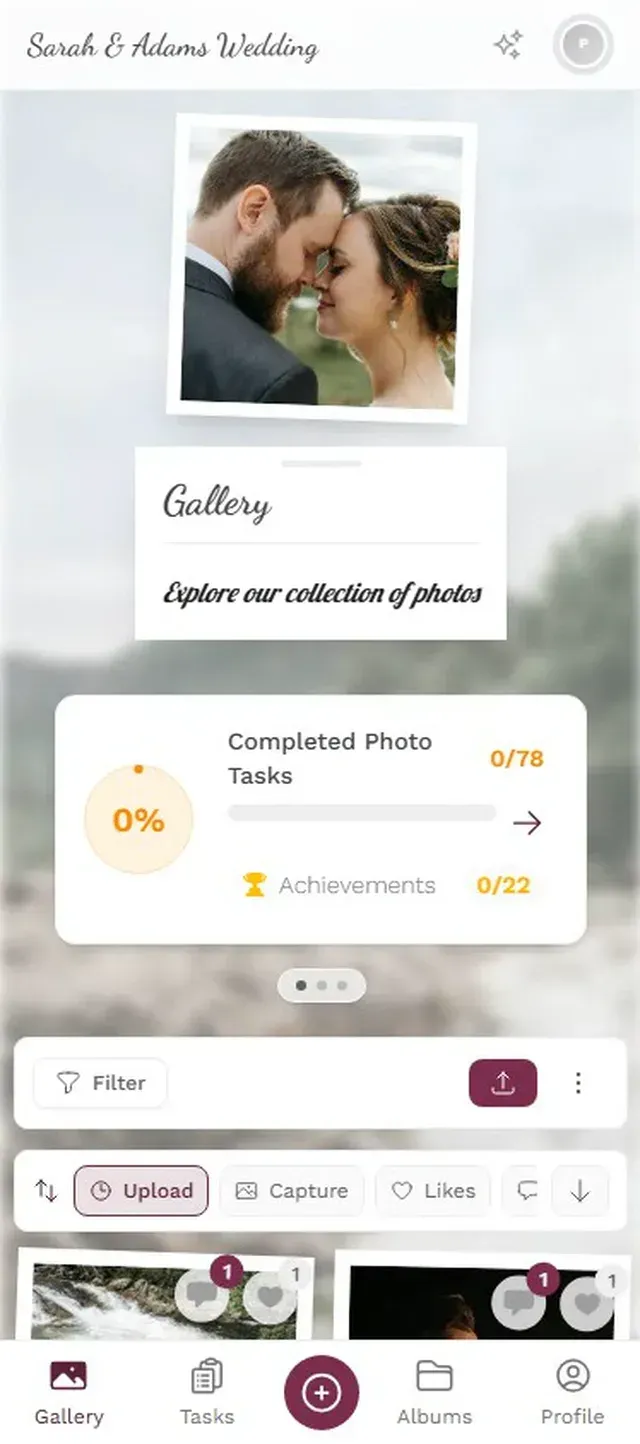

The photo wall feature is worth calling out specifically for budget-conscious planners. Instead of renting a separate screen and software system ($300-$800), you can display guest uploads on any TV or projector in real time. One screen, one HDMI cable, done. If you're planning a corporate event, our guide on making event photos look professional without a photographer covers how to make this work well.
Building the Spreadsheet That Doesn't Lie
The actual mechanics of budgeting aren't complicated. The discipline is.
4 Steps to a Budget That Holds
Set the ceiling
Total budget = savings + contributions. Subtract 10% for contingency. The remainder is your working budget. Use a free tool like Photogala's Budget Calculator to organize categories before you start.
Lock the non-negotiables
Venue, catering, core vendors. Get real quotes. These fill 60-70% of most event budgets.
Prioritize the memorable
Music, food quantity, photos, guest experience. Cut invisible costs (printed programs, custom napkins) to fund these.
Track actuals weekly
Every payment goes into the spreadsheet immediately. Compare projected vs. actual every week. Catch overruns early.
The third step is where most people struggle. It requires honest answers to uncomfortable questions. Does anyone care about the chair covers? Probably not. Will guests remember the signature cocktail? Maybe. Will they remember the photo wall where their selfie showed up on a big screen 10 seconds after uploading? Almost certainly.
For destination weddings, the budget math changes even more. Fewer guests usually means higher per-person costs but lower total spend. Photo sharing becomes more valuable because you have guests scattered across time zones who want to share moments from different parts of the trip.
Smart Spending on Guest Entertainment
Entertainment is the category with the widest spread between "cheap and forgettable" and "expensive and forgettable." The goal is "affordable and memorable."
Photo challenges are a good example of this. Instead of hiring an entertainer or renting equipment, you give guests creative missions through their phones: "find the oldest couple on the dance floor," "photograph your table's best toast," "catch someone mid-laugh." It costs nothing extra if your photo sharing platform includes challenges and gamification. Guests compete, upload more, and the gallery fills with genuinely interesting photos instead of 200 near-identical group shots.
For corporate team events, this doubles as a team-building activity. And if you're still working out how many bottles to order, Photogala's free Drinks Calculator takes one variable off your plate. The pattern is the same across every line item: plan ahead, use free tools where they exist, and save the big spend for things guests will actually notice. Our piece on how to use event calculators and planning tools covers more of these shortcuts.
One honest trade-off with digital photo sharing: it's not as "physical" as a printed photo booth strip. Some guests, especially older ones, genuinely enjoy walking away with a printed photo. If that matters for your event, budget $200-$400 for a portable instant printer as a compromise. Our guide on getting non-tech-savvy guests to participate covers how to make digital sharing work for everyone.
The Wedding Budget vs. Corporate Budget Divide
Wedding budgets and corporate budgets look similar on a spreadsheet but behave completely differently in practice.
Wedding budgets are emotional. Couples overspend on things that feel personal (the dress, the rings, the flowers) and underspend on logistics (parking, guest transportation, day-of coordination). The result: a beautiful ceremony and a confused shuttle situation. I once heard a planner say, "Nobody ever complained about too much parking, but they'll complain about too little for years." Fair point.
Corporate budgets are political. The executive team wants a premium venue. Marketing wants branded everything. Finance wants receipts for everything over $50. The event planner is caught between "make it impressive" and "keep it under $30K." For corporate events specifically, the photo sharing line item is easy to justify because it doubles as content for internal communications, social media, and post-event reporting.
Both types benefit from the same principle: spend where guests notice, save where they don't. A gallery with customizable branding costs the same as a generic one, but it looks like your company invested in the experience. For weddings, matching the gallery colors to your wedding palette takes two minutes and makes the shared album feel intentional rather than thrown together.
Budget allocation that works for most events: 45% venue and catering, 15% entertainment and experience (music, photo sharing, activities), 12% décor and florals, 10% photography/videography, 8% logistics (transport, parking, coordination), 10% contingency. Adjust the ratios, but never drop below 10% contingency.
What a Budget-Friendly Photo Setup Actually Looks Like
Say you're planning a 150-guest wedding. Your total budget is €20,000. Photography is allocated at €2,000 for a professional. What about guest photos?
Option A: Photo booth rental. €800-€1,200 for 3-4 hours. Includes props, prints, maybe a digital copy. Fun, but expensive per photo and limited to one location.
Option B: QR code photo gallery. €39-€69 one-time. unlimited photos and up to 25 videos. Works everywhere in the venue simultaneously. Includes a photo wall display on any TV. Guests upload from their own phones. You can even share the gallery with guests who couldn't attend, and share wedding photos for free after the event.
The math isn't close. Option B gives you 10x the coverage at 1/10th the cost. The photos won't be as posed as a booth strip, but they'll be more authentic, more numerous, and more varied. Plus, you keep them forever in original quality, downloadable as a ZIP archive.
For couples who want the creative photo element without the booth rental, DIY wedding photography approaches can fill the gap. Combine a professional photographer for the formal shots with a QR code gallery for everything else. That's the setup that captures both the polished ceremony portraits and the blurry, wonderful 1 AM dance floor moments.
Building a budget that doesn't collapse under the weight of forgotten line items isn't about being cheap. It's about being intentional. Spend on what guests remember. Save on what they won't notice. And always, always keep that 10% buffer untouched until you need it.
The planners who stress least on event day aren't the ones with the biggest budgets. They're the ones who accounted for the tablecloth rental, the parking fees, and the overtime clause before they signed anything. The spreadsheet isn't glamorous, but it's the thing that lets you actually enjoy the party.
Find the right plan for your event
Flexible pricing for weddings, parties and corporate events.
View PricingWritten by

I believe event photos should be more than static galleries. They should be live, playful, and unforgettable.
Categories
Related Posts

Multicultural Wedding Photo Sharing: Honoring Every Tradition in One Gallery
When your wedding blends two (or more) cultures, collecting guest photos gets complicated fast. Here's how to make it work without losing a single moment.
Free Event Planning Tools Every Organizer Should Bookmark
The best free tools for budgets, guest lists, timelines, photo sharing, and more. No subscriptions, no bloated software suites.

Milestone Birthday Photo Sharing: 30th, 40th, 50th and Beyond
At milestone birthdays, decades of relationships converge in one room. Here's how to collect every guest's photos before they vanish into 40 separate camera rolls.