Paperless Wedding

Five printed pieces for one day. Or one QR code on the table.

Invitation, running order, seat, menu and gallery all hang off the same address — your guest scans the code that is on the table anyway and reads everything in the browser, no app, no account. Handing the code out is your job, nothing gets sent. And what you still print is your call.

Start for free — no credit card required · Paid plans from 39 €

No App Required
Setup in 5 Minutes
30-Day Money Back

The printed stack and the one link

Same wedding, same guests — once spread across five printed pieces, once behind a single code.

The invitation
One QR code: a page that opens: venue, dress code, countdown — editable up to the last moment
The printed stack: a printed card: it stays in the keepsake box, but it is fixed the moment it goes to press
The running order
One QR code: the schedule on the phone, with time, duration and who is in charge of each block
The printed stack: a printed order of the day: readable at a glance, out of date after the first delay
The seat
One QR code: the guest types their name, the plan zooms to their seat
The printed stack: a chart at the entrance: visible to everyone at once — and everyone stands in front of it at once
The food
One QR code: courses with a photo per dish, notes such as vegan or gluten-free, texts storable per language
The printed stack: one card per place setting: already lying there, but in the language it was printed in
The guests' photos
One QR code: the same code leads into the gallery where every guest photo lands
The printed stack: a sign next to the photo booth pointing at a second service
A change the day before
One QR code: change it in the browser, the link shows the new version straight away
The printed stack: reprint it, another trip to the print shop, or fix it with a ballpoint pen
No reception, dead battery, no smartphone
One QR code: then there is nothing — the code leads nowhere and the guest has to ask at the table
The printed stack: paper keeps working: no network, no power, no conditions

Where paper wins

A printed chart needs no network, no battery and no link. That is exactly where a QR code fails first: in a vaulted cellar with no reception, with the guest whose phone is dead by ten, and with everyone who did not bring a smartphone at all — for them a digital seating plan simply does not exist. So we recommend printing the seating chart as a fallback even when nothing else goes to print. And then the uncomfortable part on our side: from guest 21 the free plan does not only hide the guest seat search, it locks the very same plan for export and print — it is one single gate for both. With more than 20 guests the fallback is shut just as firmly as the code. At that point a paperless wedding needs a paid plan, or you draw that chart somewhere else.

The whole day behind one code

Five views from a guest's phone, one from the host's laptop — each one replacing a printed piece, or pointedly not replacing it.

The first printed piece to go

Instead of a card, an envelope and a stamp, it starts with a link. The clip opens on a closed pair of dark wooden doors with gilt ornaments and a chandelier behind the glass. One tap on "Open invitation", the doors swing apart, the couple's names and date stand behind them, and the view drifts further down to the running countdown. If something changes, you change a line — no second print run. Handing it out is still yours to do: Photogala sends nothing, you get the link and the QR code.

The order of the day that isn't on the table

The guest starts on the event page, taps "Schedule" in the row of tiles and scrolls through the day: arrival, ceremony, photos, dinner. Every block carries its time, its duration and the person in charge of it. On the event day the view also marks where the day currently stands. No printed sheet per place setting and no second version when the ceremony slips by twenty minutes. If you want it on paper, print it from the browser — there is no PDF or calendar export for the schedule.

The entrance chart becomes a search field

The home screen carries the "Find your seat" tile. One tap opens the seating plan, and in the clip "Michael" is typed into the search — the illustrated plan highlights Michael Hofer's seat and zooms to it. The search runs in the guest's browser, with nothing to install and nothing to sign into. It does not fully replace the printed board, and the reason is spelled out above without trimming.

The card per place setting goes away

From the same row of tiles the guest taps "Menu" and browses the courses. What on paper means one copy per place setting is here a single page everyone opens: dishes with a picture, the notes underneath — and in whichever languages you stored. No reprint when the main course changes two weeks out. Those notes are freely typed chips, not verified allergen labelling.

And afterwards, the evening's photos

The clip shows the shared gallery as the guests' photo grid. It is the same code from the table — so the printed sign at the photo booth, the one that usually points at a second service, drops out as the sixth printed piece.

What still gets printed

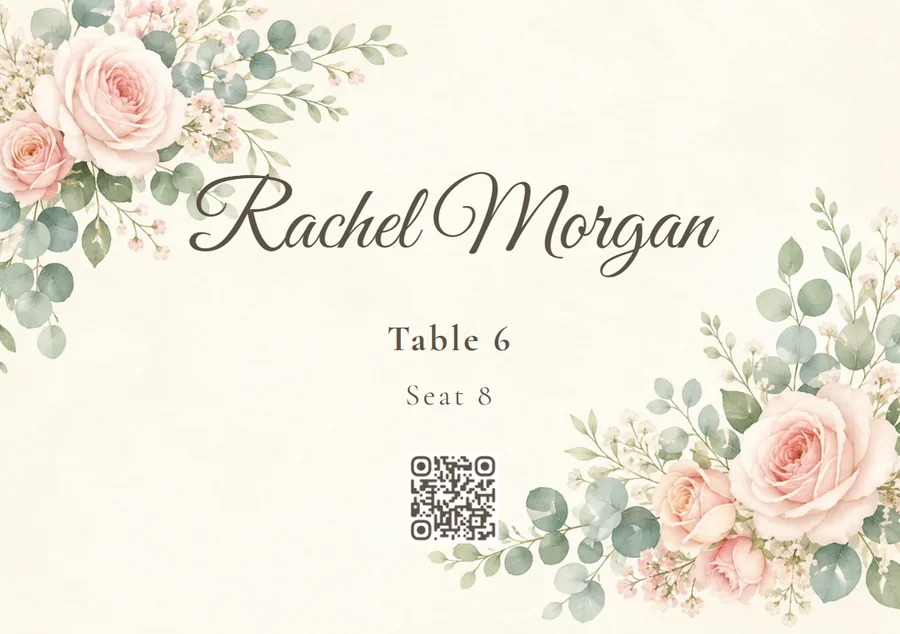
The laptop recording shows the other side. In the seating tool the host opens "Export & print": seven ways out, among them image, PDF, service plan, place cards, table numbers and the seating poster. A click on "Place cards" opens the editor already filled with a real guest — Sarah Berger, table 1, seat 1. Paperless does not mean paper-free here; it means you decide which five printed pieces shrink to one. Two things belong in the same breath: this whole dialog sits behind the same 20-guest gate as the seat search, and the printing happens at your print shop — Photogala hands over the file, not the finished card.

All of this comes with your own event.

Setting it up takes five minutes. You can build and view everything before you decide.

View Live Demo

One-time payment — No subscription

Starting from 39 € / one-time

All memories from your event — one price, no hidden fees.

See Pricing

Paperless wedding — common questions

Do our guests have to install an app or create an account?
No. Scanning the code or opening the link is enough, everything runs in the browser. The invitation does not even create a session — someone who only takes a look never shows up in a participant count later.
Which parts are free, and where does it stop?
All eleven tools are unlocked on every plan, including the free one — adding guests, placing tables, writing the running order, maintaining the menu, designing the full invitation and viewing it in the preview all cost nothing. What you pay for is delivering it. Up to 20 guests that is free; from guest 21 the server blocks five actions: the guest seat search, the seating export and print, the personal RSVP links, the full invitation and the guest-list export. For a paperless celebration the first two are the decisive ones: they hit the code on the table and the printed backup chart at the same time. Two of the five also depend on the plan regardless of guest count: publishing the full invitation and the guest-list export — both from Plus at 39 €. The save-the-date stays free on every plan. The free gallery holds 50 photos, no videos and 15 uploaders; the photo wall, photo tasks and the leaderboard, by contrast, are gallery features and only start at Plus and Premium respectively.
Do you send the invitation to our guest list?
No — and this is where paperless does not automatically mean less work. Photogala produces the code, not the delivery: no email dispatch, no SMS, no WhatsApp, no reminder to guests who have not answered yet. The route to the guest stays analogue or runs through your own messenger — as a message, on a card, or on the stand on the table. For the replies there is also a personal link per guest, which you export as a list and pass on yourself; on the free plan up to 20 guests.
What if there is no reception in the venue?
Then the code does not work, and that is the honest answer. A printed chart needs no network. So: print the seating plan as a poster even when nothing else goes to print, and print the schedule from the browser if you need it — there is no PDF or calendar export for the schedule. Watch the gate while you do: the seating print sits behind the same 20-guest limit as the seat search, so with more guests the fallback needs a paid plan too. And ask the venue about the Wi-Fi beforehand; in vaulted cellars and old barns that single question decides the whole plan.
Can we still move people on the morning of the wedding?
Yes. Drag a guest to a different seat in the plan and the seat search shows the new one from that moment on. If you have already designed a poster or a table list from that plan, the design studio flags the inserted plan blocks as outdated and refreshes them in place; place cards and table numbers are pulled fresh from the list on the next export run anyway. The cards you already printed, though, you have to run off again yourself.
We are starting a year ahead — does our free time run out?
No. The storage window is triggered by the gallery, not by the calendar: it begins with the first uploaded photo (with the tenth on the paid plans), not when you create the event. So the guest list, the seating plan, the running order and the menu can all be in place months earlier without anything counting down.
Do the notes on a dish count as allergen labelling?
No. What sits on a dish are freely typed notes such as vegan or gluten-free. There is no stored allergen catalogue, no mandatory fields and no validation. The binding answer stays with the kitchen and the service staff — exactly as it does with a printed card.

Ready to Get Started?

Create your event in minutes. No credit card required.

See Pricing
No App Required
Setup in 5 Minutes
30-Day Money Back